
Weekend-warrior exercise,
does it really help with Whether all-cause mortality differs from activity spread over three or more sessions?
research showsThe grade is D with 34 points. In 350,978 US adults, weekend-warrior and regular patterns had median weekly activity of about 240 and 420 minutes, and total activity was adjusted in regression. Adjusted hazard ratios were 1.08 (95% CI 0.97 to 1.20) for all-cause mortality, 1.14 (0.85 to 1.53) for cardiovascular mortality, and 1.07 (0.87 to 1.31) for cancer mortality. All three intervals included 1, and the all-cause interval allowed up to 20% higher harm. The study did not detect a difference; it did not establish equal effects.
ads claimThe study did not detect a mortality difference among people meeting weekly targets. Without a prespecified noninferiority margin, it cannot establish that concentrated and distributed schedules have equal effects.
Useful facts when choosing a product
- The weekend-warrior definition required the weekly target in one or two sessions.
- Exposure came from NHIS self-report, not accelerometry.
- Median weekly activity was 240 versus 420 minutes, with regression adjustment for total volume.
Chamgap Semantic Classification Code
Candidate index · review held
X.weekend-warrior-activity-concentrating-recommended-exercise-into-one-or-two-sessions.behavioral.whether-all-cause-mortality-differs-from-activity-spread-over-three-or-more-sessions.assess.UNKBehaviors, exposures and policies > Weekend-warrior activity concentrating recommended exercise into one or two sessions > Behavioral delivery > Whether all-cause mortality differs from activity spread over three or more sessions > Association or change assessment > Unknown
An automated migration candidate, not an issued permanent code; exact claim scope remains under review. This machine-generated migration candidate helps retrieval but is not a permanent assignment. The original verdict ID and URL remain authoritative.
What the research actually shows
Dos Santos et al. followed 350,978 NHIS adults for a median 10.4 years and recorded 21,898 deaths. Exposure was self-reported leisure-time physical activity. Weekend warriors completed the recommended volume in one or two sessions, while regular activity used at least three sessions. Median weekly volumes were about 240 and 420 minutes, and regression models adjusted total activity. A sensitivity analysis excluded deaths in the first five years. Public research support was reported.
Why this is classified as D (34)
All three intervals included 1, the all-cause interval allowed 20% higher harm, and no prespecified noninferiority margin existed, giving D with 34 points.
Counterpoint. This result does not say that people may ignore total weekly exercise volume.
Rejudgment record. Cross-check applied — Different median weekly volumes adjusted in regression, a five-year lag analysis, all three intervals including 1, self-reported exposure, and no prespecified noninferiority margin were considered
| Endpoint | H | Hard endpoint - actual events such as death |
| Replication | R1 | Single confirmatory trial |
| Independence | I2 | Decisive evidence is publicly or non-profit funded |
| Effect size | E0 | Null |
| Precision | C0 | The confidence interval leaves room for benefit |
Stored derived and displayed grades match; this is not a current recalculation or validity check (D).
Sub-claim grades by effect
This ingredient is marketed for several effects. A single overall grade blends strong and weak claims together, so each effect is graded separately here. The overall grade reflects the strongest disconfirming or core claim.
| Effect (sub-claim) | Grade | Basis |
|---|---|---|
| No mortality difference detected between concentrated and distributed patterns | D | The volume-adjusted hazard ratio was 1.08 (0.97 to 1.20), with the interval including 1. |
Cross-check — AI research and Codex final gate
Evidence Table
| Study | Design | Sample | Funding | Endpoint | Result | Weight |
|---|---|---|---|---|---|---|
| Dos Santos et al. 2022 | Prospective NHIS cohort | 350,978 analyzed; 21,898 deaths | Public research support including CAPES and FAPESP | All-cause, cardiovascular, and cancer mortality | Volume-adjusted all-cause HR 1.08 (0.97 to 1.20) for weekend warrior versus regular activity | Pivotal large observational event evidence |
Receipt — 1 References
All 1 cited sources were verified for existence at the original page (as of 2026-08-04).
Final verification and publication gate: Codex · Evidence date: 2026-08-04 · Corrections: none
Cite this verdict
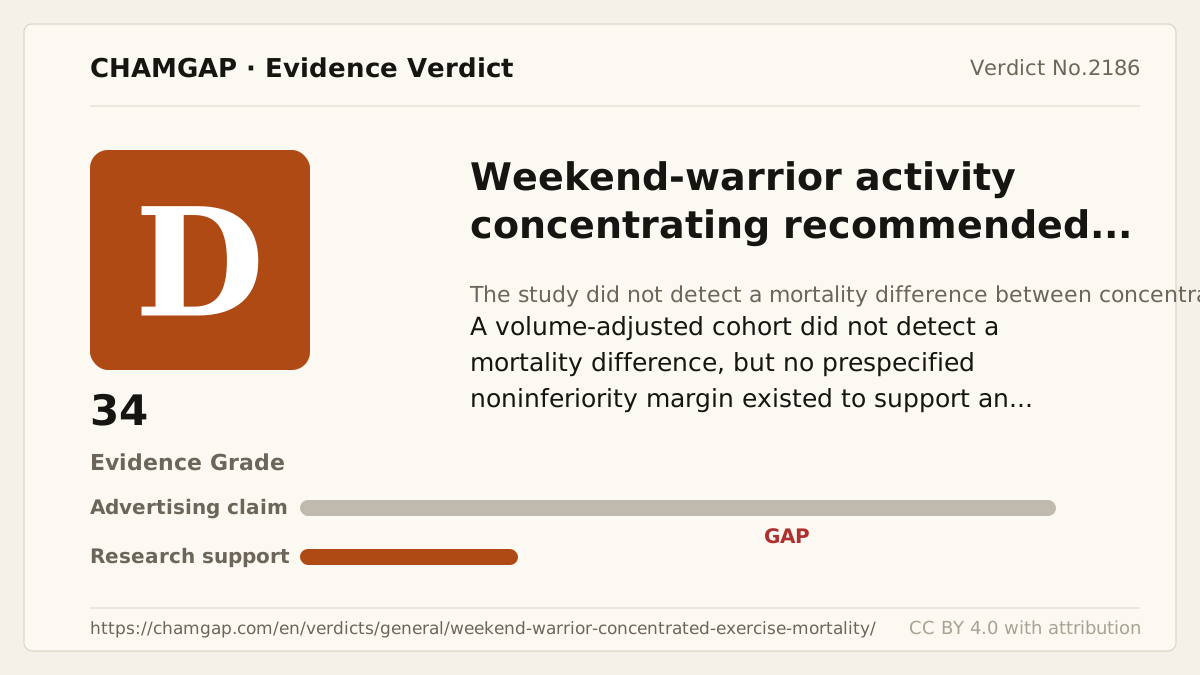
[Chamgap] Weekend-warrior exercise x mortality difference from distributed exercise — Evidence Grade D·34. 1 cited sources checked. Source: https://chamgap.com/en/verdicts/general/weekend-warrior-concentrated-exercise-mortality/ · CC BY 4.0CC BY 4.0 — free to use with attribution; do not distort grades, numbers, or verdict meaning.
What this document does and does not do
Chamgap is an information source. It reports what research has and has not confirmed; it does not tell readers what to take or buy. That decision belongs to readers and, when needed, medical or legal professionals. This verdict reflects literature available up to the search date and may change as new research appears. Nothing here is medical advice.