
Water flosser,
does it really help with Improvement in gingivitis and bleeding indices?
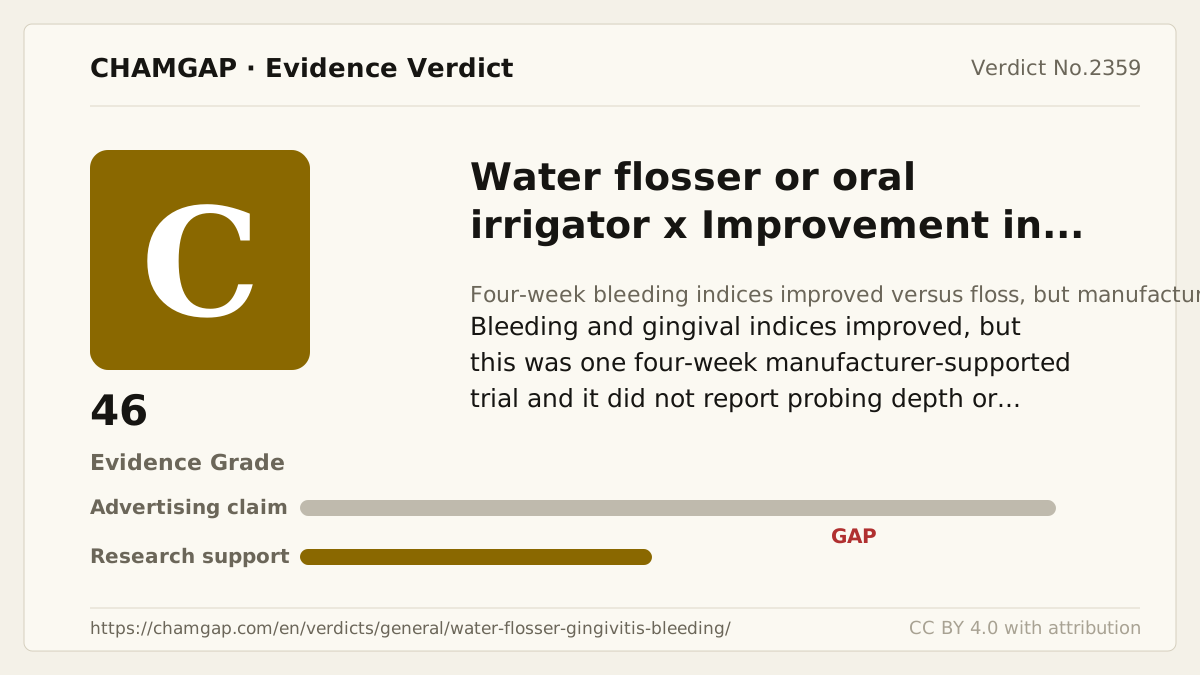
research showsThe grade is C with 46 points. In a 105-person single-blind randomized trial, four-week whole-mouth bleeding-on-probing reduction was 0.41 with a manual toothbrush plus Waterpik ION and 0.19 with a manual toothbrush plus string floss. Modified Gingival Index reductions were 0.37 and 0.20. The control was brushing plus floss, not brushing alone.
ads claimShort-term bleeding-index improvement is not proof of periodontitis treatment or tooth-loss prevention. A water flosser does not replace brushing or professional periodontal care.
Useful facts when choosing a product
- The paper states, 'DML was an employee of Water Pik, Inc. ... during execution of the study.'
- The authors declared no conflict of interest; alongside that declaration, Water Pik, Inc. funded the research and supplied Waterpik ION devices.
- The other water flosser, toothbrushes, toothpaste, and floss were purchased at retail according to the paper.
Chamgap Semantic Classification Code
Candidate index · review held
UNK.water-flosser-or-oral-irrigator.oral.gingivitis-and-bleeding-indices.improve.UNKUnknown > Water flosser or oral irrigator > Oral > gingivitis and bleeding indices > Improvement claim > Unknown
An automated migration candidate, not an issued permanent code; exact claim scope remains under review. This machine-generated migration candidate helps retrieval but is not a permanent assignment. The original verdict ID and URL remain authoritative.
What the research actually shows
Mancinelli-Lyle and colleagues randomized 35 participants each to Waterpik ION plus manual brushing, an air-microbubble water flosser plus brushing, or waxed string floss plus brushing. All completed four weeks. Whole-mouth BOP reductions were 0.41, 0.32, and 0.19; MGI reductions were 0.37, 0.30, and 0.20; plaque reductions were 0.13, 0.11, and 0.06. The paper states, 'DML was an employee of Water Pik, Inc. ... during execution of the study,' reports Water Pik funding and device supply, and also states that the authors declared no conflict of interest.
Why this is classified as C (46)
A manufacturer-funded single small short trial improved surrogates but did not permit standardized effect reconstruction, giving C with 46 points.
Counterpoint. A short-term adjunctive bleeding benefit is possible, while long-term periodontal protection needs separate testing.
Rejudgment record. Cross-check applied — Only manufacturer-funded evidence from a 105-person four-week trial of gingival and bleeding surrogates with non-reconstructable standardized between-group effect
| Endpoint | S | Surrogate marker - laboratory or imaging measures |
| Replication | R1 | Single confirmatory trial |
| Independence | I0 | Evidence comes only from manufacturer studies |
| Effect size | EX | The clinical size of the effect could not be judged |
Stored derived and displayed grades match; this is not a current recalculation or validity check (C).
Sub-claim grades by effect
This ingredient is marketed for several effects. A single overall grade blends strong and weak claims together, so each effect is graded separately here. The overall grade reflects the strongest disconfirming or core claim.
| Effect (sub-claim) | Grade | Basis |
|---|---|---|
| Four-week gingival and bleeding-index improvement | C | Mean reductions exceeded those with floss plus brushing. |
| Prevention of periodontitis progression or attachment loss | ? | Those outcomes were not measured. |
Cross-check — AI research and Codex final gate
Evidence Table
| Study | Design | Sample | Funding | Endpoint | Result | Weight |
|---|---|---|---|---|---|---|
| Mancinelli-Lyle D et al., 2023 | Single-center, examiner-blinded, three-arm randomized trial | 105 randomized and completed, 35 per group | Authors declared no conflict; Water Pik, Inc. funded the study and supplied Waterpik ION devices; the first author was a Water Pik employee during study execution | BOP, MGI, and RMNPI | At four weeks, BOP reduction was 0.41 versus 0.19 with floss; MGI was 0.37 versus 0.20. | Pivotal direct trial |
Receipt — 1 References
All 1 cited sources were verified for existence at the original page (as of 2026-08-07).
Final verification and publication gate: Codex · Evidence date: 2026-08-07 · Corrections: none
Cite this verdict
[Chamgap] Water flosser x gingivitis and bleeding indices — Evidence Grade C·46. 1 cited sources checked. Source: https://chamgap.com/en/verdicts/general/water-flosser-gingivitis-bleeding/ · CC BY 4.0CC BY 4.0 — free to use with attribution; do not distort grades, numbers, or verdict meaning.
What this document does and does not do
Chamgap is an information source. It reports what research has and has not confirmed; it does not tell readers what to take or buy. That decision belongs to readers and, when needed, medical or legal professionals. This verdict reflects literature available up to the search date and may change as new research appears. Nothing here is medical advice.