
Volunteering,
does it really help with Lower onset of physical-function limitations four years later?
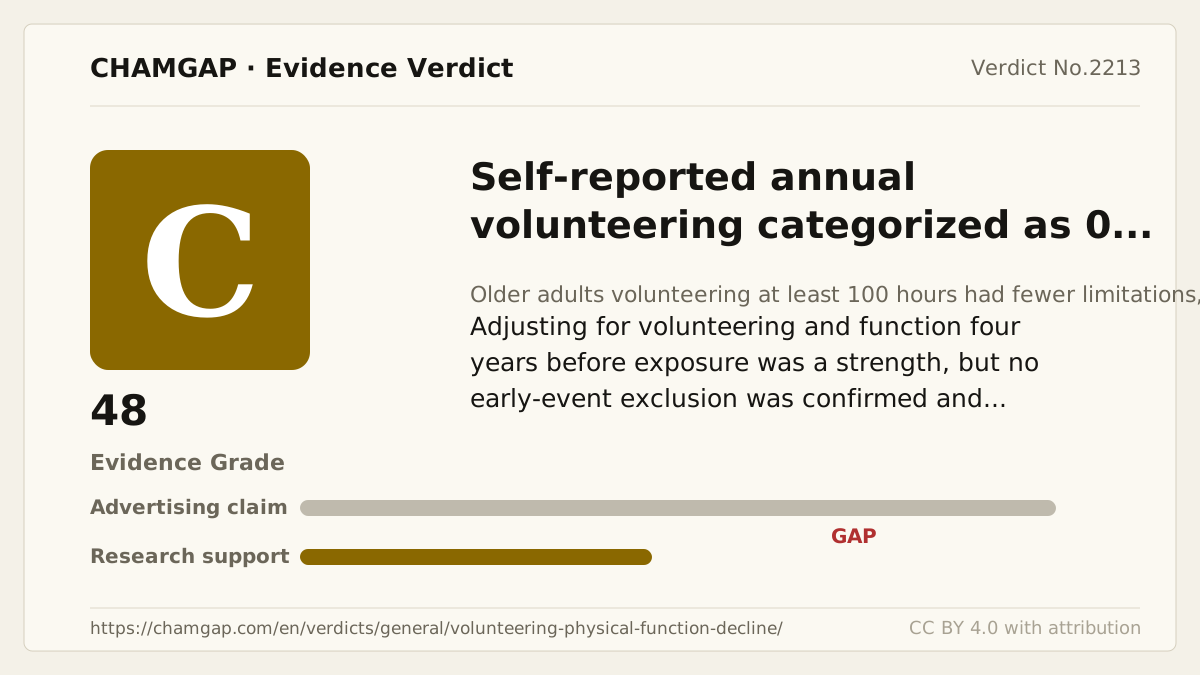
research showsThe grade is C with 54 points. In the 12,998-person HRS analysis, volunteering at least 100 hours per year versus none was associated with RR 0.83 (95% CI 0.72-0.96) for physical-function limitations. However, this result did not survive the study's correction across 34 outcomes. People with better function can more readily start and sustain volunteering, so prevention is not established.
ads claimAt least 100 hours was not a validated prescription threshold. It combined the top two survey categories based on prior literature and power. An association among healthier volunteers cannot be converted into a preventive program effect.
Useful facts when choosing a product
- At least 100 hours per year is about two hours per week and combined the two highest HRS categories.
- The main multiply imputed analysis had 12,998 participants; the nonmissing baseline table had 10,979.
- The physical-function result met conventional P<.05 but not the study's Bonferroni-corrected threshold.
Chamgap Semantic Classification Code
Candidate index · review held
UNK.self-reported-annual-volunteering-categorized.UNK.onset-of-physical-function-limitations-later.reduce.MULTIUnknown > Self-reported annual volunteering categorized > Unknown > onset of physical-function limitations later > Reduction claim > Multiple: primary unresolved
An automated migration candidate, not an issued permanent code; exact claim scope remains under review. This machine-generated migration candidate helps retrieval but is not a permanent assignment. The original verdict ID and URL remain authoritative.
What the research actually shows
The multiply imputed HRS analysis included 12,998 adults: 8,064 nonvolunteers, 1,794 volunteering 1-49 hours, 1,150 volunteering 50-99 hours, and 1,990 volunteering at least 100 hours. The comparator was observational nonvolunteering, not no treatment, a waitlist, or an active control. The nonmissing baseline table contained 10,979 people. Exposure was assessed in 2010/2012 and outcomes in 2014/2016, with 2006/2008 volunteering and all outcomes adjusted. Physical-limitation RRs were 0.84 (0.72-0.98) for 50-99 hours and 0.83 (0.72-0.96) for at least 100 hours. An early-event exclusion analysis was not identified in the paper. NIH and the John Templeton Foundation supported the work; consulting for AARP, UnitedHealth Group, and Aetna was disclosed by some authors.
Why this is classified as C (54)
Prospective ordering and broad baseline adjustment were strengths, but a single observational study, self-reported outcome, multiple-testing failure, and healthy-volunteer selection give C with 54 points.
Counterpoint. The social value of volunteering is separate from this efficacy grade, which concerns only prevention of physical-function decline.
Rejudgment record. Cross-check applied — Credited prospective ordering and extensive baseline adjustment while accounting for self-reported function, healthy-volunteer selection, and failure after multiple-testing correction
| Endpoint | P | Symptom or function itself is the target - including patient reports and performance tests |
| Replication | R1 | Single confirmatory trial |
| Independence | I2 | Decisive evidence is publicly or non-profit funded |
| Effect size | E+ | Meets the clinically important threshold |
Stored derived and displayed grades match; this is not a current recalculation or validity check (C).
Sub-claim grades by effect
This ingredient is marketed for several effects. A single overall grade blends strong and weak claims together, so each effect is graded separately here. The overall grade reflects the strongest disconfirming or core claim.
| Effect (sub-claim) | Grade | Basis |
|---|---|---|
| Association of at least 100 annual volunteering hours with fewer physical limitations | C | RR was 0.83 but did not survive Bonferroni correction. |
| Volunteering causally prevents functional decline | D | This was not a randomized intervention and healthy-volunteer selection remains. |
Cross-check — AI research and Codex final gate
Evidence Table
| Study | Design | Sample | Funding | Endpoint | Result | Weight |
|---|---|---|---|---|---|---|
| Kim et al. HRS outcome-wide cohort 2020 | Prospective observational outcome-wide cohort analysis | 12,998 in the main analysis and 10,979 in the nonmissing baseline table | NIH and John Templeton Foundation | Self-reported physical-function limitations four years later | At least 100 versus zero hours: RR 0.83 (0.72-0.96); not significant after Bonferroni correction. | Pivotal single observational evidence |
Receipt — 1 References
All 1 cited sources were verified for existence at the original page (as of 2026-08-04).
Final verification and publication gate: Codex · Evidence date: 2026-08-04 · Corrections: none
Cite this verdict
[Chamgap] Volunteering x prevention of physical-function decline in older adults — Evidence Grade C·54. 1 cited sources checked. Source: https://chamgap.com/en/verdicts/general/volunteering-physical-function-decline/ · CC BY 4.0CC BY 4.0 — free to use with attribution; do not distort grades, numbers, or verdict meaning.
What this document does and does not do
Chamgap is an information source. It reports what research has and has not confirmed; it does not tell readers what to take or buy. That decision belongs to readers and, when needed, medical or legal professionals. This verdict reflects literature available up to the search date and may change as new research appears. Nothing here is medical advice.