
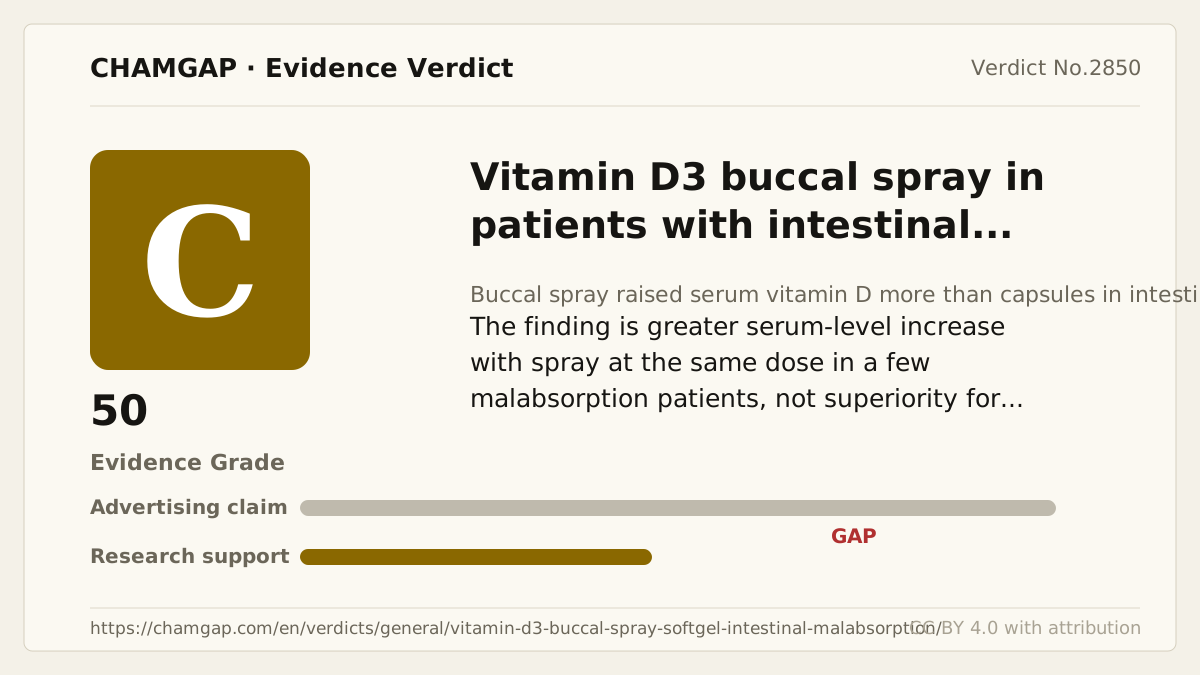
Vitamin D3 buccal spray in patients with intestinal malabsorption,
does it really help with Greater serum 25(OH)D increase than the same 1000 IU/day dose in soft-gel capsules?
research showsThe grade is C. In the 13-patient intestinal-malabsorption crossover analysis, 30-day serum 25(OH)D rose by 3.96 ng/mL with soft-gel capsules and 10.46 ng/mL with spray, a 6.50 ng/mL difference (95% CI 3.78 to 9.22). This is a blood-level surrogate, not evidence of fewer fractures or better symptoms.
ads claimVitamin D oral sprays are sold through Korean retailers including Olive Young and Coupang in a marketing context that claims better absorption. The direct evidence here is limited to a specific 1000 IU/day product and serum levels in intestinal-malabsorption patients.
Useful facts when choosing a product
- The spray delivered two 500 IU sprays daily, while the soft gel delivered one 1000 IU capsule daily.
- In malabsorption patients, mean percentage increases were 36.02% with capsule and 117.8% with spray, a difference of 81.75 percentage points (95% CI 29.80 to 133.7).
- The report found no adverse event and no significant hematology, biochemistry, or vital-sign change during the study.
Chamgap Semantic Classification Code
Candidate index · review held
S.vitamin-d3-buccal-spray-in-patients-with-intestinal-malabsorption.UNK.greater-serum-25-oh-d-increase-than-the-same-dose-in-soft-gel-capsules.increase.noneSupplements and nutraceuticals > Vitamin D3 buccal spray in patients with intestinal malabsorption > Unknown > Greater serum 25(OH)D increase than the same dose in soft-gel capsules > Increase claim > No intervention
An automated migration candidate, not an issued permanent code; exact claim scope remains under review. This machine-generated migration candidate helps retrieval but is not a permanent assignment. The original verdict ID and URL remain authoritative.
What the research actually shows
The study separately enrolled 20 healthy people and 20 intestinal-malabsorption patients. It was a predictable quasi-randomized open-label crossover trial that allocated participants in clinic-visit order: the first to buccal spray, the second to soft-gel capsule, and the third to no treatment. Fourteen in each population entered treatment sequences and six entered untreated control. Treated participants used 1000 IU/day spray and the same-dose soft-gel capsule for 30 days each, separated by a 30-day washout. Thirty-eight completed overall, with 13 completing each treatment population. A post-hoc model of period + sequence + subject(sequence) + treatment found no significant sequence effect in malabsorption patients (P=.0532) or period effect (P=.0715). No dedicated direct carryover test was reported, so the washout and post-hoc checks do not prove carryover was absent. Defect name: Inadequate allocation-sequence generation. Listed item: Inadequate random-sequence generation and allocation concealment - predictable allocation by clinic-visit order. Avoidability: Avoidable - a random-number table and central allocation could have concealed the sequence. Defect name: Small study. Listed item: Small study, total under 200 - 40 enrolled overall and 13 in the key malabsorption crossover analysis. Avoidability: Avoidable - multicentre recruitment could have enrolled at least 200, especially more malabsorption patients. Defect name: Short duration. Listed item: Short duration, under 12 weeks - 30 days per formulation. Avoidability: Avoidable - treatment could have continued for at least 12 weeks to assess durability and clinical outcomes. Unblinded subjective endpoint: not applicable - the open-label primary endpoint was a laboratory serum concentration. Substantial attrition (>=15%): actual 2/40 (5.0%) - not applicable. Verdict 2034 is C with 50 points and asks whether UV-B-treated mushroom soup raises blood vitamin D through food; this verdict asks which formulation raises it. These are different questions.
Why this is classified as C (50)
The serum-level difference was large and statistically clear, but serum 25(OH)D is a surrogate, the manufacturer supplied the product, and the key analysis involved 13 patients over 30 days per treatment, giving C with 50 points.
Counterpoint. Vitamin D treatment in malabsorption should be individualized to cause, calcium and kidney status, baseline level, and total intake; whether spray improves clinical outcomes remains unknown.
Rejudgment record. Cross-check applied — A manufacturer-supplied small short crossover trial improved the surrogate serum 25(OH)D endpoint
| Endpoint | S | Surrogate marker - laboratory or imaging measures |
| Replication | R1 | Single confirmatory trial |
| Independence | I0 | Evidence comes only from manufacturer studies |
| Effect size | E+ | Meets the clinically important threshold |
Stored derived and displayed grades match; this is not a current recalculation or validity check (C).
Sub-claim grades by effect
This ingredient is marketed for several effects. A single overall grade blends strong and weak claims together, so each effect is graded separately here. The overall grade reflects the strongest disconfirming or core claim.
| Effect (sub-claim) | Grade | Basis |
|---|---|---|
| Serum 25(OH)D increase in intestinal malabsorption | C | The spray-minus-capsule increase difference was 6.50 ng/mL. |
| Improvement in clinical outcomes such as fractures or symptoms | ? | Not tested. |
Cross-check — AI research and Codex final gate
Evidence Table
| Study | Design | Sample | Funding | Endpoint | Result | Weight |
|---|---|---|---|---|---|---|
| Satia MC et al. 2015 vitamin D3 formulation crossover trial | Predictable quasi-randomized open-label crossover trial allocating participants in clinic-visit order: first to buccal spray, second to soft-gel capsule, and third to no treatment | 40 enrolled, 38 completed; key treated intestinal-malabsorption analysis 13 plus six untreated controls | No separate funding source reported; Pharma Base SA supplied the buccal spray; authors declared no competing interests | Between-formulation differences in mean and percentage serum 25(OH)D change over each 30-day treatment | In malabsorption patients, capsule +3.96 and spray +10.46 ng/mL; difference 6.50 ng/mL (95% CI 3.78 to 9.22, P<.0001) | Manufacturer-supplied product, key analysis of 13, surrogate-endpoint single trial |
Receipt — 1 References
All 1 cited sources were verified for existence at the original page (as of 2026-08-18).
Final verification and publication gate: Codex · Evidence date: 2026-08-18 · Corrections: none
Cite this verdict
[Chamgap] Vitamin D3 Buccal Spray Benefits Serum 25(OH)D Absorption over Soft-Gel Capsules in Intestinal Malabsorption — Evidence Grade C·50. 1 cited sources checked. Source: https://chamgap.com/en/verdicts/general/vitamin-d3-buccal-spray-softgel-intestinal-malabsorption/ · CC BY 4.0CC BY 4.0 — free to use with attribution; do not distort grades, numbers, or verdict meaning.
What this document does and does not do
Chamgap is an information source. It reports what research has and has not confirmed; it does not tell readers what to take or buy. That decision belongs to readers and, when needed, medical or legal professionals. This verdict reflects literature available up to the search date and may change as new research appears. Nothing here is medical advice.