
Violent video-game exposure,
does it really help with Increased long-term aggressive behavior?
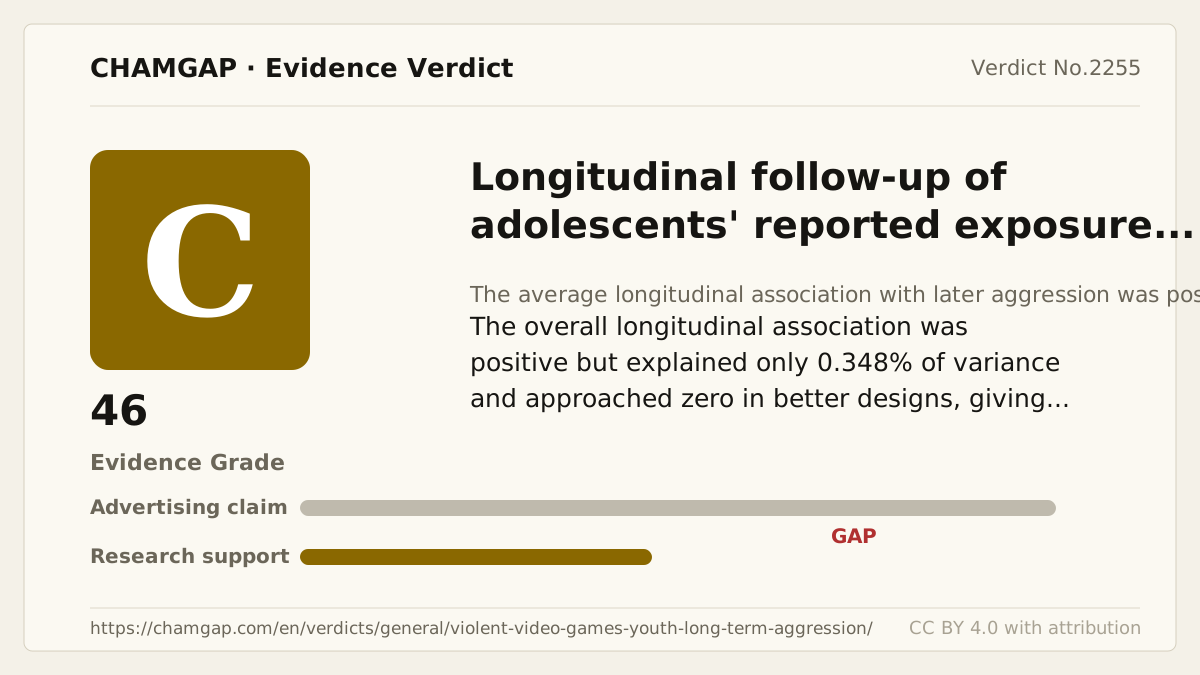
research showsThe grade is C. A preregistered meta-analysis of 28 independent longitudinal samples and about 21,000 young people found an adjusted overall association of r=0.059, 95% CI 0.034-0.084. This explains 0.348% of aggression variance. Ten higher-practice samples gave r=0.012, -0.010 to 0.034, indistinguishable from zero. Another meta-analysis reported beta=0.106, 0.078-0.134, also a small effect.
ads claimThese results do not show that a young person who plays a violent game will later commit violent crime. The evidence mainly concerns small longitudinal associations between questionnaire-based game content and aggressive behavior, not hard events such as crime or hospitalization. Tiny is not the same as exactly zero.
Useful facts when choosing a product
- Most included studies measured game time and violent content by adolescent self-report rather than objective play logs.
- The preregistered overall r=0.059 explained 0.348% of aggression variance.
- Ten higher-practice samples pooled to r=0.012, 95% CI -0.010 to 0.034.
- Prescott's random-effects beta=0.106, 95% CI 0.078-0.134, pointed in the same direction but used a different estimand and study-selection approach, so it was not treated as direct replication.
Chamgap Semantic Classification Code
Candidate index · review held
X.longitudinal-follow-up-of-adolescents-reported-exposure-to-violent-video-games.environmental.long-term-aggressive-behavior.increase.UNKBehaviors, exposures and policies > Longitudinal follow-up of adolescents' reported exposure to violent video games > Environmental exposure > long-term aggressive behavior > Increase claim > Unknown
An automated migration candidate, not an issued permanent code; exact claim scope remains under review. This machine-generated migration candidate helps retrieval but is not a permanent assignment. The original verdict ID and URL remain authoritative.
What the research actually shows
Drummond included longitudinal or prospective studies with at least three weeks between waves, violent game content as the predictor, and behavioral aggression rather than thoughts or feelings as the outcome. Twenty-eight independent samples were selected, prioritizing standardized coefficients with the most relevant adjustment for sex, baseline aggression, family, mental health, and peers. The plan was preregistered at OSF gbx4w and data and code were shared. Overall I-squared was 63.96%, which reflects magnitude heterogeneity rather than automatic directional conflict. Marsden Fund public support and no competing interests were verified, but industry funding across every primary study was not.
Why this is classified as C (46)
Preregistration and a positive longitudinal pooled association are strengths, but magnitude was tiny and self-reported exposure, inconsistent outcome standardization, and design-sensitive estimates create multiple limitations, giving C with 46 points.
Counterpoint. C does not mean a medium danger level. It grades the evidence for a long-term increase claim; the measured average association itself was very small.
Rejudgment record. Cross-check applied — Effect-size and estimand comparison between a preregistered longitudinal meta-analysis and the opposing synthesis, including self-reported exposure and best-practice subsets
| Endpoint | P | Symptom or function itself is the target - including patient reports and performance tests |
| Replication | R1 | Single confirmatory trial |
| Independence | I1 | Mixed funding sources |
| Effect size | E~ | Statistically positive but below the threshold |
Stored derived and displayed grades match; this is not a current recalculation or validity check (C).
Sub-claim grades by effect
This ingredient is marketed for several effects. A single overall grade blends strong and weak claims together, so each effect is graded separately here. The overall grade reflects the strongest disconfirming or core claim.
| Effect (sub-claim) | Grade | Basis |
|---|---|---|
| A small longitudinal association with later aggression | C | Overall r was 0.059, explaining 0.348% of variance. |
| Increased long-term aggression in higher-practice studies | D | The confidence interval around r=0.012 crossed zero. |
| Increased violent crime | ? | The meta-analysis mainly assessed questionnaire-based behavioral aggression, not established crime events. |
Cross-check — AI research and Codex final gate
Evidence Table
| Study | Design | Sample | Funding | Endpoint | Result | Weight |
|---|---|---|---|---|---|---|
| Drummond, Sauer, and Ferguson 2020 | Preregistered meta-analysis of longitudinal studies | 28 independent samples and approximately 21,000 youth | Public support from the New Zealand Marsden Fund | Later behavioral aggression adjusted for baseline aggression and other covariates | Overall r=0.059, 95% CI 0.034-0.084, I-squared 63.96%; higher-practice r=0.012, -0.010 to 0.034 | Preregistered longitudinal evidence with tiny magnitude and measurement limitations |
| Prescott, Sargent, and Hull 2018 | Meta-analysis of prospective studies | 24 studies and more than 17,000 participants | Funding across all included primary studies was not established | Physical aggression after violent video-game exposure | Random-effects beta=0.106, 95% CI 0.078-0.134 | Positive direction, but different estimand and study selection prevent treatment as direct replication |
Receipt — 2 References
All 2 cited sources were verified for existence at the original page (as of 2026-08-05).
Final verification and publication gate: Codex · Evidence date: 2026-08-05 · Corrections: none
Cite this verdict
[Chamgap] Violent video-game exposure x long-term youth aggression — Evidence Grade C·46. 2 cited sources checked. Source: https://chamgap.com/en/verdicts/general/violent-video-games-youth-long-term-aggression/ · CC BY 4.0CC BY 4.0 — free to use with attribution; do not distort grades, numbers, or verdict meaning.
What this document does and does not do
Chamgap is an information source. It reports what research has and has not confirmed; it does not tell readers what to take or buy. That decision belongs to readers and, when needed, medical or legal professionals. This verdict reflects literature available up to the search date and may change as new research appears. Nothing here is medical advice.