
Vestibular rehabilitation,
does it really help with Reduced chronic vestibular dizziness and related disability?
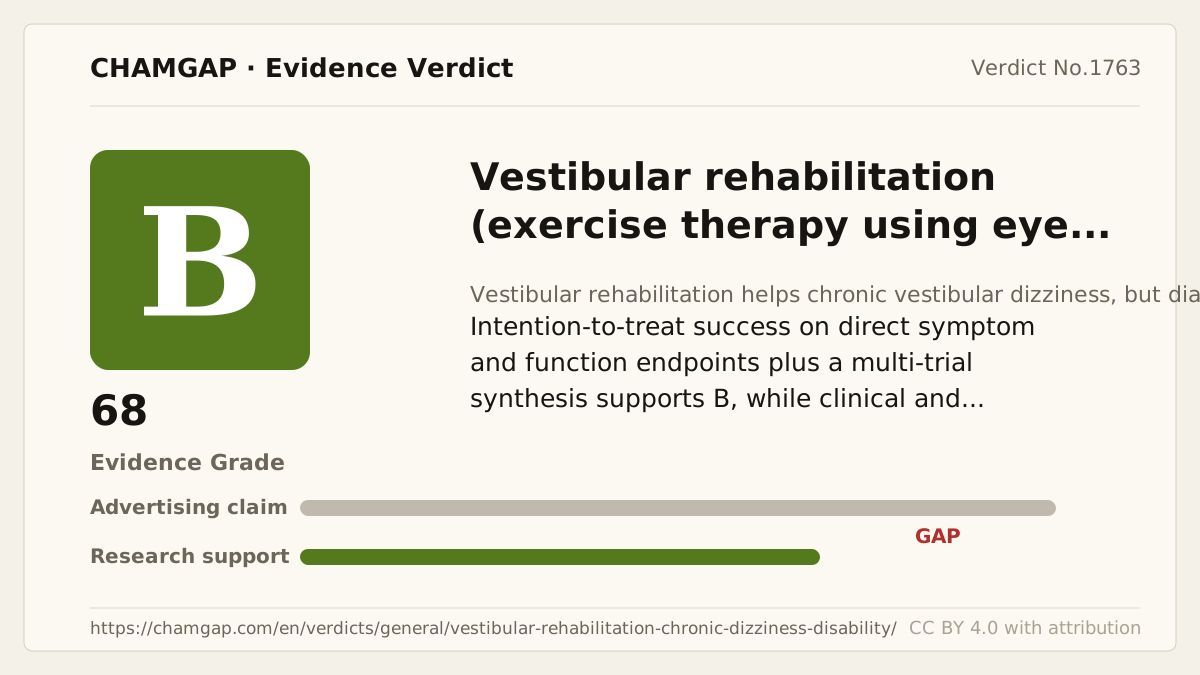
research showsVestibular rehabilitation is rated B because it reduces chronic vestibular dizziness and related disability. Yardley 2004 randomized 170 participants and used baseline-observation-carried-forward imputation for losses, so the actual intention-to-treat primary analysis also included all 170. The co-primary measures of dizziness symptoms, movement-provoked dizziness, postural stability, and disability all improved significantly at three months, making the primary assessment successful. A Cochrane review of 39 randomized trials and 2,441 participants also supported improvements in dizziness frequency and disability, but heterogeneity in diagnoses, exercises, and controls plus a failed primary analysis in a later trial limits the grade to B with 68 points.
ads claimMarketing can imply that every cause of dizziness resolves with a few generic online movements. Central neurologic disease, cardiovascular causes, medicines, migraine, and acute stroke warning signs require differentiation. Canalith repositioning for positional vertigo and rehabilitation exercise for chronic vestibular dysfunction are different interventions.
Useful facts when choosing a product
- Vestibular rehabilitation can combine gaze stabilization, graded head-movement adaptation, repeated symptom-provoking movements, balance training, and gait training.
- Exercises can transiently provoke dizziness early in treatment, making correct diagnosis and graded progression important.
- New neurologic deficits, severe headache, inability to walk, chest pain, or syncope accompanying acute dizziness require urgent assessment before exercise.
Chamgap Semantic Classification Code
Candidate index · review held
X.vestibular-rehabilitation.behavioral.chronic-vestibular-dizziness-and-related-disability.reduce.usual-careBehaviors, exposures and policies > Vestibular rehabilitation > Behavioral delivery > chronic vestibular dizziness and related disability > Reduction claim > Usual care
An automated migration candidate, not an issued permanent code; exact claim scope remains under review. This machine-generated migration candidate helps retrieval but is not a permanent assignment. The original verdict ID and URL remain authoritative.
What the research actually shows
Yardley 2004 (Ann Intern Med 141(8):598-605) randomized 170 people with chronic dizziness to nurse-delivered vestibular rehabilitation or usual care and retained all 170 in an intention-to-treat analysis; the adjusted three-month VSS difference was -3.48 points (95% CI -5.59 to -1.38), P=0.001. McDonnell 2015, Cochrane 2015(1):CD005397, assessed 39 randomized trials and 2,441 participants; dizziness frequency across four trials and 565 participants had OR 2.67 (95% CI 1.85 to 3.86). Cochrane described the overall evidence as moderate to strong and medium-term symptom and function evidence as moderate. Yardley 2012 (BMJ 344:e2237) was an unblinded booklet-based exercise trial with a failed primary analysis in one arm.
Why this is classified as B (68)
The Yardley trial retained all 170 randomized participants in its intention-to-treat primary analysis and succeeded across its co-primary measures, while 39 randomized trials and 2,441 participants reproduced direct symptom and disability improvement. Clinical and intervention heterogeneity plus a failed primary analysis in a later large trial give B with 68 points.
Counterpoint. The evidence best fits confirmed peripheral vestibular dysfunction in patients able to practice consistently. A condition such as positional vertigo may call for a more specific repositioning procedure.
Rejudgment record. Cross-check applied — Accepted the 170-person Yardley 2004 intention-to-treat success and McDonnell 2015 Cochrane evidence from 39 trials and 2,441 participants, including dizziness frequency in four trials and 565 participants with OR 2.67, with deductions for unblinded exercise, population, exercise-method and scale heterogeneity, and a failed analysis in Yardley 2012
Sub-claim grades by effect
This ingredient is marketed for several effects. A single overall grade blends strong and weak claims together, so each effect is graded separately here. The overall grade reflects the strongest disconfirming or core claim.
| Effect (sub-claim) | Grade | Basis |
|---|---|---|
| Reduced symptoms of chronic vestibular dizziness | B | Direct VSS outcomes improved in the pivotal trial and pooled evidence. |
| Reduced dizziness-related functional disability | B | DHI and clinically significant improvement rates were reproduced across trials. |
| Improved balance and gait function | B | Objective postural-stability and gait measures improved, although programs were heterogeneous. |
Cross-check — AI research and Codex final gate
Evidence Table
| Study | Design | Sample | Funding | Endpoint | Result | Weight |
|---|---|---|---|---|---|---|
| Yardley L et al. 2004 | Single-blind randomized usual-care-controlled trial | 170 randomized (83 versus 87); 170 in the actual primary intention-to-treat analysis with baseline-observation-carried-forward imputation | Public United Kingdom NHS Research and Development funding; no role beyond peer review of the original design | Co-primary measures: dizziness symptoms, movement-provoked dizziness, postural stability, and dizziness-related disability | All primary measures improved significantly at three months; adjusted VSS difference -3.48 points, P=0.001, so the primary assessment succeeded. | Pivotal direct symptom and function trial |
| McDonnell MN and Hillier SL. 2015 | Cochrane systematic review of randomized trials | 39 randomized trials and 2,441 participants; dizziness-frequency synthesis from 4 trials and 565 participants | Academic Cochrane ENT review with no manufacturer-led funding | Dizziness frequency, VSS, DHI, gait, and balance | Improved dizziness frequency had OR 2.67 (95% CI 1.85 to 3.86); VSS and DHI also favored rehabilitation. | Multi-trial replication and heterogeneity assessment |
| Yardley L et al. 2012 | Single-blind three-group pragmatic randomized trial | 337 randomized; 276 completed all clinical measures at 12 weeks | Public funding from the United Kingdom NIHR Research for Patient Benefit program | Primary endpoints: 12-week VSS-SF and cost-effectiveness | The telephone-support group versus usual care failed on 12-week VSS-SF, difference -1.79 points, P=0.064; both intervention groups were positive at one year. | Conflicting larger follow-up trial |
Receipt — 3 References
All 3 cited sources were verified for existence at the original page (as of 2026-07-24).
Final verification and publication gate: Codex · Evidence date: 2026-07-24 · Corrections: none
Cite this verdict
[Chamgap] Vestibular rehabilitation x reduced chronic dizziness and related disability — Evidence Grade B·68. 3 cited sources checked. Source: https://chamgap.com/en/verdicts/general/vestibular-rehabilitation-chronic-dizziness-disability/ · CC BY 4.0CC BY 4.0 — free to use with attribution; do not distort grades, numbers, or verdict meaning.
What this document does and does not do
Chamgap is an information source. It reports what research has and has not confirmed; it does not tell readers what to take or buy. That decision belongs to readers and, when needed, medical or legal professionals. This verdict reflects literature available up to the search date and may change as new research appears. Nothing here is medical advice.