
Venetoclax plus azacitidine,
does it really help with Longer overall survival in previously untreated acute myeloid leukemia unsuitable for intensive chemotherapy?
research showsVenetoclax plus azacitidine is rated B because VIALE-A prolonged overall survival to 14.7 months versus 9.6 months. The hazard ratio for death was 0.66 (95% CI 0.52 to 0.85), and the primary endpoint succeeded. An independently funded second confirmatory trial of the exact regimen is absent, so the R1 ceiling applies.
ads claimThis regimen improved survival rather than only remission. The evidence does not automatically extend to every person with AML or to those fit for intensive induction therapy.
Useful facts when choosing a product
- VIALE-A randomized 433 and included 431 in the primary intention-to-treat analysis.
- The comparator was azacitidine plus placebo, not no treatment.
Chamgap Semantic Classification Code
Candidate index · review held
UNK.venetoclax-plus-azacitidine.UNK.longer-overall-survival-in-previously-untreated-acute-myeloid-leukemia-unsuitable-for-intensive-chemotherapy.assess.MULTIUnknown > Venetoclax plus azacitidine > Unknown > Longer overall survival in previously untreated acute myeloid leukemia unsuitable for intensive chemotherapy > Association or change assessment > Multiple: primary unresolved
An automated migration candidate, not an issued permanent code; exact claim scope remains under review. This machine-generated migration candidate helps retrieval but is not a permanent assignment. The original verdict ID and URL remain authoritative.
What the research actually shows
VIALE-A randomized 433 people, while 431, 286 versus 145, entered the actual intention-to-treat primary analysis after two stratification errors. The overall-survival primary endpoint succeeded: median 14.7 versus 9.6 months, hazard ratio for death 0.66 (95% CI 0.52 to 0.85), P<0.001. Follow-up to 43.2 months in the same cohort yielded a hazard ratio of 0.58 (0.47 to 0.72). AbbVie and Genentech funded both reports. verdict 1521, which is B with 78 points, concerns oral azacitidine as remission maintenance in older transplant-ineligible AML; despite a shared ingredient, its maintenance evidence was not transferred to this frontline combination.
Why this is classified as B (76)
H, R1, I0, E+, and B0 with the large hard-endpoint exemption derive B with 76 points.
Counterpoint. The direct population is newly diagnosed AML unsuitable for intensive induction because of age or comorbidity.
Rejudgment record. Cross-check applied — Clear overall-survival benefit in a large randomized trial, with an R1 ceiling because the exact combination lacks independently funded confirmatory replication
| Endpoint | H | Hard endpoint - actual events such as death |
| Replication | R1 | Single confirmatory trial |
| Independence | I0 | Evidence comes only from manufacturer studies |
| Effect size | E+ | Meets the clinically important threshold |
Stored derived and displayed grades match; this is not a current recalculation or validity check (B).
Sub-claim grades by effect
This ingredient is marketed for several effects. A single overall grade blends strong and weak claims together, so each effect is graded separately here. The overall grade reflects the strongest disconfirming or core claim.
| Effect (sub-claim) | Grade | Basis |
|---|---|---|
| Longer overall survival | B | A large randomized trial succeeded, but independent confirmation of the exact regimen is absent. |
| Higher composite complete remission | B | Composite complete remission increased significantly, 66.4% versus 28.3%. |
| Durable survival benefit on long-term follow-up | B | The hazard ratio remained 0.58 at 43.2 months of follow-up. |
Cross-check — AI research and Codex final gate
Evidence Table
| Study | Design | Sample | Funding | Endpoint | Result | Weight |
|---|---|---|---|---|---|---|
| DiNardo CD et al. VIALE-A, 2020 | Multinational randomized double-blind placebo-controlled phase 3 trial | 433 randomized; 431 in the primary intention-to-treat analysis | Manufacturer sponsorship by AbbVie and Genentech with employee coauthors | Overall-survival primary endpoint | 14.7 versus 9.6 months; HR 0.66 (95% CI 0.52 to 0.85), P<0.001; succeeded | Key hard-endpoint confirmatory trial |
| Pratz KW et al. VIALE-A final follow-up, 2024 | Prespecified long-term follow-up of VIALE-A | Same 431-person intention-to-treat cohort; final analysis at 360 prespecified deaths | Manufacturer sponsorship by AbbVie and Genentech | Overall survival at 43.2 months of follow-up | 14.7 versus 9.6 months; HR 0.58 (95% CI 0.47 to 0.72), P<0.001 | Durability confirmation, not independent replication |
Receipt — 2 References
All 2 cited sources were verified for existence at the original page (as of 2026-07-24).
Final verification and publication gate: Codex · Evidence date: 2026-07-24 · Corrections: none
Cite this verdict
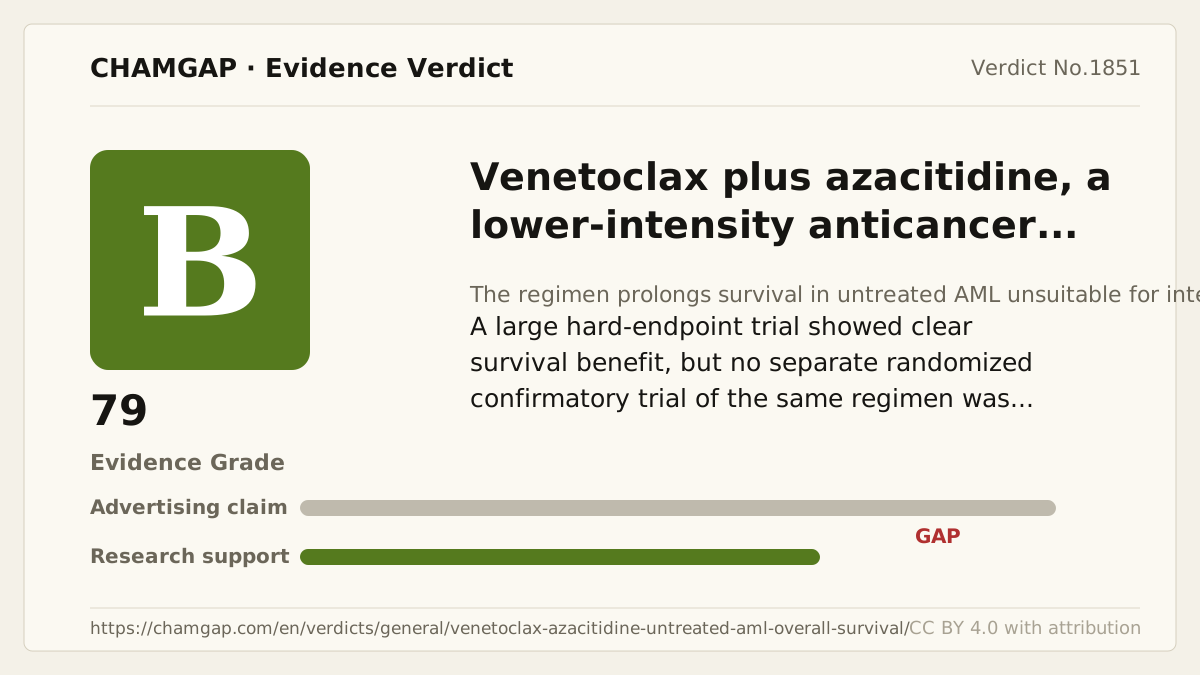
[Chamgap] Venetoclax plus azacitidine x longer overall survival in untreated AML — Evidence Grade B·76. 2 cited sources checked. Source: https://chamgap.com/en/verdicts/general/venetoclax-azacitidine-untreated-aml-overall-survival/ · CC BY 4.0CC BY 4.0 — free to use with attribution; do not distort grades, numbers, or verdict meaning.
What this document does and does not do
Chamgap is an information source. It reports what research has and has not confirmed; it does not tell readers what to take or buy. That decision belongs to readers and, when needed, medical or legal professionals. This verdict reflects literature available up to the search date and may change as new research appears. Nothing here is medical advice.