
Vegetarian diet,
does it really help with Reduced all-cause mortality versus nonvegetarian eating?
research showsThe grade is C. In 73,308 AHS-2 participants, 2,570 died over a mean 5.79 years and the adjusted HR for all vegetarian patterns combined versus nonvegetarian was 0.88 (95% CI 0.80 to 0.97). The event association is positive, but diet was not randomized; smoking, alcohol, exercise, education, BMI, and one-time baseline diet measurement limit causal interpretation, giving C with 56 points.
ads claimAnimal-food frequency genuinely differed, but attributing survival differences solely to diet erases correlated behavior and selection.
Useful facts when choosing a product
- AHS-2 defined vegan as consuming meat, fish, dairy, and eggs less than once per month each.
- Diet classification came from the baseline FFQ and individual separation was not repeatedly measured through the end of follow-up.
- Vegetarian participants had more education, less smoking and alcohol use, more exercise, and lower BMI.
- Verdict 2109 is D with 28 points for an uncooked vegan raw-food diet and rheumatoid arthritis; this verdict concerns general vegetarian patterns and all-cause mortality.
Chamgap Semantic Classification Code
Candidate index · review held
D.vegetarian-dietary-pattern.dietary.all-cause-mortality.reduce.UNKDietary patterns and eating practices > Vegetarian dietary pattern > Dietary regimen > all-cause mortality > Reduction claim > Unknown
An automated migration candidate, not an issued permanent code; exact claim scope remains under review. This machine-generated migration candidate helps retrieval but is not a permanent assignment. The original verdict ID and URL remain authoritative.
What the research actually shows
AHS-2 analyzed 73,308 of 96,469 enrollees after exclusions for prior disease, extreme energy reports, and missing data. A baseline quantitative FFQ classified vegan, lacto-ovo, pesco, semi-vegetarian, and nonvegetarian patterns; deaths came from the National Death Index. Energy- and attenuation-adjusted FFQ validity correlations were about 0.60 in White participants and 0.52 in Black participants. The combined vegetarian HR was 0.88 (0.80 to 0.97), while vegan alone was 0.85 (0.73 to 1.01) and was not conclusive. Models adjusted major lifestyle and socioeconomic factors. NCI and USDA/NIFA supported the work; one author disclosed small honoraria from regional Seventh-day Adventist organizations.
Why this is classified as C (56)
A significant association in a large publicly funded cohort is limited by nonrandomized exposure, healthy-user bias, and long-term exposure misclassification, giving C with 56 points.
Counterpoint. C does not mean vegetarian eating is moderately good. It means causal evidence for life extension remains limited to observational data.
Rejudgment record. Cross-check applied — Positive AHS-2 mortality association limited by nonrandomized exposure, residual confounding, and single baseline dietary assessment
| Endpoint | H | Hard endpoint - actual events such as death |
| Replication | R1 | Single confirmatory trial |
| Independence | I2 | Decisive evidence is publicly or non-profit funded |
| Effect size | E+ | Meets the clinically important threshold |
Stored derived and displayed grades match; this is not a current recalculation or validity check (C).
Sub-claim grades by effect
This ingredient is marketed for several effects. A single overall grade blends strong and weak claims together, so each effect is graded separately here. The overall grade reflects the strongest disconfirming or core claim.
| Effect (sub-claim) | Grade | Basis |
|---|---|---|
| Reduced all-cause mortality for combined vegetarian patterns | C | The AHS-2 association was significant, but residual confounding from self-selected diet is substantial. |
| Reduced all-cause mortality for vegan diet alone | D | The vegan-only HR of 0.85 had a confidence interval including 1. |
Cross-check — AI research and Codex final gate
Evidence Table
| Study | Design | Sample | Funding | Endpoint | Result | Weight |
|---|---|---|---|---|---|---|
| Orlich MJ et al. 2013 AHS-2 | Prospective observational cohort | 73,308 analyzed, mean 5.79 years, 2,570 deaths | NCI and USDA/NIFA | All-cause mortality for all vegetarian patterns versus nonvegetarian | Adjusted HR 0.88 (95% CI 0.80 to 0.97); vegan alone 0.85 (0.73 to 1.01) | Primary association evidence |
| Appleby PN et al. 2016 EPIC-Oxford | Independent prospective cohort | British vegetarian and nonvegetarian cohort | Cancer Research UK and UK Medical Research Council | All-cause mortality, vegetarian versus nonvegetarian | HR 1.05 (95% CI 0.93 to 1.19) | Indirect nonreplication in a different population |
Receipt — 2 References
All 2 cited sources were verified for existence at the original page (as of 2026-08-04).
Final verification and publication gate: Codex · Evidence date: 2026-08-04 · Corrections: none
Cite this verdict
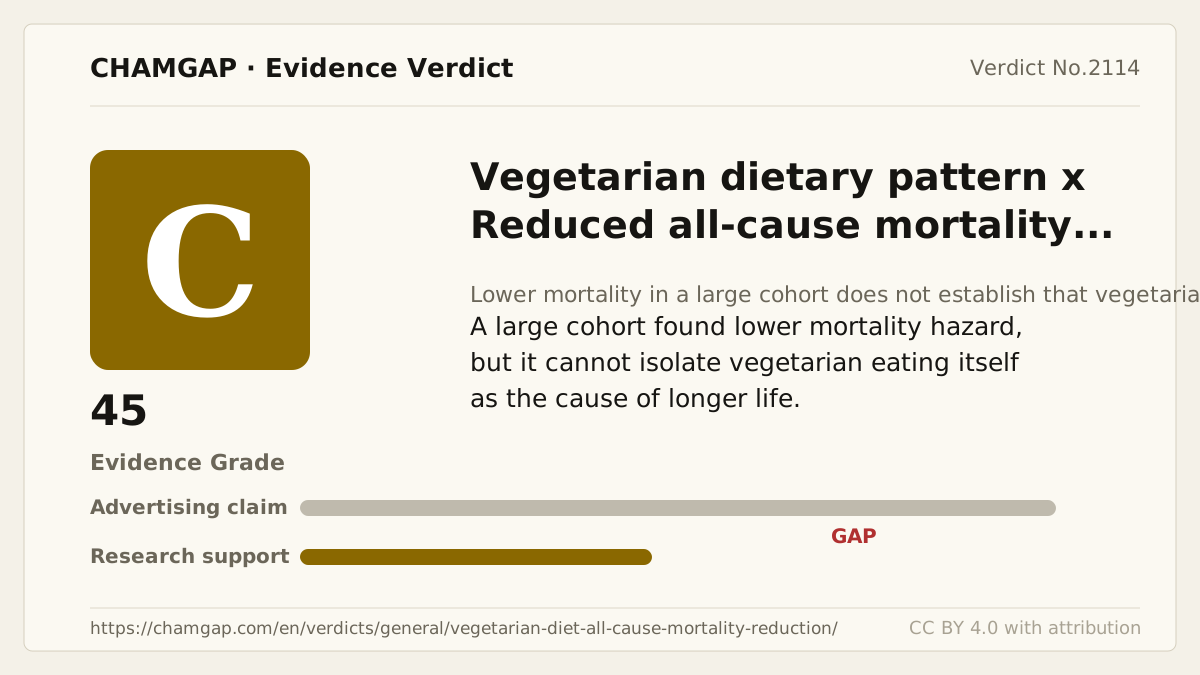
[Chamgap] Vegetarian diet x reduced all-cause mortality — Evidence Grade C·56. 2 cited sources checked. Source: https://chamgap.com/en/verdicts/general/vegetarian-diet-all-cause-mortality-reduction/ · CC BY 4.0CC BY 4.0 — free to use with attribution; do not distort grades, numbers, or verdict meaning.
What this document does and does not do
Chamgap is an information source. It reports what research has and has not confirmed; it does not tell readers what to take or buy. That decision belongs to readers and, when needed, medical or legal professionals. This verdict reflects literature available up to the search date and may change as new research appears. Nothing here is medical advice.