
Ultrasound-assisted prompted voiding,
does it really help with Reduced daytime urine leakage in older nursing-home residents?
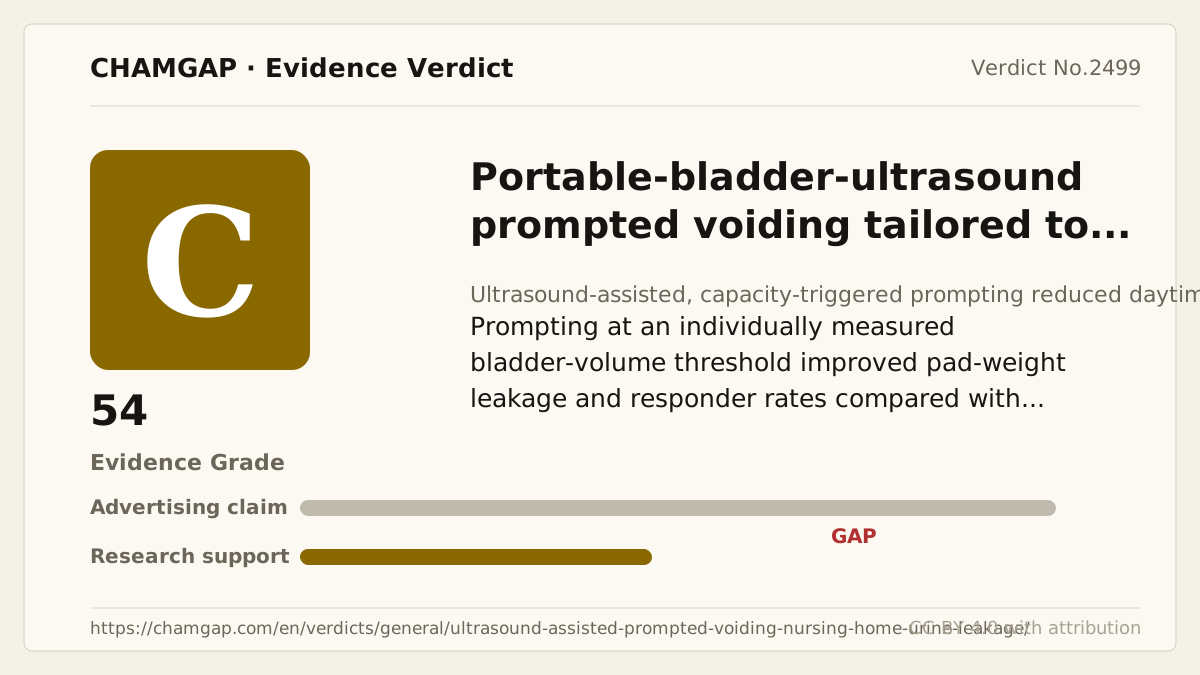
research showsThe grade is C. In 80 residents from 11 contributing homes, daytime leakage changed by -80 g versus -9 g (P=0.018), and at least 25% reduction occurred in 23/45 versus 9/35. However, EQ-5D, co-primary with leakage in UMIN, did not improve significantly in either group. Leakage improved but the co-primary outcomes split; the trial was small and unmasked and two randomized homes enrolled no patients, giving C with 54 points.
ads claimThe scanner alone was not the intervention. The program first established individual capacity, measured every two to three hours, and required trained staff to prompt toileting at a threshold.
Useful facts when choosing a product
- The intervention prompted voiding when bladder volume approached about 75% of each individual's optimized capacity.
- UMIN000017963 lists the funding-organization category as self funding and names the Japanese Society of Geriatric Urology as sponsor.
- Bladder scanners are used clinically for residual-volume assessment, but domestic standard use of this exact nursing-home program was not verified. No duplicate verdict or pivotal PMID, DOI, or UMIN identifier was found.
Chamgap Semantic Classification Code
Candidate index · review held
P.portable-bladder-ultrasound-prompted-voiding-tailored-to-individual-bladder-capacity.UNK.daytime-urine-leakage-in-older-nursing-home-residents.reduce.UNKProcedures, devices and tests > Portable-bladder-ultrasound prompted voiding tailored to individual bladder capacity > Unknown > daytime urine leakage in older nursing-home residents > Reduction claim > Unknown
An automated migration candidate, not an issued permanent code; exact claim scope remains under review. This machine-generated migration candidate helps retrieval but is not a permanent assignment. The original verdict ID and URL remain authoritative.
What the research actually shows
Thirteen facilities were cluster-randomized by random-number table, but one intervention and one control facility enrolled no eligible residents, leaving 11 facilities and 80 participants, 45 versus 35. There was no individual loss to follow-up, and leakage was measured using pad weights and frequency-volume charts. Caregiver masking was impossible. A sample under 200 and two randomized facilities contributing no patients were counted as two limitations. UMIN labels the funding category self-funded and names the Japanese Society of Geriatric Urology as sponsor.
Why this is classified as C (54)
A registered nonprofit/public-interest cluster trial found a large difference in a directly meaningful leakage outcome, providing two strength axes. Only 80 participants in 11 contributing facilities and two randomized facilities with no enrollment cap the result at C with 54 points.
Counterpoint. Care burden was stable in the ultrasound group and worsened in controls, but resident quality of life did not improve. Durability beyond eight weeks and added staffing and training costs remain uncertain.
Rejudgment record. Cross-check applied — We cross-checked cluster allocation, contributing facilities and participants, registered intervention, leakage and responder results, follow-up, and funding against the primary report, UMIN, and a public evidence review.
| Endpoint | P | Symptom or function itself is the target - including patient reports and performance tests |
| Replication | R1 | Single confirmatory trial |
| Independence | I2 | Decisive evidence is publicly or non-profit funded |
| Effect size | E+ | Meets the clinically important threshold |
Stored derived and displayed grades match; this is not a current recalculation or validity check (C).
Sub-claim grades by effect
This ingredient is marketed for several effects. A single overall grade blends strong and weak claims together, so each effect is graded separately here. The overall grade reflects the strongest disconfirming or core claim.
| Effect (sub-claim) | Grade | Basis |
|---|---|---|
| Ultrasound-assisted prompted voiding reduces daytime urine leakage. | C | Median change was -80 g versus -9 g, but evidence comes from one 80-participant trial in 11 facilities. |
| Ultrasound-assisted prompted voiding improves quality of life. | D | Quality of life did not change significantly in either group at eight weeks. |
Cross-check — AI research and Codex final gate
Evidence Table
| Study | Design | Sample | Funding | Endpoint | Result | Weight |
|---|---|---|---|---|---|---|
| Suzuki et al., Neurourol Urodyn 2019 | Cluster-randomized nursing-home clinical trial | 13 facilities randomized; 2 enrolled no residents; 11 facilities and 80 participants analyzed (45 ultrasound, 35 conventional) | UMIN: Organization None, Category of Funding Organization Self funding; sponsor Japanese Society of Geriatric Urology | Co-primary: eight-week daytime urine leakage and EQ-5D quality of life | Leakage median change -80 g versus -9 g, P=0.018; at least 25% reduction 23/45 versus 9/35, independently calculated RR 1.99 (95% CI 1.06-3.73); no significant EQ-5D improvement in either group | Pivotal registered cluster trial |
Receipt — 2 References
All 2 cited sources were verified for existence at the original page (as of 2026-08-14).
Final verification and publication gate: Codex · Evidence date: 2026-08-14 · Corrections: none
Cite this verdict
[Chamgap] Ultrasound-assisted prompted voiding x daytime urine leakage in nursing homes — Evidence Grade C·54. 2 cited sources checked. Source: https://chamgap.com/en/verdicts/general/ultrasound-assisted-prompted-voiding-nursing-home-urine-leakage/ · CC BY 4.0CC BY 4.0 — free to use with attribution; do not distort grades, numbers, or verdict meaning.
What this document does and does not do
Chamgap is an information source. It reports what research has and has not confirmed; it does not tell readers what to take or buy. That decision belongs to readers and, when needed, medical or legal professionals. This verdict reflects literature available up to the search date and may change as new research appears. Nothing here is medical advice.