
Tezepelumab,
does it really help with Prevention of exacerbations requiring systemic corticosteroids, emergency care, or hospitalization in severe uncontrolled asthma?
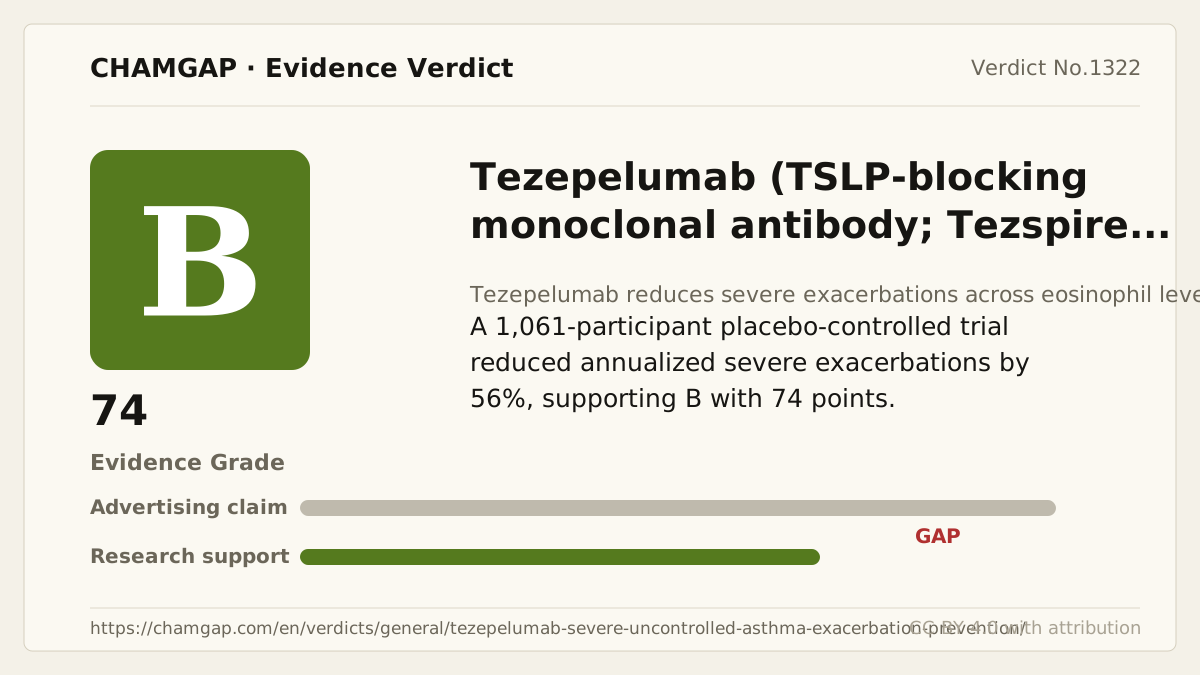
research showsTezepelumab is rated B because it reduced exacerbations requiring systemic corticosteroids, emergency care, or hospitalization in severe asthma uncontrolled despite standard therapy. Among 1,061 NAVIGATOR participants, the annualized exacerbation rate fell from 2.10 to 0.93 per patient-year, with benefit also present below 300 blood eosinophils per microliter. Manufacturer support, a restricted severe population, and ongoing injections support B with 74 points.
ads claimBiomarker-broad efficacy can be expanded into a cure for every patient with asthma or a reason to stop inhalers. The evidence concerns add-on maintenance treatment while background controllers continue in severe uncontrolled disease.
Useful facts when choosing a product
- Tezepelumab is a prescription monoclonal antibody against the epithelial cytokine TSLP and is used as add-on maintenance treatment for severe asthma.
- A common regimen is 210 mg subcutaneously every four weeks; it is not rescue treatment for acute bronchospasm or status asthmaticus.
- Inhaled or oral corticosteroids should not be stopped abruptly without clinical supervision.
- Injection-site reactions, pharyngitis, arthralgia, and hypersensitivity can occur, and live vaccines should be avoided.
Chamgap Semantic Classification Code
Candidate index · review held
M.tezepelumab.UNK.exacerbations-requiring-systemic-corticosteroids-emergency-care-or-hospitalization-in-severe-uncontrolled-asthma.prevent.placeboMedicinal interventions > Tezepelumab > Unknown > exacerbations requiring systemic corticosteroids, emergency care, or hospitalization in severe uncontrolled asthma > Occurrence-prevention claim > Placebo
An automated migration candidate, not an issued permanent code; exact claim scope remains under review. This machine-generated migration candidate helps retrieval but is not a permanent assignment. The original verdict ID and URL remain authoritative.
What the research actually shows
The NAVIGATOR investigators randomized 1,061 adults and adolescents with severe uncontrolled asthma to tezepelumab 210 mg subcutaneously every four weeks or placebo for 52 weeks. Annualized exacerbations were 0.93 versus 2.10, rate ratio 0.44, and 1.02 versus 1.73 below 300 eosinophils per microliter, rate ratio 0.59. Exacerbations required at least three days of systemic corticosteroids or an asthma-related emergency-department visit or hospitalization. The phase 2 PATHWAY trial reproduced exacerbation reductions across doses.
Why this is classified as B (74)
NAVIGATOR reduced annualized exacerbations from 2.10 to 0.93, rate ratio 0.44, but manufacturer-led add-on evidence in a restricted severe population supports B with 74 points.
Counterpoint. Exacerbation history, inhaler adherence, comorbidities, phenotype, cost, and injection burden all affect treatment choice.
Rejudgment record. Cross-check applied — A 52-week placebo-controlled trial in 1,061 patients with severe uncontrolled asthma substantially reduced exacerbations requiring systemic corticosteroids, emergency care, or hospitalization across eosinophil strata, with manufacturer leadership and population restriction reflected
Sub-claim grades by effect
This ingredient is marketed for several effects. A single overall grade blends strong and weak claims together, so each effect is graded separately here. The overall grade reflects the strongest disconfirming or core claim.
| Effect (sub-claim) | Grade | Basis |
|---|---|---|
| Reduced asthma exacerbations requiring systemic corticosteroids | B | This was a prespecified exacerbation component, and the overall annualized rate fell by 56%. |
| Reduced asthma exacerbations requiring emergency care or hospitalization | B | Events requiring emergency care or hospitalization were part of the direct clinical exacerbation definition. |
| Reduced asthma exacerbations in patients with low eosinophil counts | B | Below 300 eosinophils per microliter, annualized rates were 1.02 versus 1.73, rate ratio 0.59. |
Cross-check — AI research and Codex final gate
Evidence Table
| Study | Design | Sample | Funding | Endpoint | Result | Weight |
|---|---|---|---|---|---|---|
| Menzies-Gow A et al.; NAVIGATOR Investigators. 2021 | Multinational randomized double-blind placebo-controlled phase 3 trial | 1,061 adults and adolescents with severe uncontrolled asthma | Supported by AstraZeneca and Amgen | Annualized asthma exacerbation rate over 52 weeks | 0.93 versus 2.10 per patient-year, rate ratio 0.44 (95% CI 0.37 to 0.53). | Pivotal phase 3 clinical-exacerbation trial |
| Corren J et al.; PATHWAY Investigators. 2017 | Randomized double-blind placebo-controlled phase 2 dose-ranging trial | 584 adults with uncontrolled asthma | Supported by MedImmune | Annualized rate of clinically significant asthma exacerbations over 52 weeks | Across three tezepelumab doses, exacerbation rates were 61% to 71% lower than placebo. | Phase 2 replication across doses |
Receipt — 2 References
All 2 cited sources were verified for existence at the original page (as of 2026-07-23).
Final verification and publication gate: Codex · Evidence date: 2026-07-23 · Corrections: none
Cite this verdict
[Chamgap] Tezepelumab x prevention of severe exacerbations in severe uncontrolled asthma — Evidence Grade B·74. 2 cited sources checked. Source: https://chamgap.com/en/verdicts/general/tezepelumab-severe-uncontrolled-asthma-exacerbation-prevention/ · CC BY 4.0CC BY 4.0 — free to use with attribution; do not distort grades, numbers, or verdict meaning.
What this document does and does not do
Chamgap is an information source. It reports what research has and has not confirmed; it does not tell readers what to take or buy. That decision belongs to readers and, when needed, medical or legal professionals. This verdict reflects literature available up to the search date and may change as new research appears. Nothing here is medical advice.