
Back sleeping,
does it really help with Reduced sudden infant death syndrome?
research showsThe grade is C. Randomly assigning infants to a potentially lethal sleep position would be unethical. UK case-control evidence found adjusted OR 9.00 (95% CI 2.84 to 28.47) for prone and 1.84 (1.02 to 3.31) for side versus supine sleep; later California evidence found OR 2.6 (1.5 to 4.5) for prone and 2.0 (1.2 to 3.4) for side placement at the last sleep. Independent studies across countries and large post-campaign declines point in the same direction, but several avoidable biases give C with 54 points.
ads claimThe evidence comes from death case-control studies and large natural experiments, not randomized trials. It is wrong both to dismiss this as no evidence and to assign every campaign-era decline to sleep position alone.
Useful facts when choosing a product
- A 2022 review pooled 4,720 SIDS cases and 54,612 controls from 26 observational studies, with supine OR 0.51 (95% CI 0.42 to 0.61).
- The 1993-1995 UK case-control study found prone OR 9.00 and side OR 1.84 versus supine.
- US SIDS fell from 1.20 to 0.67 per 1,000 and Tyrol from 1.83 to 0.4, while other safety advice and diagnostic coding also changed.
Chamgap Semantic Classification Code
Candidate index · review held
UNK.placing-an-infant-supine.UNK.sudden-infant-death-syndrome.reduce.baselineUnknown > Placing an infant supine > Unknown > sudden infant death syndrome > Reduction claim > Within-group baseline comparison
An automated migration candidate, not an issued permanent code; exact claim scope remains under review. This machine-generated migration candidate helps retrieval but is not a permanent assignment. The original verdict ID and URL remain authoritative.
What the research actually shows
A 1993-1995 UK study of 195 SIDS cases and 780 controls found adjusted OR 9.00 (95% CI 2.84 to 28.47) for prone and 1.84 (1.02 to 3.31) for side sleep. A 1989-1992 Southern California study of 200 cases and 200 controls found usual-prone OR 0.76 (0.42 to 1.38). A 1997-2000 California study of 185 cases and 312 controls found last-sleep OR 2.6 (1.5 to 4.5) for prone and 2.0 (1.2 to 3.4) for side placement. A 2022 review pooled 26 observational studies and 59,332 infants, estimating supine OR 0.51 (0.42 to 0.61). These independent UK and US studies relied on parental exposure reports after death. Country time series showed large post-campaign declines but could not separate death-classification changes and concurrent risk-factor changes.
Why this is classified as C (54)
For an ethically nonrandomizable mortality question, independent multinational case-control studies and large campaign-era declines are consistent. Parental recall, post-death ascertainment, and ecological confounding from death coding and concurrent changes give C with 54 points.
Counterpoint. Supine placement is one component of a safe sleep environment. It does not replace a firm flat separate surface, removal of loose bedding, and avoidance of smoke exposure.
Rejudgment record. Cross-check applied — Consistent multinational evidence for an ethically nonrandomizable question, limited by parental recall, post-death exposure ascertainment, and campaign time-series confounding
| Endpoint | H | Hard endpoint - actual events such as death |
| Replication | R1 | Single confirmatory trial |
| Independence | I1 | Mixed funding sources |
| Effect size | E+ | Meets the clinically important threshold |
Stored derived and displayed grades match; this is not a current recalculation or validity check (C).
Sub-claim grades by effect
This ingredient is marketed for several effects. A single overall grade blends strong and weak claims together, so each effect is graded separately here. The overall grade reflects the strongest disconfirming or core claim.
| Effect (sub-claim) | Grade | Basis |
|---|---|---|
| Supine placement and reduced SIDS | B | Multinational case-control and time-series evidence is consistent despite no randomized trial. |
| All campaign-era decline was caused by sleep position alone | C | Smoking, bedding, breastfeeding advice, and cause-of-death classification also changed. |
Cross-check — AI research and Codex final gate
Evidence Table
| Study | Design | Sample | Funding | Endpoint | Result | Weight |
|---|---|---|---|---|---|---|
| Fleming et al. 1996 CESDI case-control study | Multiregional population-based case-control study | 195 SIDS cases and 780 controls | Exact funding not verified in the accessible report | Sudden infant death syndrome before age one | Adjusted OR 9.00 (2.84 to 28.47) for prone and 1.84 (1.02 to 3.31) for side versus supine | Pivotal individual case-control evidence |
| Priyadarshi et al. 2022 systematic review | Systematic review and meta-analysis of observational studies | 26 studies; 4,720 SIDS cases and 54,612 controls | Exact funding not verified in the accessible report | SIDS from birth to one year | Supine OR 0.51 (95% CI 0.42 to 0.61); very low certainty | Pooled multinational observational evidence |
| Wennergren et al. 1997 Scandinavian time series | Natural experiment before and after prevention campaigns | Norway, Denmark, and Sweden; separate case-control sample of 244 cases and 869 controls | Exact funding not verified in the accessible abstract | National SIDS incidence | From 2.3, 1.6, and 1.0 per 1,000 to 0.6 or less in all three countries by 1995 | Multinational time-series support |
Receipt — 7 References
All 7 cited sources were verified for existence at the original page (as of 2026-08-04).
Final verification and publication gate: Codex · Evidence date: 2026-08-04 · Corrections: none
Cite this verdict
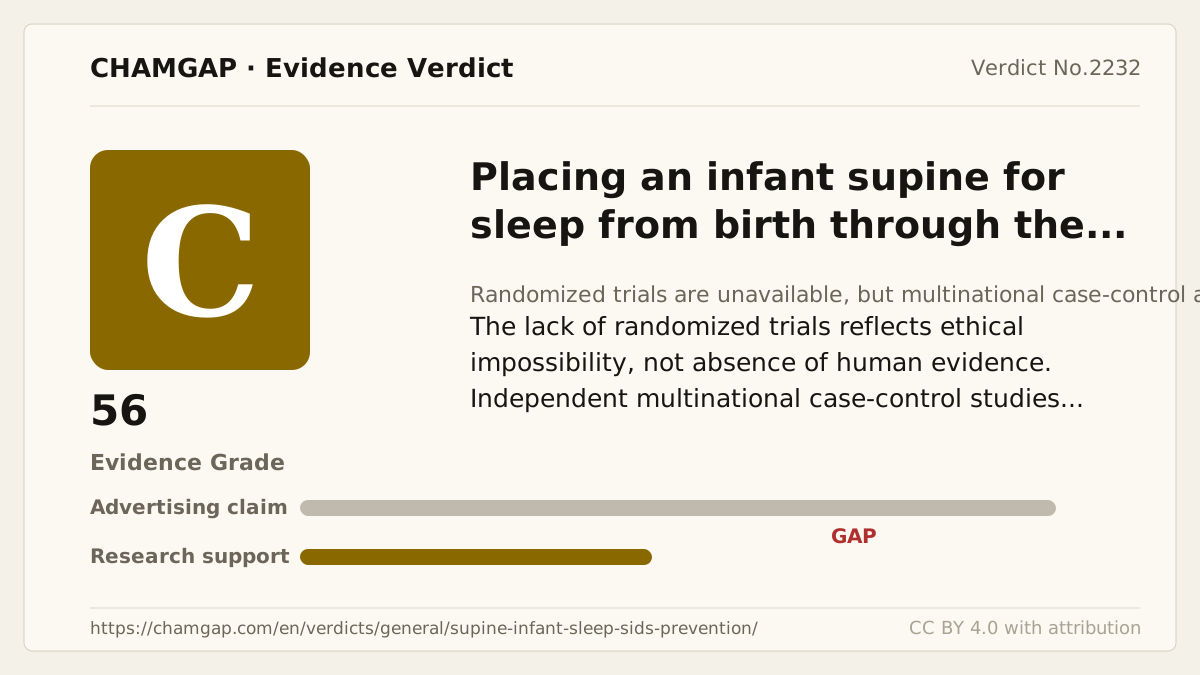
[Chamgap] Back sleeping x reduced sudden infant death syndrome — Evidence Grade C·54. 7 cited sources checked. Source: https://chamgap.com/en/verdicts/general/supine-infant-sleep-sids-prevention/ · CC BY 4.0CC BY 4.0 — free to use with attribution; do not distort grades, numbers, or verdict meaning.
What this document does and does not do
Chamgap is an information source. It reports what research has and has not confirmed; it does not tell readers what to take or buy. That decision belongs to readers and, when needed, medical or legal professionals. This verdict reflects literature available up to the search date and may change as new research appears. Nothing here is medical advice.