
Medication optimization,
does it really help with Reduction of 12-month drug-related hospital admission in inpatients aged 70 or older with multimorbidity and polypharmacy?
research showsThe grade is D. In OPERAM, first drug-related admission occurred in 211/963 (21.9%) participants receiving optimization and 234/1,045 (22.4%) receiving usual care; the competing-risk analysis gave HR 0.95 (95% CI 0.77 to 1.17). The trial randomized 110 prescriber-defined clusters and accounted for clustering, but one null trial neither proves benefit nor constitutes repeated refutation.
ads claimA higher rate of prescription change cannot be presented as fewer admissions. The intervention bundled software, physician-pharmacist review, shared decisions, and discharge communication, so its result cannot be assigned to one component.
Useful facts when choosing a product
- The bundle addressed overuse, underuse, misuse, adherence, and adverse reactions rather than simply stopping medicines.
- Controls received each hospital's usual prescribing and discharge care.
- At two months, 491 of 789 evaluable intervention participants had at least one recommendation implemented.
Chamgap Semantic Classification Code
Candidate index · review held
UNK.physician-pharmacist-medication-optimization-using-stopp-start-and-stripa.UNK.drug-related-hospital-admission-in-inpatients-with-multimorbidity-and-polypharmacy.reduce.usual-careUnknown > Physician-pharmacist medication optimization using STOPP/START and STRIPA > Unknown > drug-related hospital admission in inpatients with multimorbidity and polypharmacy > Reduction claim > Usual care
An automated migration candidate, not an issued permanent code; exact claim scope remains under review. This machine-generated migration candidate helps retrieval but is not a permanent assignment. The original verdict ID and URL remain authoritative.
What the research actually shows
OPERAM randomized 110 ward-care clusters defined by attending prescribers across four countries: 54 clusters with 963 participants to intervention and 56 clusters with 1,045 participants to usual care. During the index admission, a research physician and pharmacist performed one structured review using STRIPA and STOPP/START, discussed recommendations with the attending physician and patient, and transferred agreed changes into discharge and general-practitioner reports. A mean 2.75 recommendations per participant were issued; 491/789 evaluable participants had at least one implemented at two months. Blinded adjudicators assessed admissions, and analyses accounted for clustering and competing death.
Why this is classified as D (34)
A large publicly funded cluster trial was null for a hard outcome, but there was neither repeated refutation nor exclusion of clinically important benefit, giving D with 34 points.
Counterpoint. D does not mean medication review is useless; it means this bundle has not been shown to reduce 12-month drug-related admission.
Rejudgment record. Cross-check applied — OPERAM's prespecified primary endpoint was null in an analysis accounting for clustering and competing death, without repeated refutation or exclusion of benefit
| Endpoint | H | Hard endpoint - actual events such as death |
| Replication | R1 | Single confirmatory trial |
| Independence | I2 | Decisive evidence is publicly or non-profit funded |
| Effect size | E0 | Null |
| Precision | C0 | The confidence interval leaves room for benefit |
Stored derived and displayed grades match; this is not a current recalculation or validity check (D).
Sub-claim grades by effect
This ingredient is marketed for several effects. A single overall grade blends strong and weak claims together, so each effect is graded separately here. The overall grade reflects the strongest disconfirming or core claim.
| Effect (sub-claim) | Grade | Basis |
|---|---|---|
| Reduction in first drug-related admission within 12 months | D | The result was null at 21.9% versus 22.4%, HR 0.95. |
Cross-check — AI research and Codex final gate
Evidence Table
| Study | Design | Sample | Funding | Endpoint | Result | Weight |
|---|---|---|---|---|---|---|
| Blum et al. 2021 OPERAM | Multinational partially blinded cluster-randomized trial | 110 prescriber clusters and 2,008 participants, 963 versus 1,045, intention-to-treat | Public funding from EU Horizon 2020 and the Swiss State Secretariat for Education, Research and Innovation | First drug-related hospital admission within 12 months | 211/963 (21.9%) versus 234/1,045 (22.4%); HR 0.95 (95% CI 0.77 to 1.17) | Pivotal direct evidence |
Receipt — 1 References
All 1 cited sources were verified for existence at the original page (as of 2026-08-05).
Final verification and publication gate: Codex · Evidence date: 2026-08-05 · Corrections: none
Cite this verdict
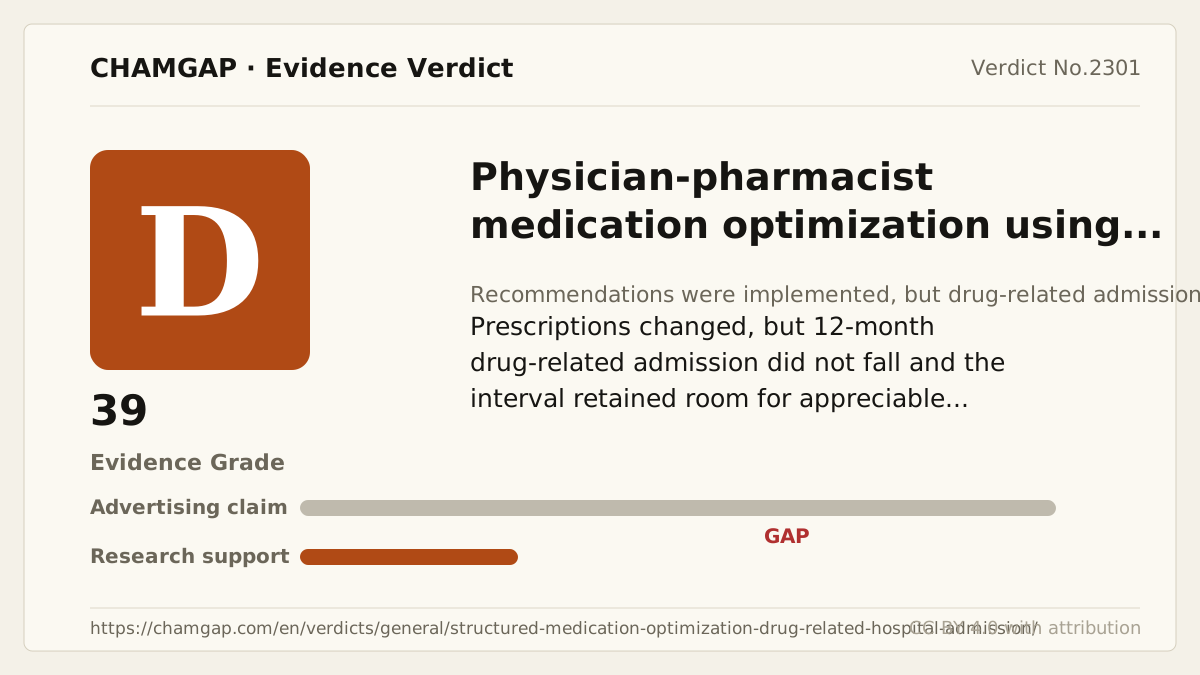
[Chamgap] Medication optimization x drug-related hospital admission — Evidence Grade D·34. 1 cited sources checked. Source: https://chamgap.com/en/verdicts/general/structured-medication-optimization-drug-related-hospital-admission/ · CC BY 4.0CC BY 4.0 — free to use with attribution; do not distort grades, numbers, or verdict meaning.
What this document does and does not do
Chamgap is an information source. It reports what research has and has not confirmed; it does not tell readers what to take or buy. That decision belongs to readers and, when needed, medical or legal professionals. This verdict reflects literature available up to the search date and may change as new research appears. Nothing here is medical advice.