
Structured exercise program,
does it really help with Reduced recurrence, new primary cancer, or death after adjuvant chemotherapy for resected colon cancer?
research showsA three-year structured exercise program after adjuvant chemotherapy for resected colon cancer is rated B with 76 points. CHALLENGE (Courneya 2025, NEJM) randomized 889 participants and followed them for a median 7.9 years. The prespecified disease-free-survival primary endpoint succeeded, HR 0.72 (95% CI 0.55 to 0.94), and overall survival also improved, HR 0.63 (0.43 to 0.94). However, CHALLENGE is the only randomized trial confirming this hard outcome — the second citation, Choy 2022, is a meta-analysis of observational studies, not a new trial — and no replication by different investigators with different funding has been confirmed, so the axis-2 R1 ceiling of B applies. The unblinded intervention and the intensive three-year supervision and behavioral support also limit transferability to routine care. Verdict 1723, which is B with 72 points, and verdict 1557, which is C with 55 points, concern different purposes and indications, and their evidence was not mixed.
ads claimMarketing may reduce the intervention to generic advice to exercise, but the trial used a three-year program with individualized goals, exercise-specialist contact, and long-term behavioral support.
Useful facts when choosing a product
- The intervention included exercise-specialist supervision and behavioral support rather than written self-exercise advice alone.
- It began after completion of adjuvant chemotherapy and does not replace surgery or chemotherapy.
- Clinical assessment and gradual prescription should account for cardiopulmonary and musculoskeletal status and treatment sequelae.
Chamgap Semantic Classification Code
Candidate index · review held
M.structured-exercise-program.oral.recurrence-new-primary-cancer-or-death-after-adjuvant-chemotherapy-for-resected-colon-cancer.reduce.UNKMedicinal interventions > Structured exercise program > Oral > recurrence, new primary cancer, or death after adjuvant chemotherapy for resected colon cancer > Reduction claim > Unknown
An automated migration candidate, not an issued permanent code; exact claim scope remains under review. This machine-generated migration candidate helps retrieval but is not a permanent assignment. The original verdict ID and URL remain authoritative.
What the research actually shows
CHALLENGE randomized 889 patients with high-risk stage II or stage III resected colon cancer who had completed adjuvant chemotherapy at 55 centers: 445 to structured exercise and 444 to health-education materials. The actual primary analysis included all 889 by intention to treat. After a three-year intervention and median 7.9-year follow-up, the disease-free-survival primary endpoint succeeded; five-year disease-free survival was 80.3% versus 73.9%. A 2022 meta-analysis of 13 observational studies and 19,135 patients found overall- and cancer-specific-survival associations but not disease-free survival, so it does not replace the randomized evidence.
Why this is classified as B (76)
In the 889-participant publicly funded CHALLENGE hard-outcome trial, disease-free survival improved with HR 0.72 and overall survival with HR 0.63, but this is the only randomized trial cited and no replication by different investigators with different funding has been confirmed, so the axis-2 R1 ceiling of B applies, giving B with 76 points. The unblinded intervention and intensive three-year supervision and behavioral support also limit transferability to routine care.
Counterpoint. Structured support can reduce recurrence, new cancer, or death in eligible colon-cancer survivors, but the unblinded intervention and intensive three-year supervision and behavioral support are difficult to transfer directly to routine care.
Rejudgment record. Cross-check applied — Applied the axis-2 R1 ceiling of B because the direct hard-outcome success after median 7.9-year follow-up in the 889-participant publicly funded CHALLENGE trial rests on a single randomized trial without confirmed replication by different investigators with different funding, while also accounting for the unblinded intervention and limited routine-care transferability of three years of supervision and behavioral support
| Endpoint | H | Hard endpoint - actual events such as death |
| Replication | R1 | Single confirmatory trial |
| Independence | I2 | Decisive evidence is publicly or non-profit funded |
| Effect size | E+ | Meets the clinically important threshold |
Stored derived and displayed grades match; this is not a current recalculation or validity check (B).
Sub-claim grades by effect
This ingredient is marketed for several effects. A single overall grade blends strong and weak claims together, so each effect is graded separately here. The overall grade reflects the strongest disconfirming or core claim.
| Effect (sub-claim) | Grade | Basis |
|---|---|---|
| Improved disease-free survival | A | The prespecified primary endpoint succeeded in 889 intention-to-treat participants, HR 0.72 (95% CI 0.55 to 0.94). |
| Improved overall survival | A | Overall survival also improved, HR 0.63 (95% CI 0.43 to 0.94). |
| Improved physical functioning | B | SF-36 physical functioning improved substantially at six months and was maintained through 24 months. |
Cross-check — AI research and Codex final gate
Evidence Table
| Study | Design | Sample | Funding | Endpoint | Result | Weight |
|---|---|---|---|---|---|---|
| Courneya KS et al. CHALLENGE 2025 | Phase 3 multicenter randomized controlled trial | 889 randomized; all 889 in the intention-to-treat primary analysis | Public and charitable funding including the Canadian Cancer Society, Canadian Institutes of Health Research, Australian NHMRC, and Cancer Research UK | Disease-free survival composite of recurrence, new primary cancer, or death | The disease-free-survival primary endpoint succeeded, HR 0.72 (95% CI 0.55 to 0.94), P=0.02; overall survival also improved, HR 0.63 (0.43 to 0.94). | Key direct hard-outcome evidence |
| Choy KT et al. 2022 | Systematic review and meta-analysis | 13 prospective observational studies; 19,135 patients | No study funding reported; authors declared no competing interests | Overall, cancer-specific, and disease-free survival | Activity was associated with overall and cancer-specific survival, but not significantly with disease-free survival, and observational confounding remained. | Indirect supportive pre-randomized evidence |
Receipt — 2 References
All 2 cited sources were verified for existence at the original page (as of 2026-08-11).
Final verification and publication gate: Codex · Evidence date: 2026-08-11 · Corrections: 1
Correction log — 1
Corrections applied to this verdict, in chronological order. Changes are logged, not erased.
- 2026-08-11 · Grade correction for unmet independent-replication requirement — Only one randomized trial was cited, CHALLENGE (NCT00819208); the second citation (Choy 2022) is a meta-analysis of observational studies, not a new trial. Chamgap's A requires axis-2 R2 (multiple RCTs by different investigators with different funding), and no independent randomized exercise trial replicating the recurrence or disease-free-survival hard outcome was found in the literature. Axis 2 is R1 and the ceiling is B. The axes were recorded as B·H·R1·I2·E+·B1 and 76 points were assigned. The effect itself (disease-free survival HR 0.72, 95% CI 0.55 to 0.94; overall survival HR 0.63, 0.43 to 0.94) is not disputed. Confirmed in the 2026-08-11 internal audit (workflow verification plus concurring Codex cross-check). (grade A→B)
Cite this verdict
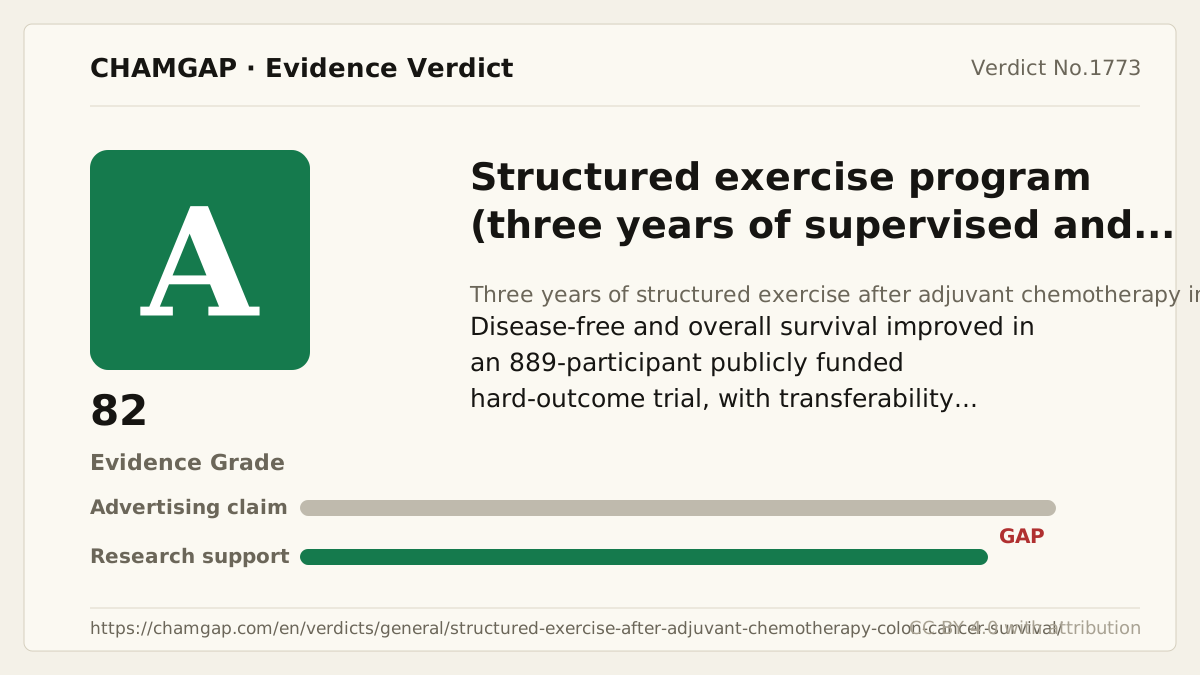
[Chamgap] Structured exercise program x Reduced recurrence, new primary cancer, or death after adjuvant chemotherapy for resected colon cancer — Evidence Grade B·76. 2 cited sources checked. Source: https://chamgap.com/en/verdicts/general/structured-exercise-after-adjuvant-chemotherapy-colon-cancer-survival/ · CC BY 4.0CC BY 4.0 — free to use with attribution; do not distort grades, numbers, or verdict meaning.
What this document does and does not do
Chamgap is an information source. It reports what research has and has not confirmed; it does not tell readers what to take or buy. That decision belongs to readers and, when needed, medical or legal professionals. This verdict reflects literature available up to the search date and may change as new research appears. Nothing here is medical advice.