
Spinach plus milk or dairy,
does it really help with Increased calcium oxalate kidney-stone events?
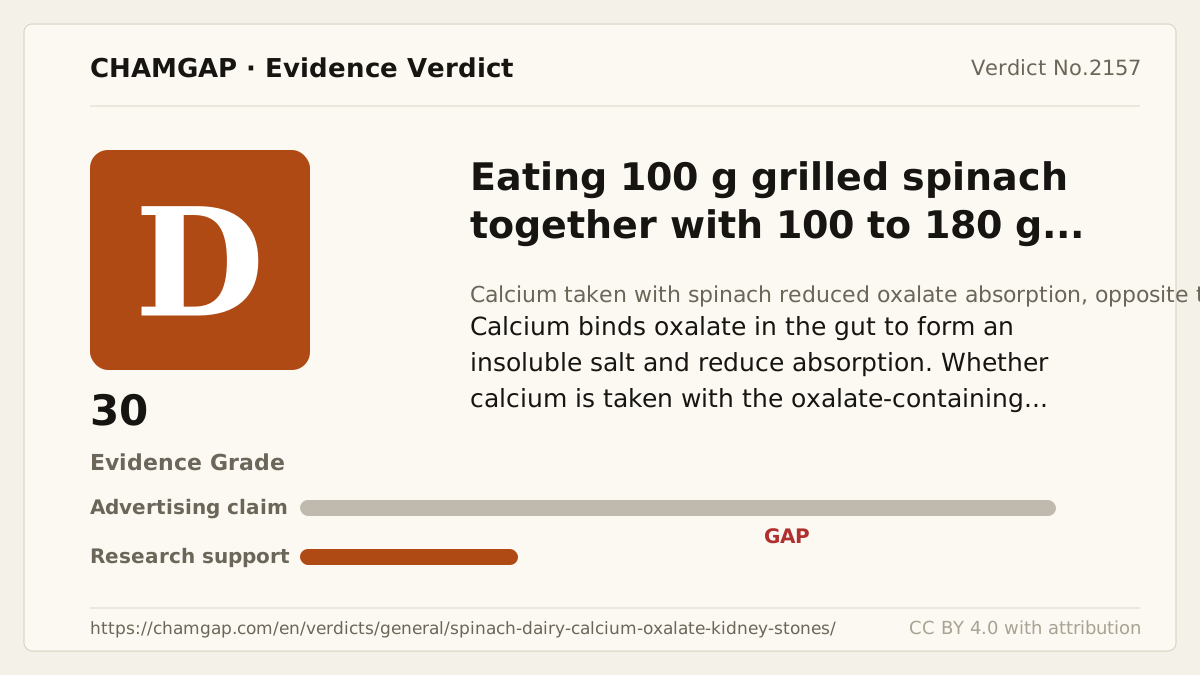
research showsThe grade is D. The belief that spinach and milk together cause stones has the direction reversed. Calcium binds oxalate in the gut and lowers oxalate absorption; consuming them separately can be less favorable. Acute human studies and large cohorts point this way, but no long-term trial measured stone events from this exact combination, giving D with 30 points.
ads claimThe belief that spinach plus milk causes stones has the direction reversed. Dietary calcium reduced oxalate absorption when present with the meal, whereas supplemental calcium, often taken away from oxalate-containing meals, pointed the other way in women. Timing with the meal separates these directions.
Useful facts when choosing a product
- Calcium binding oxalate into an insoluble salt is a chemical fact; that fact itself was not used to determine the grade.
- The tested 100 g spinach contained 736.6±20.4 mg soluble oxalate, 220.1±96.5 mg insoluble oxalate, and about 90 mg calcium.
- Spinach-alone bioavailability was 0.75±0.48% at six hours and 1.93±0.85% at 24 hours; sour cream plus calcium-fortified milk significantly lowered both.
- With 198 mg oxalate plus 300 mg elemental calcium, exogenous urinary oxalate fell from 36.2 mg to 16.1 mg with calcium carbonate and 14.3 mg with calcium citrate malate; absorption fell from 18.3% to 8.1% and 7.2%.
Chamgap Semantic Classification Code
Candidate index · review held
F.eating-grilled-spinach-together-with-milk-or-dairy-products.oral.calcium-oxalate-kidney-stone-events.increase.UNKFoods and beverages > Eating grilled spinach together with milk or dairy products > Oral > calcium oxalate kidney-stone events > Increase claim > Unknown
An automated migration candidate, not an issued permanent code; exact claim scope remains under review. This machine-generated migration candidate helps retrieval but is not a permanent assignment. The original verdict ID and URL remain authoritative.
What the research actually shows
Brogren and Savage gave ten healthy volunteers 100 g grilled spinach alone or with dairy, and sour cream plus calcium-fortified milk lowered both six- and 24-hour oxalate bioavailability, P<.05. Liebman and Chai likewise found that concurrent calcium more than halved oxalate absorption. Among 45,619 men followed for four years, 505 symptomatic stones occurred and the multivariable risk ratio for the highest dietary-calcium quintile was 0.66, 95% CI 0.49 to 0.90. Among 91,731 women followed for 12 years, 864 stones occurred and the dietary-calcium risk ratio was 0.65, 0.50 to 0.83. In that same study, supplemental calcium had the opposite association, 1.20, 1.02 to 1.41; 67% of users took it apart from meals or with low-oxalate meals. The two cohorts came from the same research network and are not independent-team replication. Funding for the pivotal ten-person study could not be confirmed.
Why this is classified as D (30)
Acute human studies and two large cohorts point opposite to the belief, but no long-term event trial tested the exact combination and the cohorts were observational, giving D with 30 points.
Counterpoint. People with recurrent stones, enteric hyperoxaluria, or chronic kidney disease may require individualized meal planning beyond this acute healthy-volunteer study.
Rejudgment record. Cross-check applied — Opposite-direction human absorption evidence and dietary-calcium cohorts, with no combination-specific long-term stone trial
| Endpoint | H | Hard endpoint - actual events such as death |
| Replication | R1 | Single confirmatory trial |
| Independence | I1 | Mixed funding sources |
| Effect size | E0 | Null |
| Precision | C0 | The confidence interval leaves room for benefit |
Stored derived and displayed grades match; this is not a current recalculation or validity check (D).
Sub-claim grades by effect
This ingredient is marketed for several effects. A single overall grade blends strong and weak claims together, so each effect is graded separately here. The overall grade reflects the strongest disconfirming or core claim.
| Effect (sub-claim) | Grade | Basis |
|---|---|---|
| Eating spinach with dairy increases stone events | D | Human absorption studies and dietary-calcium cohorts point the other way, but no long-term combination trial exists. |
| Concurrent dairy increases spinach-oxalate absorption | D | A ten-person meal study found a decrease instead. |
Cross-check — AI research and Codex final gate
Evidence Table
| Study | Design | Sample | Funding | Endpoint | Result | Weight |
|---|---|---|---|---|---|---|
| Brogren and Savage 2003 | Acute comparative meal study in healthy volunteers | 10 participants | Original funding not confirmed | Six- and 24-hour oxalate bioavailability | Sour cream plus calcium-fortified milk significantly reduced both periods versus spinach alone, P<.05 | Direct combination absorption evidence |
| Curhan research-network cohorts of men and women | Two prospective cohorts | 45,619 men with 505 events; 91,731 women with 864 events | US National Institutes of Health grants for the men's study; funding for the women's study not confirmed | Symptomatic kidney stones | Dietary-calcium risk ratio 0.66 (0.49 to 0.90) in men and 0.65 (0.50 to 0.83) in women | Supporting direction for overall dietary calcium |
Receipt — 4 References
All 4 cited sources were verified for existence at the original page (as of 2026-08-04).
Final verification and publication gate: Codex · Evidence date: 2026-08-04 · Corrections: none
Cite this verdict
[Chamgap] Spinach plus milk or dairy x more kidney stones — Evidence Grade D·30. 4 cited sources checked. Source: https://chamgap.com/en/verdicts/general/spinach-dairy-calcium-oxalate-kidney-stones/ · CC BY 4.0CC BY 4.0 — free to use with attribution; do not distort grades, numbers, or verdict meaning.
What this document does and does not do
Chamgap is an information source. It reports what research has and has not confirmed; it does not tell readers what to take or buy. That decision belongs to readers and, when needed, medical or legal professionals. This verdict reflects literature available up to the search date and may change as new research appears. Nothing here is medical advice.