
Spicy-food habit,
does it really help with Lower all-cause mortality?
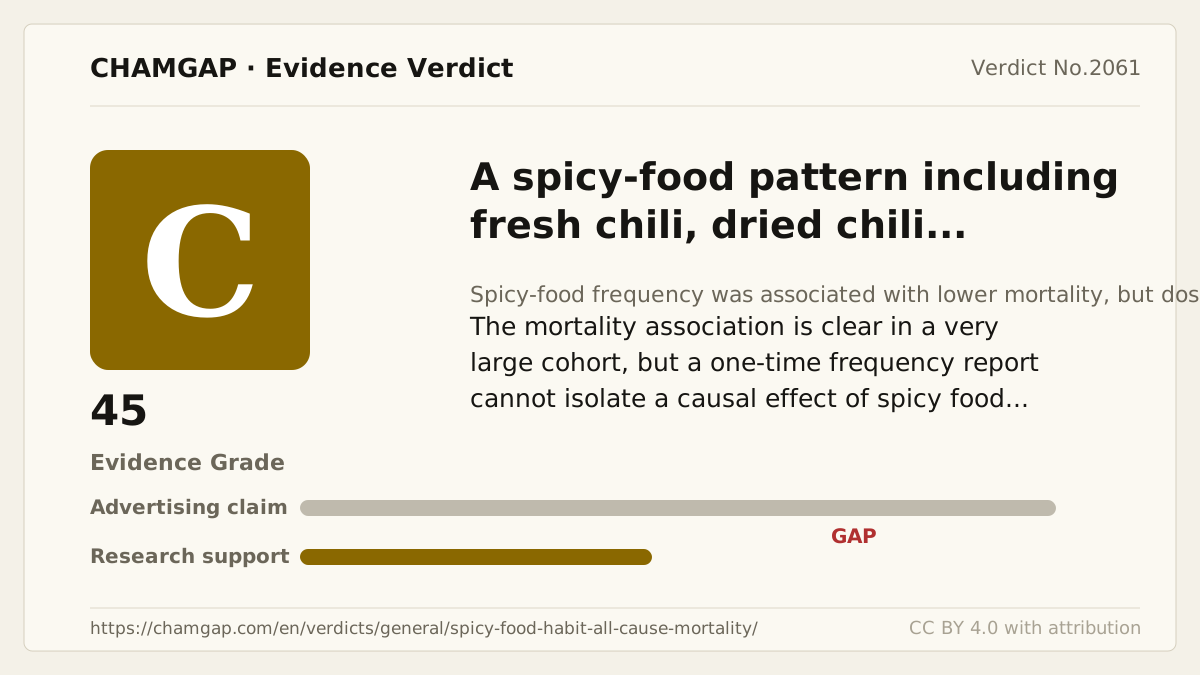
research showsThe grade is C with 56 points. In a cohort of 487,375 Chinese adults followed for a median 7.2 years, mortality hazards were 10%, 14%, and 14% lower for consumption on 1-2, 3-5, and 6-7 days per week versus less than once weekly. This observational study measured neither grams nor capsaicin, so it cannot establish that spicy food lengthens life.
ads claimA lower mortality hazard among frequent consumers is real as an observation, but it does not show that a defined gram dose of chili or milligram dose of capsaicin lengthens life. Verdict 1977 is C with 54 points for whole chili and sweet pepper in relation to sarcopenia prevalence; this verdict addresses multiple spicy-food forms and all-cause mortality.
Useful facts when choosing a product
- The questionnaire recorded spicy-food frequency and the predominant form among fresh chili, dried chili, chili sauce, chili oil, and other or unspecified forms. Curry cannot be excluded from the other category, but its inclusion cannot be asserted.
- Grams, serving size, and capsaicin content were not measured, so tablespoon or pinch conversion is impossible.
- The spicy-food item was not directly validated in this study, and long-term diet was represented by one baseline report.
Chamgap Semantic Classification Code
Candidate index · review held
F.spicy-food-pattern-including-fresh-chili.food.all-cause-mortality.reduce.UNKFoods and beverages > spicy-food pattern including fresh chili > Food consumption > all-cause mortality > Reduction claim > Unknown
An automated migration candidate, not an issued permanent code; exact claim scope remains under review. This machine-generated migration candidate helps retrieval but is not a permanent assignment. The original verdict ID and URL remain authoritative.
What the research actually shows
The analysis included 199,293 men and 288,082 women, 487,375 total, after excluding baseline cancer, heart disease, and stroke. During 3,500,004 person-years and median 7.2-year follow-up, 11,820 men and 8,404 women died. Exposure was self-reported once at baseline; respondents identified frequency and the predominant form among fresh chili, dried chili, sauce, oil, and other or unspecified forms, but not quantity or serving size. Curry cannot be excluded from the other category, but its inclusion cannot be asserted. Chinese, UK, and US public or nonprofit grants supported the work.
Why this is classified as C (56)
A large and important mortality association is offset by unvalidated self-reported exposure, residual confounding, and multiple analyses, giving C with 56 points.
Counterpoint. C does not mean spicy food is harmful or that the association is false; it means causal life extension has not been established.
Rejudgment record. Cross-check applied — The BMJ article's analysis population, deaths, hazard ratios, exposure instrument, lack of direct validation, funding, and the existing chili verdict were cross-checked
| Endpoint | H | Hard endpoint - actual events such as death |
| Replication | R1 | Single confirmatory trial |
| Independence | I2 | Decisive evidence is publicly or non-profit funded |
| Effect size | E+ | Meets the clinically important threshold |
Stored derived and displayed grades match; this is not a current recalculation or validity check (C).
Sub-claim grades by effect
This ingredient is marketed for several effects. A single overall grade blends strong and weak claims together, so each effect is graded separately here. The overall grade reflects the strongest disconfirming or core claim.
| Effect (sub-claim) | Grade | Basis |
|---|---|---|
| Higher spicy-food frequency is associated with lower all-cause mortality hazard | C | Observed in a large prospective cohort but not established as causal. |
| A defined chili or capsaicin dose lengthens life | ? | Neither food quantity nor capsaicin dose was measured. |
Cross-check — AI research and Codex final gate
Evidence Table
| Study | Design | Sample | Funding | Endpoint | Result | Weight |
|---|---|---|---|---|---|---|
| Lv J et al. 2015 China Kadoorie Biobank | Population-based prospective cohort | 487,375 analyzed; median 7.2 years; 20,224 deaths | Chinese public grants, Kadoorie Charitable Foundation, Wellcome Trust, and US public grants | All-cause and cause-specific mortality | Fully adjusted HRs versus less than weekly were 0.90, 0.86, and 0.86; 95% CIs 0.84-0.96, 0.80-0.92, and 0.82-0.90 | Large hard-outcome association from a nonrandomized dietary study |
Receipt — 1 References
All 1 cited sources were verified for existence at the original page (as of 2026-08-03).
Final verification and publication gate: Codex · Evidence date: 2026-08-03 · Corrections: none
Cite this verdict
[Chamgap] Spicy-food habit x lower all-cause mortality — Evidence Grade C·56. 1 cited sources checked. Source: https://chamgap.com/en/verdicts/general/spicy-food-habit-all-cause-mortality/ · CC BY 4.0CC BY 4.0 — free to use with attribution; do not distort grades, numbers, or verdict meaning.
What this document does and does not do
Chamgap is an information source. It reports what research has and has not confirmed; it does not tell readers what to take or buy. That decision belongs to readers and, when needed, medical or legal professionals. This verdict reflects literature available up to the search date and may change as new research appears. Nothing here is medical advice.