
Social-prescribing link worker,
does it really help with Improved quality of life and mental health?
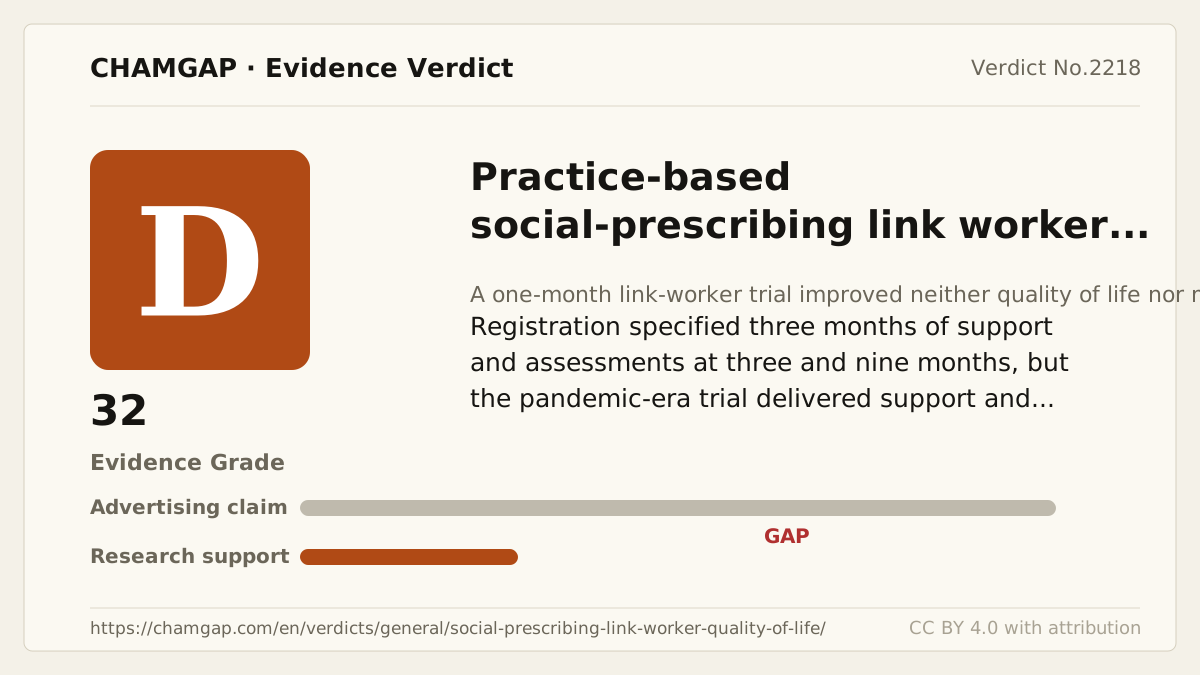
research showsThe grade is D with 30 points. In the LinkMM trial, 240 people were randomized and the one-month between-group difference was 0.01 (95% CI -0.07 to 0.09) for EQ-5D-5L and 0.05 (-0.63 to 0.73) for HADS. Both registered primary outcomes failed. This is direct null evidence, but it is one one-month trial and the intervals still allow benefit, so it is not repeated refutation.
ads claimDelivery of referrals and community links is not evidence that quality of life improved. This one-month trial was null; a longer program requires a new test.
Useful facts when choosing a product
- Social prescribing uses a nonmedical link worker to connect patients with community, welfare, and activity resources.
- After 240 participants were randomized, one-month retention was 80% and complete primary data were available for 75%.
- Both registered primary outcomes, EQ-5D-5L and HADS, were null.
Chamgap Semantic Classification Code
Candidate index · review held
UNK.practice-based-social-prescribing-link-worker-support.UNK.quality-of-life-and-mental-health.improve.usual-careUnknown > Practice-based social-prescribing link worker support > Unknown > quality of life and mental health > Improvement claim > Usual care
An automated migration candidate, not an issued permanent code; exact claim scope remains under review. This machine-generated migration candidate helps retrieval but is not a permanent assignment. The original verdict ID and URL remain authoritative.
What the research actually shows
During COVID-19, 251 people were recruited from 13 practices and 240 were randomized after baseline, 123 versus 117. Controls received wait-list usual care for one month and were then offered link-worker contact. One-month retention was 80% and primary-outcome completion was 75%. The registry was prospective on December 10, 2019 and planned three months of support with EQ-5D-5L and HADS assessments at three and nine months, whereas the published trial delivered support and assessment at one month. Analysts were blinded, and public agencies funded the trial.
Why this is classified as D (30)
Both patient-centered primary outcomes were null in a prospectively registered trial, but the single one-month study and benefit-compatible intervals give D with 30 points.
Counterpoint. Longer support or different populations were not excluded and require separate trials.
Rejudgment record. Cross-check applied — Compared registration with publication to verify the three-to-one-month change, wait-list control, both primary outcomes, randomized count, retention, and complete-data rate
| Endpoint | P | Symptom or function itself is the target - including patient reports and performance tests |
| Replication | R1 | Single confirmatory trial |
| Independence | I2 | Decisive evidence is publicly or non-profit funded |
| Effect size | E0 | Null |
| Precision | C0 | The confidence interval leaves room for benefit |
Stored derived and displayed grades match; this is not a current recalculation or validity check (D).
Sub-claim grades by effect
This ingredient is marketed for several effects. A single overall grade blends strong and weak claims together, so each effect is graded separately here. The overall grade reflects the strongest disconfirming or core claim.
| Effect (sub-claim) | Grade | Basis |
|---|---|---|
| Improved quality of life at one month | D | The EQ-5D-5L difference was 0.01 (-0.07 to 0.09). |
| Improved mental health at one month | D | The HADS difference was 0.05 (-0.63 to 0.73). |
| Benefit from longer social prescribing | ? | The randomized intervention lasted one month, so longer-term benefit is not judged. |
Cross-check — AI research and Codex final gate
Evidence Table
| Study | Design | Sample | Funding | Endpoint | Result | Weight |
|---|---|---|---|---|---|---|
| Kiely et al. LinkMM RCT 2024 | Prospectively registered exploratory randomized wait-list usual-care trial | 251 recruited, 240 randomized (123/117), and 75% with complete primary outcomes | Health Research Board Ireland and Department of Health Slaintecare Integration Fund | One-month co-primary EQ-5D-5L and HADS outcomes | EQ-5D-5L 0.01 (-0.07 to 0.09); HADS 0.05 (-0.63 to 0.73). | Pivotal direct null evidence |
Receipt — 2 References
All 2 cited sources were verified for existence at the original page (as of 2026-08-04).
Final verification and publication gate: Codex · Evidence date: 2026-08-04 · Corrections: none
Cite this verdict
[Chamgap] Social-prescribing link worker x quality of life in multimorbidity — Evidence Grade D·30. 2 cited sources checked. Source: https://chamgap.com/en/verdicts/general/social-prescribing-link-worker-quality-of-life/ · CC BY 4.0CC BY 4.0 — free to use with attribution; do not distort grades, numbers, or verdict meaning.
What this document does and does not do
Chamgap is an information source. It reports what research has and has not confirmed; it does not tell readers what to take or buy. That decision belongs to readers and, when needed, medical or legal professionals. This verdict reflects literature available up to the search date and may change as new research appears. Nothing here is medical advice.