
Snakebite wound suction,
does it really help with Removal of a clinically meaningful amount of venom?
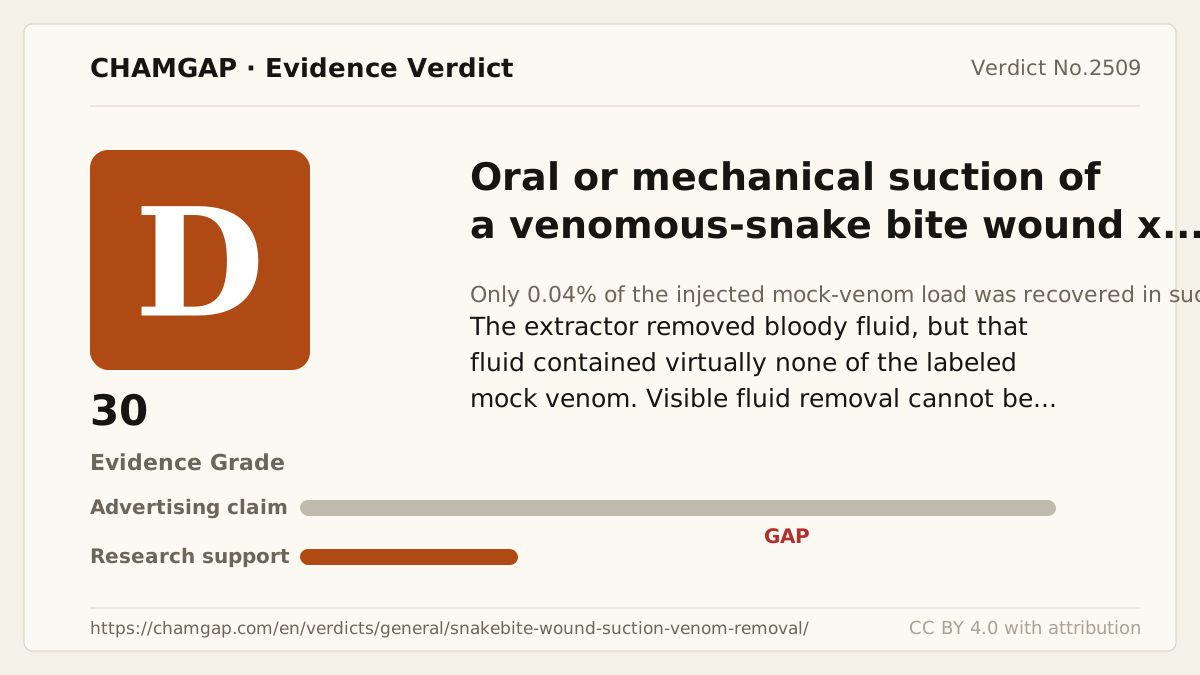
research showsThe grade is D. In eight male volunteers injected with radiolabeled mock venom, a Sawyer extractor recovered 0.04% of the injected load in suction fluid. The estimated reduction in leg and total-body burden was 2.0%, but its 95% confidence interval included no effect. This did not test real venom, necrosis, disability, or death, giving D with 30 points for meaningful venom removal.
ads claimBlood or fluid in the cup does not mean that a meaningful amount of venom was removed. Time should be spent keeping the patient still and obtaining emergency care, not applying suction.
Useful facts when choosing a product
- The Sawyer Extractor applies negative pressure to draw surface wound fluid into a cup.
- The human mock-venom experiment recovered 0.04% in suction fluid; the estimated 2.0% body-burden decrease had an interval including no effect.
- No duplicate verdict or matching PMID or DOI was found.
Chamgap Semantic Classification Code
Candidate index · review held
UNK.or-mechanical-suction-of-a-venomous-snake-bite-wound.oral.removal-of-a-clinically-meaningful-amount-of-venom.assess.noneUnknown > or mechanical suction of a venomous-snake bite wound > Oral > Removal of a clinically meaningful amount of venom > Association or change assessment > No intervention
An automated migration candidate, not an issued permanent code; exact claim scope remains under review. This machine-generated migration candidate helps retrieval but is not a permanent assignment. The original verdict ID and URL remain authoritative.
What the research actually shows
The Alberts experiment had no parallel untreated group and compared radiotracer counts before and after suction within each participant. It was unregistered, small, prospective, and reported no outside funding or support. A separate Nigerian hospital cohort compared three suction patients with 15 receiving no first aid; death or disability was 0/3 versus 1/15, RR 1.33 (95% CI 0.07-26.98), with severe imprecision and no confounding adjustment. Different interventions, endpoints, and estimands prevented treating these as replicated trials.
Why this is classified as D (30)
An independently conducted human experiment found virtually no recovery, but it involved eight people and a mock-venom surrogate; real-patient evidence included only three exposed patients and could not exclude benefit precisely. One strength feature gives D with 30 points.
Counterpoint. Mechanical and oral suction differ in pressure and contamination risk, but neither has human evidence of clinically meaningful venom removal.
Rejudgment record. Cross-check applied — We cross-checked mock-venom injection, suction timing, recovered counts and confidence intervals, and real-patient event counts and confounding limitations against the primary report and systematic review.
| Endpoint | S | Surrogate marker - laboratory or imaging measures |
| Replication | R1 | Single confirmatory trial |
| Independence | I2 | Decisive evidence is publicly or non-profit funded |
| Effect size | E0 | Null |
| Precision | C0 | The confidence interval leaves room for benefit |
Stored derived and displayed grades match; this is not a current recalculation or validity check (D).
Sub-claim grades by effect
This ingredient is marketed for several effects. A single overall grade blends strong and weak claims together, so each effect is graded separately here. The overall grade reflects the strongest disconfirming or core claim.
| Effect (sub-claim) | Grade | Basis |
|---|---|---|
| A mechanical extractor removes a substantial amount of mock venom from a bite wound. | D | Recovery was 0.04% of the injected load, with an interval including zero. |
| Bite-site suction reduces disability or death after real snakebite. | D | Only three suction patients were observed, excluding neither substantial benefit nor harm. |
Cross-check — AI research and Codex final gate
Evidence Table
| Study | Design | Sample | Funding | Endpoint | Result | Weight |
|---|---|---|---|---|---|---|
| Alberts et al., Ann Emerg Med 2004 | Prospective mock-venom suction experiment in healthy volunteers | Eight male volunteers | No outside funding or support | Radiotracer recovered in suction fluid and change in leg and total-body mock-venom burden | Suction fluid 38.5 counts/min (95% CI -33 to 110), 0.04% of load; burden decrease 1,832 counts/min, 2.0% (95% CI -3,863 to 200) | Pivotal human mock-venom surrogate experiment |
| Michael et al., Trans R Soc Trop Med Hyg 2011 | Nigerian hospital-based observational cohort | Three suction patients versus 15 receiving no first aid | Original-study funding was not verified in the accessible source set | Death or disability, antivenom amount, and hospital stay | Death or disability 0/3 versus 1/15, RR 1.33 (95% CI 0.07-26.98); no significant difference in antivenom amount or hospital stay | Very small indirect real-patient evidence |
Receipt — 2 References
All 2 cited sources were verified for existence at the original page (as of 2026-08-14).
Final verification and publication gate: Codex · Evidence date: 2026-08-14 · Corrections: none
Cite this verdict
[Chamgap] Snakebite wound suction x venom removal — Evidence Grade D·30. 2 cited sources checked. Source: https://chamgap.com/en/verdicts/general/snakebite-wound-suction-venom-removal/ · CC BY 4.0CC BY 4.0 — free to use with attribution; do not distort grades, numbers, or verdict meaning.
What this document does and does not do
Chamgap is an information source. It reports what research has and has not confirmed; it does not tell readers what to take or buy. That decision belongs to readers and, when needed, medical or legal professionals. This verdict reflects literature available up to the search date and may change as new research appears. Nothing here is medical advice.