
Smartphone use while walking,
does it really help with Reduced gait stability?
research showsThe grade is C. In a meta-analysis of 22 observational cross-sectional studies and 592 participants, gait velocity was 1.45 SD slower, 95% CI 1.24-1.66 slower, and step length was 1.01 SD shorter while using a phone. These are large changes, but the meta-analysis included single-session gait parameters rather than incidence of traffic crashes, collisions, injuries, or falls.
ads claimSlower speed and longer support time are measured facts, but they cannot be converted into a claimed multiple of accident risk. Real-road events and long-term falls require separate evidence.
Useful facts when choosing a product
- Investigators assigned phone tasks and compared them with no-phone walking.
- Pooled outcomes were measured gait parameters, not crashes, collisions, injuries, or falls.
- Egger P was .094 for gait velocity and .522 for step length, while step-length heterogeneity was 82%.
Chamgap Semantic Classification Code
Candidate index · review held
X.smartphone-dual-tasks-such.behavioral.gait-stability.reduce.UNKBehaviors, exposures and policies > Smartphone dual tasks such > Behavioral delivery > gait stability > Reduction claim > Unknown
An automated migration candidate, not an issued permanent code; exact claim scope remains under review. This machine-generated migration candidate helps retrieval but is not a permanent assignment. The original verdict ID and URL remain authoritative.
What the research actually shows
The meta-analysis registered as PROSPERO CRD42022358963 included 22 studies, 592 participants, and 10 countries. With phone use, gait velocity SMD was -1.45, 95% CI -1.66 to -1.24, I-squared 66%; step length -1.01, -1.43 to -0.59, I-squared 82%; and double-support time +1.09, 0.86-1.31, I-squared 42%. Texting and reading affected velocity, whereas calling, talking, and dialing were null for some outcomes. The pooled endpoints were gait parameters, not crashes or falls.
Why this is classified as C (50)
Twenty-two observational cross-sectional studies show large objective gait changes, but brief, small-study designs and surrogate rather than event outcomes give C with 50 points.
Counterpoint. Slower, wider-support gait may partly represent cautious compensation. Accident incidence cannot be calculated from these data.
Rejudgment record. Cross-check applied — Used the source classification of observational cross-sectional designs, verified PROSPERO registration, pooled estimates, and heterogeneity, and separated measured gait parameters from accident events absent from this meta-analysis
| Endpoint | S | Surrogate marker - laboratory or imaging measures |
| Replication | R1 | Single confirmatory trial |
| Independence | I1 | Mixed funding sources |
| Effect size | E+ | Meets the clinically important threshold |
Stored derived and displayed grades match; this is not a current recalculation or validity check (C).
Sub-claim grades by effect
This ingredient is marketed for several effects. A single overall grade blends strong and weak claims together, so each effect is graded separately here. The overall grade reflects the strongest disconfirming or core claim.
| Effect (sub-claim) | Grade | Basis |
|---|---|---|
| Reduced gait velocity | C | SMD was -1.45 with I-squared 66%. |
| Shorter step length | C | SMD was -1.01 with I-squared 82%. |
| More actual crashes or falls | ? | The meta-analysis did not pool event incidence. |
Cross-check — AI research and Codex final gate
Evidence Table
| Study | Design | Sample | Funding | Endpoint | Result | Weight |
|---|---|---|---|---|---|---|
| Zhang et al. 2023 | Systematic review and meta-analysis of observational cross-sectional designs | 22 studies and 592 participants | Cross-disciplinary projects 2021JC011; funding of included studies was not consolidated | Gait velocity, step length, and support time | Velocity SMD -1.45 (-1.66 to -1.24); step length -1.01 (-1.43 to -0.59) | Large objective gait effects, but this meta-analysis did not use actual events as endpoints |
Receipt — 1 References
All 1 cited sources were verified for existence at the original page (as of 2026-08-05).
Final verification and publication gate: Codex · Evidence date: 2026-08-05 · Corrections: none
Cite this verdict
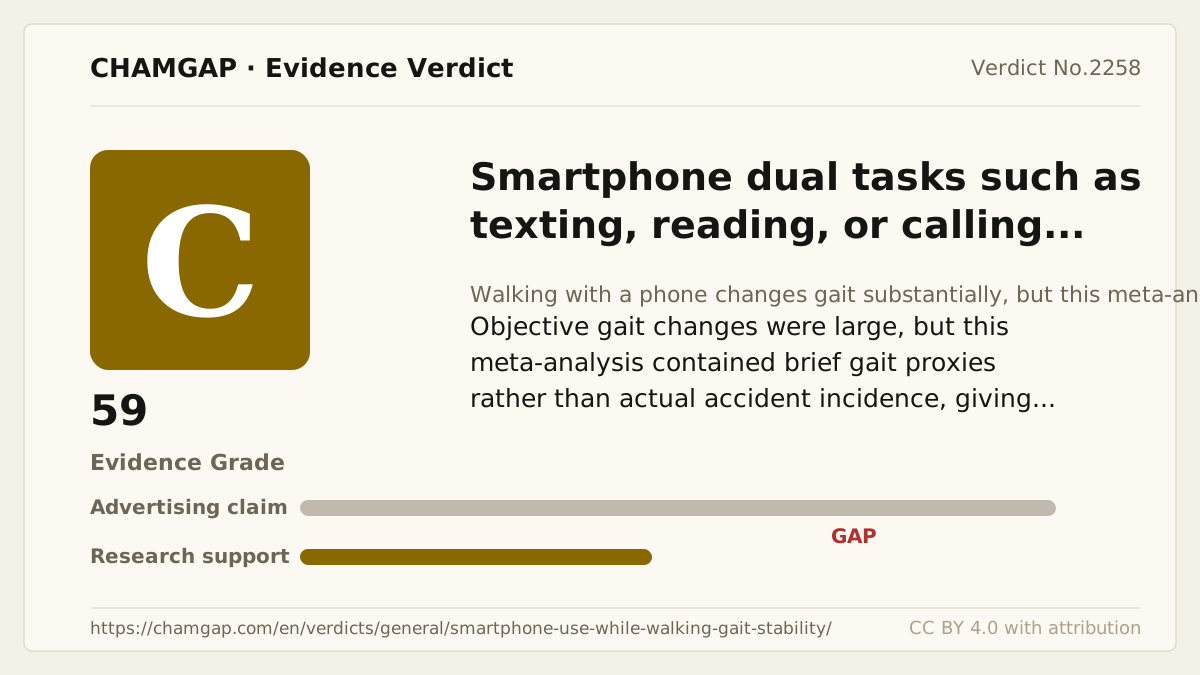
[Chamgap] Smartphone use while walking x gait stability — Evidence Grade C·50. 1 cited sources checked. Source: https://chamgap.com/en/verdicts/general/smartphone-use-while-walking-gait-stability/ · CC BY 4.0CC BY 4.0 — free to use with attribution; do not distort grades, numbers, or verdict meaning.
What this document does and does not do
Chamgap is an information source. It reports what research has and has not confirmed; it does not tell readers what to take or buy. That decision belongs to readers and, when needed, medical or legal professionals. This verdict reflects literature available up to the search date and may change as new research appears. Nothing here is medical advice.