
Small-bites midline closure,
does it really help with Reduced one-year incisional hernia versus at least 10 mm bites and 10 mm advances with 1 PDS Plus II?
research showsThe grade is B. STITCH randomized 560 patients and included 545 in the one-year outcome analysis. Incisional hernia occurred in 35/268 (13%) with small bites versus 57/277 (21%) with large bites, adjusted OR 0.52 (95% CI 0.31 to 0.87). The hard-event absolute difference was 8 points, but independent confirmation is absent and 15 randomized patients were not in the primary analysis, giving B with 72 points.
ads claimSmall bites are a trained operative technique involving spacing, bite depth, suture-to-wound ratio, and suture material. Not every closely spaced stitch can claim the STITCH result.
Useful facts when choosing a product
- Small bites used 5 mm by 5 mm placement and 2-0 PDS Plus II; controls used at least 10 mm by 10 mm and 1 PDS Plus II.
- The trial was registered as NCT01132209 and NTR2052 with 12-month incisional hernia as primary.
- The 2026 long-term report is follow-up of the same STITCH cohort, not independent randomization.
Chamgap Semantic Classification Code
Candidate index · review held
UNK.continuous-small-bites-closure-using-5-mm-bites-and-5-mm-advances-with-2-0-pds-plus-ii-after-elective-midline-laparotomy.UNK.incisional-hernia.reduce.UNKUnknown > Continuous small-bites closure using 5 mm bites and 5 mm advances with 2-0 PDS Plus II after elective midline laparotomy > Unknown > incisional hernia > Reduction claim > Unknown
An automated migration candidate, not an issued permanent code; exact claim scope remains under review. This machine-generated migration candidate helps retrieval but is not a permanent assignment. The original verdict ID and URL remain authoritative.
What the research actually shows
The Dutch multicenter STITCH trial randomized 560 elective midline laparotomy patients. Patients and study investigators were masked, and 12-month incisional hernia was prespecified. Among 545 analyzed, events were 35/268 versus 57/277, adjusted OR 0.52 (0.31 to 0.87). Ethicon Investigator Initiated Clinical Research Funding Grant 09-107 and Erasmus MC Efficiency Research Grant 2008-8106 jointly funded it; the report states funders had no role in design, conduct, analysis, interpretation, or writing. The 2026 13-year report follows the same NCT01132209 participants and is not a separate trial.
Why this is classified as B (72)
A large mixed-funded randomized trial substantially reduced a hard clinical event, but incomplete all-randomized analysis and no independent confirmation give B with 72 points.
Counterpoint. Verdict 2401 is B with 76 points for prophylactic mesh, a different intervention that was not pooled with suture-bite technique.
Rejudgment record. Cross-check applied — The STITCH paper, NCT01132209, NTR2052, and 2026 long-term report were checked for primary outcome, analyzed count, funding, and same-trial status
| Endpoint | H | Hard endpoint - actual events such as death |
| Replication | R1 | Single confirmatory trial |
| Independence | I1 | Mixed funding sources |
| Effect size | E+ | Meets the clinically important threshold |
Stored derived and displayed grades match; this is not a current recalculation or validity check (B).
Sub-claim grades by effect
This ingredient is marketed for several effects. A single overall grade blends strong and weak claims together, so each effect is graded separately here. The overall grade reflects the strongest disconfirming or core claim.
| Effect (sub-claim) | Grade | Basis |
|---|---|---|
| Reduced one-year incisional hernia with the closure-technique package | B | Rates were 13% versus 21%, adjusted OR 0.52. |
| An isolated effect of 5 mm spacing alone | ? | Suture caliber and needle also differed, so spacing alone cannot be isolated. |
Cross-check — AI research and Codex final gate
Evidence Table
| Study | Design | Sample | Funding | Endpoint | Result | Weight |
|---|---|---|---|---|---|---|
| Deerenberg EB et al. 2015 STITCH | Multicenter patient- and follow-up-investigator-masked randomized trial | 560 randomized; 545 in one-year analysis, 268 versus 277 | Ethicon grant 09-107 and Erasmus MC grant 2008-8106 | Primary 12-month incisional hernia outcome | 35/268 (13%) versus 57/277 (21%), adjusted OR 0.52 (0.31 to 0.87) | Only direct large confirmatory trial |
Receipt — 1 References
All 1 cited sources were verified for existence at the original page (as of 2026-08-15).
Final verification and publication gate: Codex · Evidence date: 2026-08-15 · Corrections: none
Cite this verdict
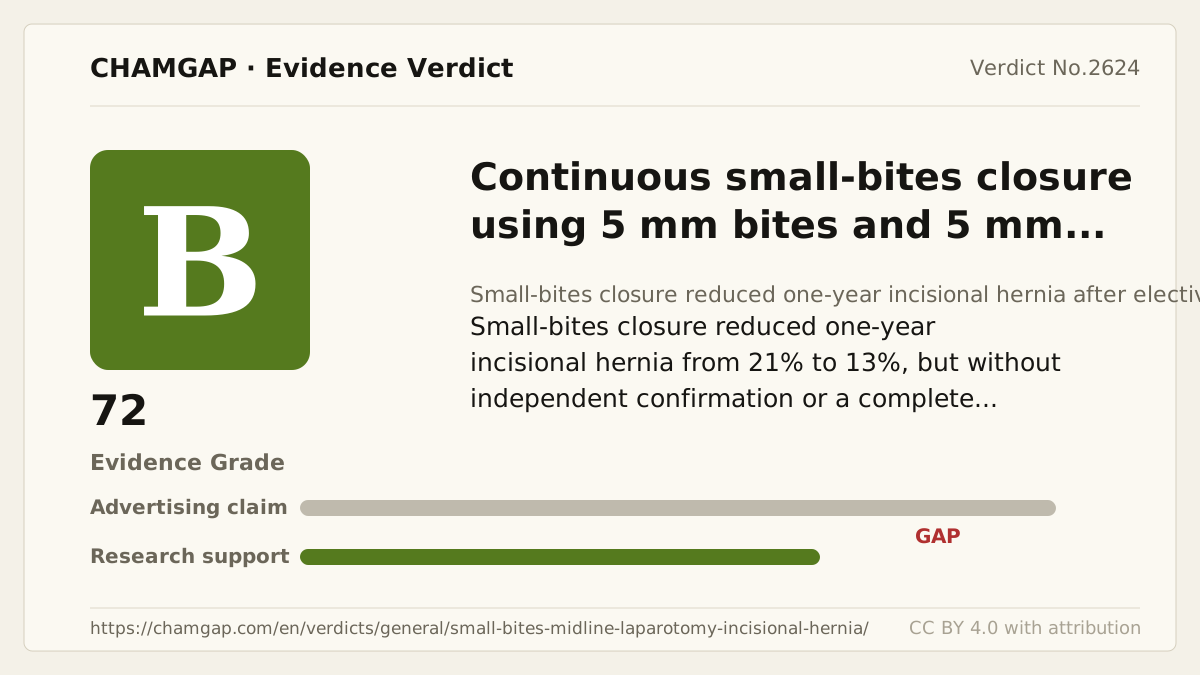
[Chamgap] Small-bites midline closure x reduced one-year incisional hernia — Evidence Grade B·72. 1 cited sources checked. Source: https://chamgap.com/en/verdicts/general/small-bites-midline-laparotomy-incisional-hernia/ · CC BY 4.0CC BY 4.0 — free to use with attribution; do not distort grades, numbers, or verdict meaning.
What this document does and does not do
Chamgap is an information source. It reports what research has and has not confirmed; it does not tell readers what to take or buy. That decision belongs to readers and, when needed, medical or legal professionals. This verdict reflects literature available up to the search date and may change as new research appears. Nothing here is medical advice.