
Sit-stand desk,
does it really help with Improved cardiovascular and metabolic health?
research showsThe grade is D with 28 points. Sitting fell by 80.2 minutes per eight-hour workday (95% CI -129.0 to -31.4), but that is a behavioral endpoint, not a health endpoint. Contrary to the cardiometabolic-health claim, glucose, triglycerides, flow-mediated dilation, blood pressure, and carotid intima-media thickness were mostly null. The only positive result was total cholesterol, -0.40 mmol/L (-0.79 to -0.003), P=.049, one of multiple secondary outcomes.
ads claimAbout 80 fewer sitting minutes is an accepted behavior measurement, not proof of preventing heart attack, stroke, or diabetes.
Useful facts when choosing a product
- Sitting fell 80.2 minutes and standing rose 72.9 minutes per eight-hour workday.
- Total cholesterol fell 0.40 mmol/L, while glucose, triglycerides, blood pressure, and carotid thickness were not significant.
- Ergotron supplied and installed WorkFit-A units and provided basic training but reported no role in conduct or analysis.
Chamgap Semantic Classification Code
Candidate index · review held
UNK.manually-adjustable-sit-stand-workstation-provided-to-office-workers.UNK.cardiovascular-and-metabolic-health.improve.MULTIUnknown > manually adjustable sit-stand workstation provided to office workers > Unknown > cardiovascular and metabolic health > Improvement claim > Multiple: primary unresolved
An automated migration candidate, not an issued permanent code; exact claim scope remains under review. This machine-generated migration candidate helps retrieval but is not a permanent assignment. The original verdict ID and URL remain authoritative.
What the research actually shows
Graves et al. individually randomized 47 asymptomatic office workers at one organization, 26 to a desk and 21 to no intervention; this was not a cluster trial. Fifteen-minute paper diaries measured sitting. Eight-week blood data covered 20 versus 17 and vascular data 24 versus 19, small complete-case subsamples. Total cholesterol alone changed by -0.40 mmol/L (-0.79 to -0.003), P=.049; glucose, triglycerides, flow-mediated dilation, blood pressure, and carotid intima-media thickness were mostly null. The study ran from August to December 2013, while NCT02496507 was posted in July 2015, making registration retrospective. Unblinding, diary self-report, short duration, retrospective registration, small complete-case subsamples, multiple secondary outcomes, and a no-intervention control raise bias concerns. An attention- and expectation-matched active control was feasible.
Why this is classified as D (28)
The behavioral endpoint was separated from health benefit. Mostly null health surrogates, one borderline secondary cholesterol result, 47 participants, eight weeks, complete-case subsamples, retrospective registration, and no-intervention control give D with 28 points.
Counterpoint. A brief trial is not expected to show events, which is precisely why it cannot support long-term disease-prevention marketing.
Rejudgment record. Cross-check applied — Separated retrospective-registered sitting primary outcome from secondary health surrogates and checked adjusted effects, analyzed samples, and Ergotron support
| Endpoint | S | Surrogate marker - laboratory or imaging measures |
| Replication | R1 | Single confirmatory trial |
| Independence | I1 | Mixed funding sources |
| Effect size | E0 | Null |
| Precision | C0 | The confidence interval leaves room for benefit |
Stored derived and displayed grades match; this is not a current recalculation or validity check (D).
Sub-claim grades by effect
This ingredient is marketed for several effects. A single overall grade blends strong and weak claims together, so each effect is graded separately here. The overall grade reflects the strongest disconfirming or core claim.
| Effect (sub-claim) | Grade | Basis |
|---|---|---|
| Reduced workplace sitting time | C | The registered primary endpoint fell by 80.2 minutes per day. |
| Improved total cholesterol | C | The secondary difference was -0.40 mmol/L, about 0.43 SD. |
| Prevention of cardiovascular disease or diabetes | ? | The eight-week trial did not measure clinical events. |
Cross-check — AI research and Codex final gate
Evidence Table
| Study | Design | Sample | Funding | Endpoint | Result | Weight |
|---|---|---|---|---|---|---|
| Graves LEF et al. BMC Public Health 2015 | Individually randomized open-label no-intervention controlled trial | 47 randomized (26/21); blood outcomes 20/17 and vascular outcomes 24/19 available cases | Ergotron Ltd supplied desks, installation, and training; no other financial disclosure reported | Registered sitting-time primary outcome; eight-week secondary cardiometabolic surrogates | Sitting -80.2 min/8 h (-129.0 to -31.4); total cholesterol -0.40 mmol/L (-0.79 to -0.003); multiple other markers null | Clear behavioral effect but exploratory health evidence |
Receipt — 2 References
All 2 cited sources were verified for existence at the original page (as of 2026-08-05).
Final verification and publication gate: Codex · Evidence date: 2026-08-05 · Corrections: none
Cite this verdict
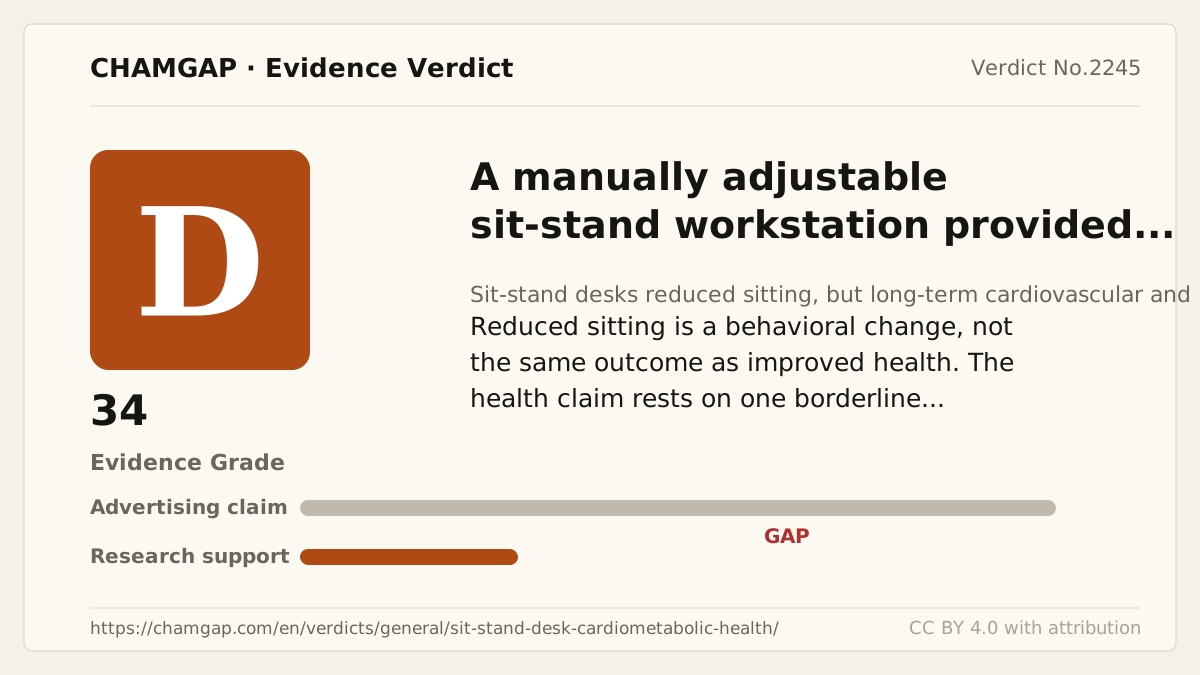
[Chamgap] Sit-stand desk x cardiometabolic health — Evidence Grade D·28. 2 cited sources checked. Source: https://chamgap.com/en/verdicts/general/sit-stand-desk-cardiometabolic-health/ · CC BY 4.0CC BY 4.0 — free to use with attribution; do not distort grades, numbers, or verdict meaning.
What this document does and does not do
Chamgap is an information source. It reports what research has and has not confirmed; it does not tell readers what to take or buy. That decision belongs to readers and, when needed, medical or legal professionals. This verdict reflects literature available up to the search date and may change as new research appears. Nothing here is medical advice.