
Single-dose oral dexamethasone,
does it really help with Reduced return visits and persistent symptoms in mild pediatric croup?
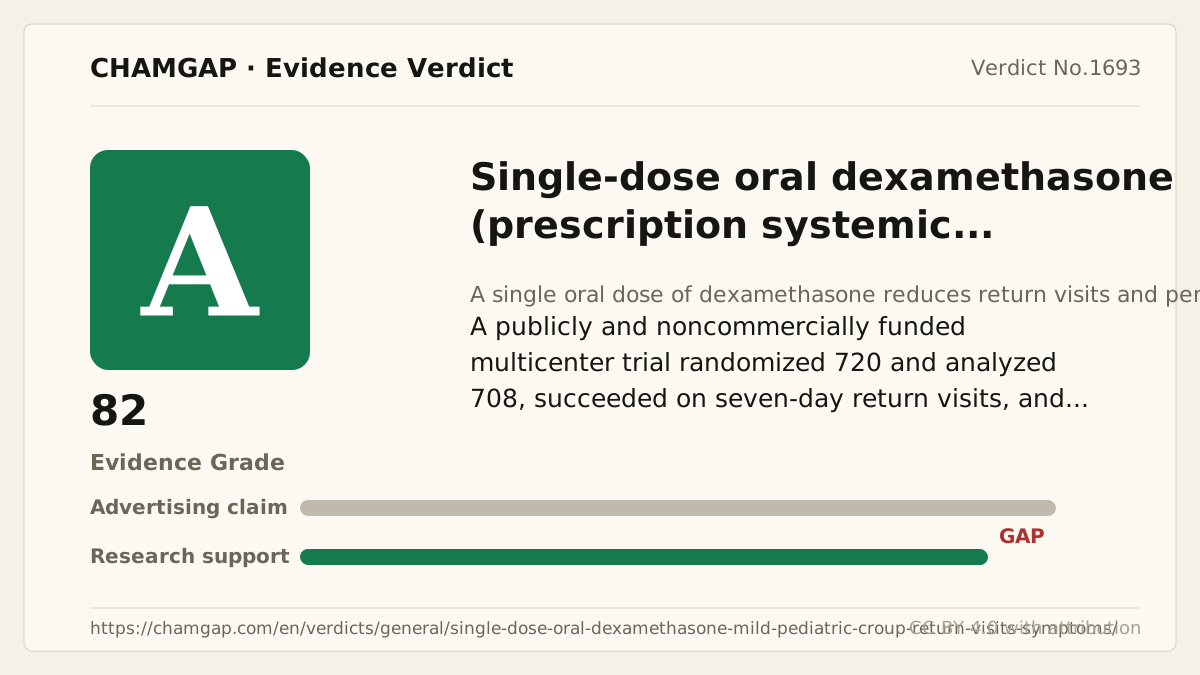
research showsSingle-dose oral dexamethasone is rated A because it reduces return visits and persistent symptoms in mild pediatric croup. Bjornson 2004 was a multicenter randomized trial with public and nonprofit funding; it randomized 720 children and analyzed 708. The prespecified seven-day return-visit primary endpoint succeeded at 7.3% versus 15.3%, an 8.0-percentage-point difference (95% CI 3.3 to 12.5), P<.001. Large independent replication across 45 Cochrane trials and 5,888 children supports A with 82 points. About 18% of included trials had industry funding and about 55% did not report funding, so the entire evidence base cannot be described as publicly or nonmanufacturer funded.
ads claimMarketing can broaden one steroid dose into a remedy for every cough or noisy breath in a child. The evidence applies to clinically diagnosed croup. Drooling, toxic appearance, respiratory failure, or possible foreign-body aspiration requires urgent assessment.
Useful facts when choosing a product
- The pivotal trial used one oral dose of dexamethasone 0.6 mg/kg, capped at 20 mg.
- Severity and local guidance can lead to a lower dose, another route, nebulized epinephrine, or observation.
- Dexamethasone is prescription medicine, and diagnosis and weight-based dosing require a clinician.
- A single dose is generally well tolerated, but vomiting, behavioral or sleep changes, and temporary glucose elevation can occur.
Chamgap Semantic Classification Code
Candidate index · review held
M.oral-dexamethasone.oral.return-visits-and-persistent-symptoms-in-mild-pediatric-croup.reduce.placeboMedicinal interventions > oral dexamethasone > Oral > return visits and persistent symptoms in mild pediatric croup > Reduction claim > Placebo
An automated migration candidate, not an issued permanent code; exact claim scope remains under review. This machine-generated migration candidate helps retrieval but is not a permanent assignment. The original verdict ID and URL remain authoritative.
What the research actually shows
Bjornson et al. 2004 randomized 720 children with mild croup at four pediatric emergency departments under double masking to dexamethasone 0.6 mg/kg once or placebo. The randomized groups contained 359 and 361 children; 354 in each group, 708 total, had seven-day return-visit data and entered the primary outcome analysis. Return visits were 26 of 354 versus 54 of 354, and symptom resolution was faster. The 2023 Aregbesola et al. Cochrane review included 45 trials and 5,888 children and concluded that glucocorticoids improved the two-hour croup score, shortened hospital stay, and reduced returns or readmissions.
Why this is classified as A (82)
Bjornson 2004 was a publicly and noncommercially funded multicenter randomized trial that randomized 720 and analyzed 708; its prespecified seven-day return-visit primary endpoint succeeded at 7.3% versus 15.3%, an 8.0-percentage-point difference, P<.001. Independent replication across 45 Cochrane trials and 5,888 children means the rule 2-b manufacturer-only ceiling does not apply. About 18% of included trials had industry funding and about 55% did not report funding, preventing a claim that all evidence was publicly or nonmanufacturer funded and keeping the result below the top of A at A with 82 points.
Counterpoint. The absolute reduction in return visits was about 8 percentage points, so most children recovered without returning even on placebo, but reductions in overall burden and time to recovery were consistent.
Rejudgment record. Cross-check applied — Applied the successful prespecified seven-day return-visit endpoint in a publicly and noncommercially funded multicenter trial that randomized 720 and analyzed 708, plus large independent replication across 45 trials and 5,888 children; did not apply the rule 2-b ceiling but deducted because about 18% of included trials had industry funding and about 55% did not report funding
Sub-claim grades by effect
This ingredient is marketed for several effects. A single overall grade blends strong and weak claims together, so each effect is graded separately here. The overall grade reflects the strongest disconfirming or core claim.
| Effect (sub-claim) | Grade | Basis |
|---|---|---|
| Reduction in croup-related return visits within seven days | A | The actual primary analysis of 708 succeeded with 7.3% versus 15.3%. |
| Shorter duration of persistent mild-croup symptoms | B | Symptoms resolved faster in the pivotal trial, P=.003. |
| Reduction in child sleep lost because of croup | B | Mean sleep loss decreased to 2.9 hours versus 4.2 hours. |
Cross-check — AI research and Codex final gate
Evidence Table
| Study | Design | Sample | Funding | Endpoint | Result | Weight |
|---|---|---|---|---|---|---|
| Bjornson CL et al. 2004 | Randomized double-blind placebo-controlled trial at four pediatric emergency departments | 720 randomized (359/361); actual primary analysis of seven-day return data in 708 (354/354) | Public and nonprofit funding from the Canadian Institutes of Health Research and three children's hospital foundations or institutes; no manufacturer sponsorship | Primary: return to a health care provider for croup within seven days | Primary endpoint succeeded: 26/354 (7.3%) versus 54/354 (15.3%), P<.001. | Pivotal large independent direct clinical outcome |
| Aregbesola A et al. 2023 | Cochrane systematic review and meta-analysis of randomized trials | 45 randomized trials and 5,888 children | Cochrane Child Health and academic support; no manufacturer funding for the review itself | Croup score, length of stay, and return visits or readmissions | Glucocorticoids improved symptoms at two hours, length of stay, and return visits or readmissions. | Broad synthesis of replicated evidence |
| Geelhoed GC et al. 1996 | Randomized double-blind placebo-controlled trial at the emergency department of a tertiary pediatric hospital in Australia (a single oral dose of dexamethasone 0.15 mg/kg versus placebo) | 100 outpatient children with mild croup aged 4 to 122 months | Could not be confirmed | Primary: return to medical care with ongoing croup | All eight returns to medical care with ongoing croup occurred in the placebo group (one admitted) and none in the dexamethasone group. There was no reported difference in duration of croup symptoms, duration of viral symptoms, or returns for other reasons. | Small independent replication by a different team (same direction on the return-visit endpoint, at a lower dose) |
Receipt — 3 References
All 3 cited sources were verified for existence at the original page (as of 2026-08-11).
Final verification and publication gate: Codex · Evidence date: 2026-08-11 · Corrections: none
Cite this verdict
[Chamgap] Single-dose oral dexamethasone x reduced return visits and persistent symptoms in mild pediatric croup — Evidence Grade A·82. 3 cited sources checked. Source: https://chamgap.com/en/verdicts/general/single-dose-oral-dexamethasone-mild-pediatric-croup-return-visits-symptoms/ · CC BY 4.0CC BY 4.0 — free to use with attribution; do not distort grades, numbers, or verdict meaning.
What this document does and does not do
Chamgap is an information source. It reports what research has and has not confirmed; it does not tell readers what to take or buy. That decision belongs to readers and, when needed, medical or legal professionals. This verdict reflects literature available up to the search date and may change as new research appears. Nothing here is medical advice.