
Showering within 12 hours after suturing,
does it really help with No greater wound-infection risk than keeping the wound dry and covered for 48 hours?
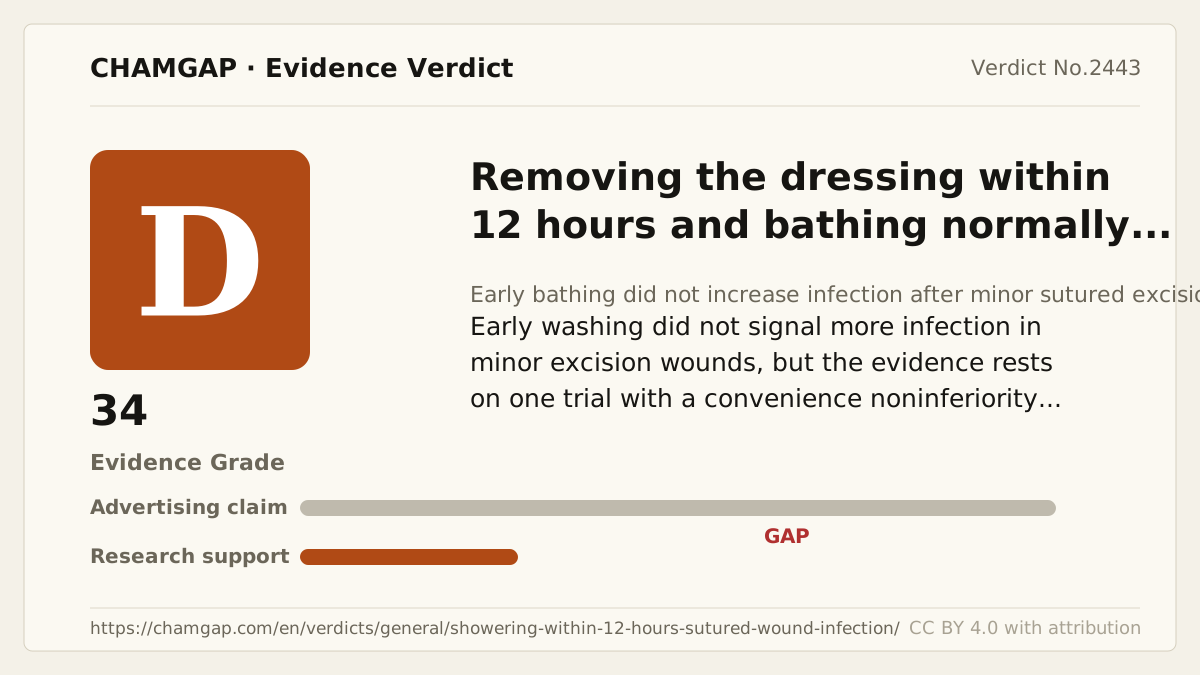
research showsThe grade is D with 34 points. Among 857 patients with minor skin excisions closed with nonabsorbable sutures in Australian general practice, infection occurred in 35/415 (8.4%) after dressing removal and bathing within 12 hours versus 39/442 (8.9%) after 48 hours dry and covered. The risk difference was about -0.5 points and the one-sided 95% upper bound for increased infection was 2.8 points. This does not show infection reduction; it shows no increase beyond the trial’s chosen margin.
ads claimThe result does not require a waterproof bandage and does not prove that every surgical or procedural wound is ready for water at 12 hours. Korean waterproof dressings are separate products; timing depends on procedure, closure, drains, and clinician instructions.
Useful facts when choosing a product
- Participants had sutured minor skin excisions, not traumatic lacerations.
- The comparator kept a dressing dry for 48 hours, not indefinitely.
- The early group removed the dressing within 12 hours and bathed normally rather than retaining a waterproof dressing.
Chamgap Semantic Classification Code
Candidate index · review held
UNK.removing-the-dressing-within-and-bathing-normally-after-primary-closure-of-a-minor-skin-excision.UNK.no-greater-wound-infection-risk-than-keeping-the-wound-dry-and-covered-for.assess.UNKUnknown > Removing the dressing within and bathing normally after primary closure of a minor skin excision > Unknown > No greater wound-infection risk than keeping the wound dry and covered for > Association or change assessment > Unknown
An automated migration candidate, not an issued permanent code; exact claim scope remains under review. This machine-generated migration candidate helps retrieval but is not a permanent assignment. The original verdict ID and URL remain authoritative.
What the research actually shows
Allocation used a ball-draw method. The dry group kept the dressing dry for 48 hours; the wet group removed it within 12 hours and bathed normally. Infection within 30 days meant purulent discharge, GP diagnosis, or antibiotic initiation; stitch abscess was excluded. Doctors or nurses assessed wounds at suture removal without masking. Funding was stated as “a novice research scholarship from the primary health care research and development fund,” with the work independent of the funder.
Why this is classified as D (34)
The difference was null, but this was one noninferiority trial with an unvalidated design margin and unblinded infection assessment, giving D with 34 points.
Counterpoint. The trial addressed no material increase in infection, not a reduction in infection.
Rejudgment record. Cross-check applied — A single noninferiority RCT found a null difference, but its margin was not a validated clinical threshold and infection assessment was unblinded
| Endpoint | H | Hard endpoint - actual events such as death |
| Replication | R1 | Single confirmatory trial |
| Independence | I2 | Decisive evidence is publicly or non-profit funded |
| Effect size | E0 | Null |
| Precision | C0 | The confidence interval leaves room for benefit |
Stored derived and displayed grades match; this is not a current recalculation or validity check (D).
Sub-claim grades by effect
This ingredient is marketed for several effects. A single overall grade blends strong and weak claims together, so each effect is graded separately here. The overall grade reflects the strongest disconfirming or core claim.
| Effect (sub-claim) | Grade | Basis |
|---|---|---|
| Bathing within 12 hours does not increase infection versus 48 hours dry | D | Rates were 8.4% versus 8.9%, but the margin was not a validated clinical threshold. |
| Bathing within 12 hours reduces infection | D | Superiority or infection reduction was not established. |
Cross-check — AI research and Codex final gate
Evidence Table
| Study | Design | Sample | Funding | Endpoint | Result | Weight |
|---|---|---|---|---|---|---|
| Heal C et al. 2006 | Multicenter randomized noninferiority trial | 870 randomized; 857 assessed (415/442) | Novice research scholarship from the Primary Health Care Research and Development Fund | Infection within 30 days after sutured excision | 35/415 (8.4%) vs 39/442 (8.9%); risk difference about -0.5 points, one-sided 95% upper bound 2.8 points | Only direct randomized trial |
Receipt — 2 References
All 2 cited sources were verified for existence at the original page (as of 2026-08-08).
Final verification and publication gate: Codex · Evidence date: 2026-08-08 · Corrections: none
Cite this verdict
[Chamgap] Showering within 12 hours after suturing x wound-infection risk — Evidence Grade D·34. 2 cited sources checked. Source: https://chamgap.com/en/verdicts/general/showering-within-12-hours-sutured-wound-infection/ · CC BY 4.0CC BY 4.0 — free to use with attribution; do not distort grades, numbers, or verdict meaning.
What this document does and does not do
Chamgap is an information source. It reports what research has and has not confirmed; it does not tell readers what to take or buy. That decision belongs to readers and, when needed, medical or legal professionals. This verdict reflects literature available up to the search date and may change as new research appears. Nothing here is medical advice.