
Septoplasty,
does it really help with Improved patient-reported symptoms and quality of life in nasal obstruction caused by a deviated septum?
research showsSeptoplasty earns C with 56 points despite a large symptom benefit because two design flaws impose a ceiling. Of 378 randomized participants, 307 entered the six-month primary analysis; SNOT-22 was 19.9 versus 39.5, adjusted difference -20.0 points (95% CI -23.6 to -16.4), P<0.001.
ads claimSurgery does not guarantee immediate elimination of every blockage or improvement in objective airflow. The meta-analysis found no clear PNIF difference.
Useful facts when choosing a product
- Of 378 randomized participants, 307 entered the six-month primary analysis, an 18.8% attrition rate.
- The open-label comparison used patient-reported SNOT-22 as its primary outcome.
- The nine-point threshold was borrowed from another surgical population, not validated specifically for septoplasty.
Chamgap Semantic Classification Code
Candidate index · review held
P.septoplasty.procedural.patient-reported-symptoms-and-quality-of-life-in-nasal-obstruction-caused-by-a-deviated-septum.improve.activeProcedures, devices and tests > Septoplasty > Procedural > patient-reported symptoms and quality of life in nasal obstruction caused by a deviated septum > Improvement claim > Active comparator
An automated migration candidate, not an issued permanent code; exact claim scope remains under review. This machine-generated migration candidate helps retrieval but is not a permanent assignment. The original verdict ID and URL remain authoritative.
What the research actually shows
Across 17 NHS sites, 378 participants were randomized to surgery, 188, or medical management, 190; the six-month analysis included 152 and 155. SNOT-22 was 19.9 versus 39.5, adjusted difference -20.0 points (95% CI -23.6 to -16.4), P<0.001. The nine-point threshold was not validated for septoplasty but borrowed by rounding an 8.9-point value from another surgical population.
Why this is classified as C (56)
Large symptom improvement and replication are limited by 18.8% attrition and an unblinded patient-reported primary outcome, imposing C with 56 points.
Counterpoint. Bleeding, infection, septal perforation, and persistent symptoms remain possible.
Rejudgment record. Cross-check applied — Large patient-reported benefit with a ceiling imposed for 18.8% attrition and an unblinded self-rated outcome
| Endpoint | P | Symptom or function itself is the target - including patient reports and performance tests |
| Replication | R2 | Independently replicated across trials |
| Independence | I2 | Decisive evidence is publicly or non-profit funded |
| Effect size | E+ | Meets the clinically important threshold |
Stored derived and displayed grades match; this is not a current recalculation or validity check (C).
Sub-claim grades by effect
This ingredient is marketed for several effects. A single overall grade blends strong and weak claims together, so each effect is graded separately here. The overall grade reflects the strongest disconfirming or core claim.
| Effect (sub-claim) | Grade | Basis |
|---|---|---|
| Improved nasal symptoms at six months | B | The adjusted difference exceeded the nine-point threshold. |
| Improved nasal symptoms at twelve months | B | The effect was replicated in a three-trial meta-analysis. |
| Improved sinonasal quality of life | B | Patient-reported outcomes and SF-36 improved in NAIROS. |
Cross-check — AI research and Codex final gate
Evidence Table
| Study | Design | Sample | Funding | Endpoint | Result | Weight |
|---|---|---|---|---|---|---|
| Carrie S et al. 2023 (NAIROS) | Seventeen-center open-label randomized active-control trial | 378 randomized; 307 in the six-month primary analysis | Public funding from the United Kingdom NIHR Efficacy and Mechanism Evaluation program | Primary six-month SNOT-22 outcome | Adjusted difference -20.0 points (95% CI -23.6 to -16.4), P<0.001; exceeded the nine-point benchmark borrowed from another surgical population | Key publicly funded confirmatory trial |
| Taha HI et al. 2025 | Systematic review and meta-analysis of randomized trials | Three trials and 721 participants | No external study funding reported; no conflicts declared | NOSE, SNOT-22, and nasal airflow | Symptom benefit replicated at six and twelve months; no clear difference at three months or in PNIF | Multiple-trial replication |
| Hopkins C et al. 2009 | Prospective cohort validation of an outcome instrument | 3,128 participants at 87 NHS hospitals | Academic data from a United Kingdom NHS national comparative audit | SNOT-22 minimally important difference derived in another surgical population | Minimal important difference was 8.9 points | Source of the borrowed benchmark |
Receipt — 3 References
All 3 cited sources were verified for existence at the original page (as of 2026-07-24).
Final verification and publication gate: Codex · Evidence date: 2026-07-24 · Corrections: none
Cite this verdict
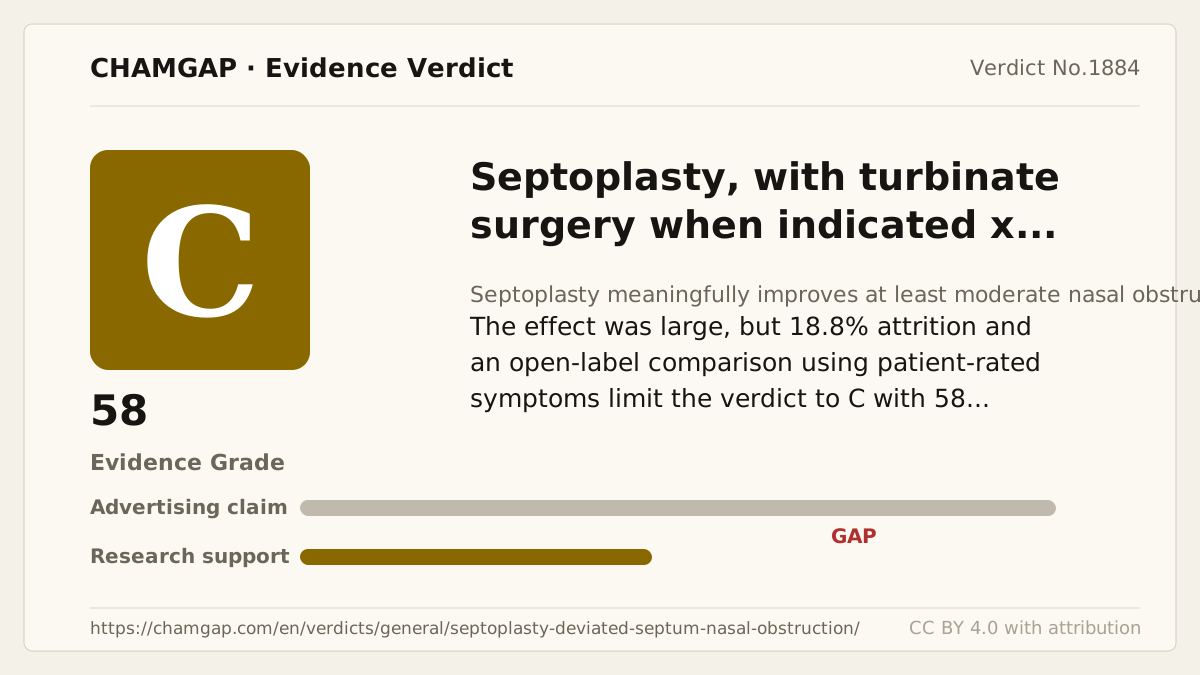
[Chamgap] Septoplasty x nasal obstruction from a deviated septum — Evidence Grade C·56. 3 cited sources checked. Source: https://chamgap.com/en/verdicts/general/septoplasty-deviated-septum-nasal-obstruction/ · CC BY 4.0CC BY 4.0 — free to use with attribution; do not distort grades, numbers, or verdict meaning.
What this document does and does not do
Chamgap is an information source. It reports what research has and has not confirmed; it does not tell readers what to take or buy. That decision belongs to readers and, when needed, medical or legal professionals. This verdict reflects literature available up to the search date and may change as new research appears. Nothing here is medical advice.