
Self-assembling peptide P11-4,
does it really help with Arrest or regression of early occlusal caries in children and adolescents?
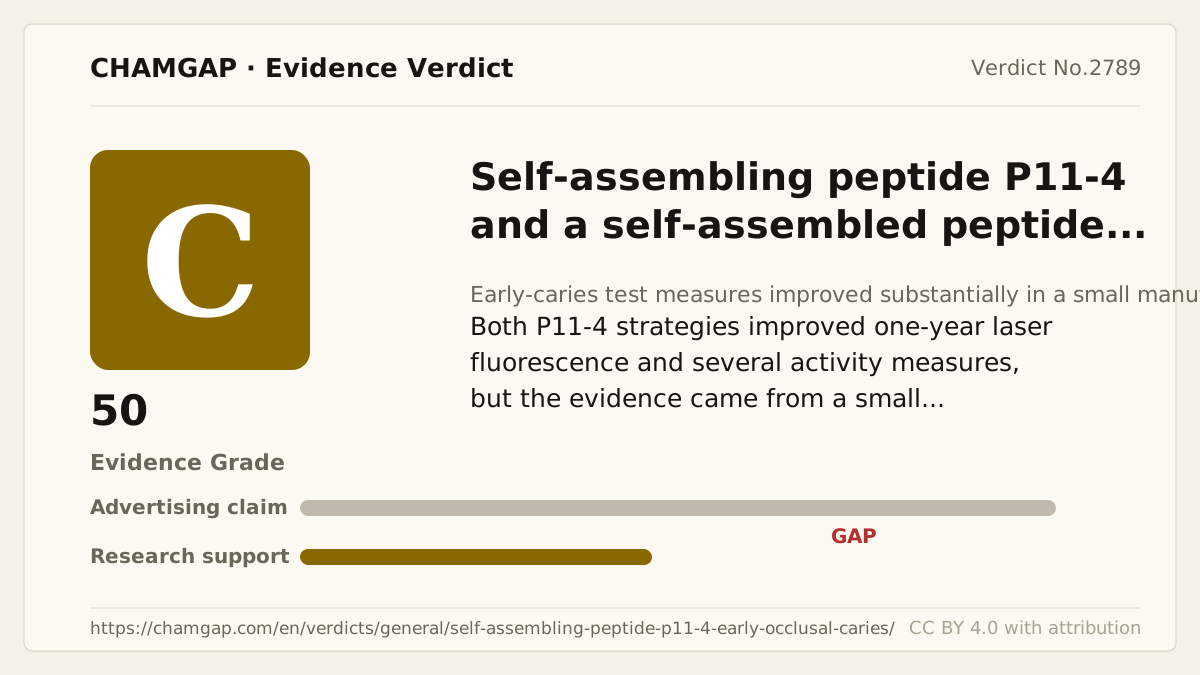
research showsThe grade is C. The three-arm trial randomized 90 participants and analyzed 77 at day 360: 23 controls and 27 in each P11-4 arm. Laser-fluorescence change was +5.5 with fluoride varnish, -8.5 with P11-4 plus varnish, and -7.7 with P11-4 plus home peptide matrix, both comparisons P<.0005. Between-group change differences were 14.0 and 13.2 points; standardization using reported change SDs gives approximately 2.0 and 1.7, large effects. However, this was a surrogate, small completer trial with active control only and substantial manufacturer material and personnel involvement, giving C with 50 points.
ads claimClaims that P11-4 regenerated cavities or eliminated the need for fillings exceed the evidence. The trial established improvement in laser fluorescence and activity classifications for early noncavitated lesions over one year.
Useful facts when choosing a product
- Fluoride toothpaste in verdict 701 is A with 92 points, xylitol in verdict 748 is C with 45 points, fissure sealants in verdict 1841 are A with 86 points, supervised fluoride brushing in verdict 2515 is C with 50 points, and the Hall technique in verdict 2712 is B with 70 points. Those address prevention exposures or restoration of carious primary teeth rather than P11-4 treatment of early lesions.
- Water flossing in verdict 2359 is C with 46 points and mouthwash in verdict 2707 is C with 50 points for gingival or plaque control; periodontal treatment in pregnancy in verdict 2226 is D with 34 points for preterm birth. They do not overlap this early occlusal-caries question.
- Credentis supplied the P11-4 intervention material, not the laser assessment device.
Chamgap Semantic Classification Code
Candidate index · review held
UNK.self-assembling-peptide-p11-4-and-a-self-assembled-peptide-matrix.UNK.arrest-or-regression-of-early-occlusal-caries-and-adolescents.assess.MULTIUnknown > Self-assembling peptide P11-4 and a self-assembled peptide matrix > Unknown > Arrest or regression of early occlusal caries and adolescents > Association or change assessment > Multiple: primary unresolved
An automated migration candidate, not an issued permanent code; exact claim scope remains under review. This machine-generated migration candidate helps retrieval but is not a permanent assignment. The original verdict ID and URL remain authoritative.
What the research actually shows
Ninety children and adolescents with early noncavitated occlusal lesions were randomized equally to fluoride varnish, P11-4 plus fluoride varnish, or P11-4 plus twice-weekly home peptide matrix. By day 360, seven controls and three participants in each test arm had been lost, leaving 23/27/27. Laser-fluorescence change was the primary parameter and used an ANCOVA hierarchical model adjusting for baseline and covariates. Registration NCT03780270 occurred in December 2018, after recruitment and follow-up ended, so it was not prospective. There was no early stopping. The article disclosed that credentis provided the intervention material, employee C. Bommer was an author, and M. Heinzel-Gutenbrunner received compensation for clinical-study work. No public or nonprofit grant was identified in the article, leaving the confirmed efficacy evidence entirely manufacturer-involved. Avoidable limitations were sample size below 200, completer analysis, and active control without placebo.
Why this is classified as C (50)
The test-measure effect was very large, but a manufacturer-involved single small completer trial with active control only gives C with 50 points.
Counterpoint. C does not deny improvement in early-caries measures. It reflects missing independent replication and long-term tooth-centered outcomes.
Rejudgment record. Cross-check applied — Calculates between-group magnitude from reported change means and SDs and cross-checks analysis counts, retrospective registration, material supply, employee authorship, and compensation disclosures
| Endpoint | S | Surrogate marker - laboratory or imaging measures |
| Replication | R1 | Single confirmatory trial |
| Independence | I0 | Evidence comes only from manufacturer studies |
| Effect size | E+ | Meets the clinically important threshold |
Stored derived and displayed grades match; this is not a current recalculation or validity check (C).
Sub-claim grades by effect
This ingredient is marketed for several effects. A single overall grade blends strong and weak claims together, so each effect is graded separately here. The overall grade reflects the strongest disconfirming or core claim.
| Effect (sub-claim) | Grade | Basis |
|---|---|---|
| Improved one-year test measures in early occlusal caries | C | Standardized laser-fluorescence change was approximately 1.7 to 2.0. |
| Long-term avoidance of fillings or extraction | ? | This small one-year trial did not establish long-term tooth retention. |
Cross-check — AI research and Codex final gate
Evidence Table
| Study | Design | Sample | Funding | Endpoint | Result | Weight |
|---|---|---|---|---|---|---|
| Doberdoli D et al. 2020 | Three-arm single-blind active-controlled randomized trial | 90 randomized, 30 per arm; 77 completers at day 360, 23/27/27 | Credentis supplied study material, employed an author, and compensated clinical-study work; no public funding identified | Change in laser fluorescence through day 360 | Control +5.5±7.8, P11-4 plus fluoride -8.5±5.9, P11-4 plus matrix -7.7±7.8; both comparisons P<.0005 | Large test-measure signal from a small manufacturer-involved completer trial |
Receipt — 1 References
All 1 cited sources were verified for existence at the original page (as of 2026-08-18).
Final verification and publication gate: Codex · Evidence date: 2026-08-18 · Corrections: none
Cite this verdict
[Chamgap] Self-assembling peptide P11-4 x early occlusal caries — Evidence Grade C·50. 1 cited sources checked. Source: https://chamgap.com/en/verdicts/general/self-assembling-peptide-p11-4-early-occlusal-caries/ · CC BY 4.0CC BY 4.0 — free to use with attribution; do not distort grades, numbers, or verdict meaning.
What this document does and does not do
Chamgap is an information source. It reports what research has and has not confirmed; it does not tell readers what to take or buy. That decision belongs to readers and, when needed, medical or legal professionals. This verdict reflects literature available up to the search date and may change as new research appears. Nothing here is medical advice.