
Prolonged sedentary time,
does it really help with Mortality risk as large as smoking and not attenuated by exercise?
research showsThe grade is D with 34 points. Prolonged sedentary time is associated with mortality, but the claim that it is as dangerous as smoking and cannot be offset by activity is unsupported. A sedentary-behavior meta-analysis reported HR 1.22 (1.09 to 1.41), versus current-smoking mortality risks near 2.8. A device-based analysis of 44,370 people found attenuation at about 30 to 40 minutes of daily moderate-to-vigorous activity.
ads claim'Sitting is the new smoking' is rhetoric, not a calibrated risk estimate. Reducing sedentary time is sensible, but equating it with smoking or claiming exercise cannot help overstates the data.
Useful facts when choosing a product
- REGARDS used seven days of accelerometry.
- Direct-review estimates were HR 1.22 for sedentary behavior and RR about 2.8 for current smoking.
- About 30 to 40 daily minutes of MVPA attenuated the sedentary association.
Chamgap Semantic Classification Code
Candidate index · review held
UNK.approximately-8-5-to-12-5-sedentary-hours.UNK.mortality-risk-as-large-as-smoking-and-not-attenuated-by-exercise.reduce.UNKUnknown > Approximately 8.5 to 12.5 sedentary hours > Unknown > Mortality risk as large as smoking and not attenuated by exercise > Reduction claim > Unknown
An automated migration candidate, not an issued permanent code; exact claim scope remains under review. This machine-generated migration candidate helps retrieval but is not a permanent assignment. The original verdict ID and URL remain authoritative.
What the research actually shows
Diaz et al. analyzed 7,985 REGARDS participants wearing hip accelerometers for seven days, with 340 deaths over a median four years. Ekelund et al. harmonized nine cohorts, 44,370 participants and 3,451 deaths, and excluded deaths in the first two years. Their estimands and activity strata differ, so they were not treated as direct replications.
Why this is classified as D (34)
The enlarged claim is unsupported, but the post hoc smoking comparison was not a validated or prespecified clinical threshold and its exclusion was not established, giving D with 34 points.
Counterpoint. Prolonged sitting remained unfavorable among people with little activity.
Rejudgment record. Cross-check applied — Device measurement, MVPA adjustment and stratification, and lag analyses were considered, while the post hoc smoking comparison was not treated as a validated or prespecified clinical threshold whose exclusion had been demonstrated
| Endpoint | H | Hard endpoint - actual events such as death |
| Replication | R1 | Single confirmatory trial |
| Independence | I2 | Decisive evidence is publicly or non-profit funded |
| Effect size | E0 | Null |
| Precision | C0 | The confidence interval leaves room for benefit |
Stored derived and displayed grades match; this is not a current recalculation or validity check (D).
Sub-claim grades by effect
This ingredient is marketed for several effects. A single overall grade blends strong and weak claims together, so each effect is graded separately here. The overall grade reflects the strongest disconfirming or core claim.
| Effect (sub-claim) | Grade | Basis |
|---|---|---|
| Sitting carries mortality risk as large as smoking | D | Direct comparative estimates differed substantially. |
| Exercise does not attenuate sedentary risk | D | The association attenuated at high activity levels. |
Cross-check — AI research and Codex final gate
Evidence Table
| Study | Design | Sample | Funding | Endpoint | Result | Weight |
|---|---|---|---|---|---|---|
| Diaz et al. 2017 REGARDS | Prospective accelerometer cohort | 7,985 participants; 340 deaths | Public funding including NINDS and NHLBI | All-cause mortality | Highest versus lowest sedentary quartile HR 2.63 (1.60 to 4.30) | Core evidence for the sedentary association |
| Ekelund et al. 2020 | Harmonized meta-analysis of device-based cohorts | 44,370 participants; 3,451 deaths | Public and nonprofit cohort support | Joint activity and sedentary time with all-cause mortality | Sedentary association attenuated at about 30 to 40 daily minutes of MVPA | Evidence against the no-attenuation claim |
Receipt — 3 References
All 3 cited sources were verified for existence at the original page (as of 2026-08-04).
Final verification and publication gate: Codex · Evidence date: 2026-08-04 · Corrections: none
Cite this verdict
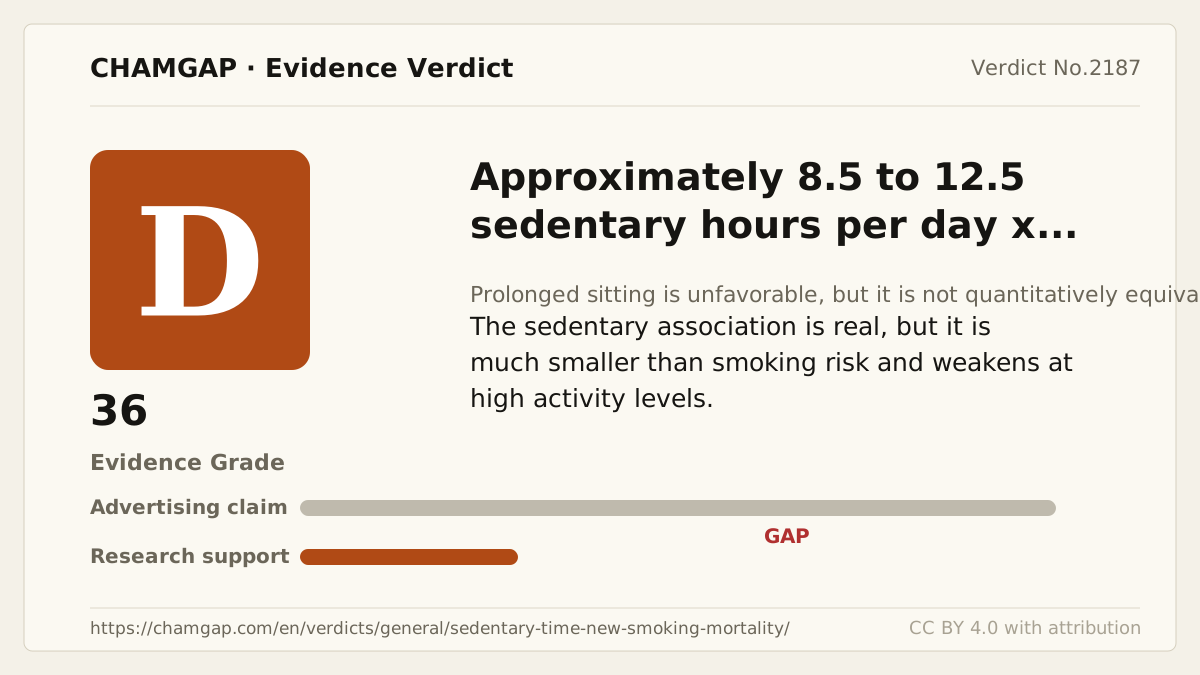
[Chamgap] Prolonged sedentary time x a 'new smoking' level of mortality risk — Evidence Grade D·34. 3 cited sources checked. Source: https://chamgap.com/en/verdicts/general/sedentary-time-new-smoking-mortality/ · CC BY 4.0CC BY 4.0 — free to use with attribution; do not distort grades, numbers, or verdict meaning.
What this document does and does not do
Chamgap is an information source. It reports what research has and has not confirmed; it does not tell readers what to take or buy. That decision belongs to readers and, when needed, medical or legal professionals. This verdict reflects literature available up to the search date and may change as new research appears. Nothing here is medical advice.