
Screening colonoscopy,
does it really help with Prevention of colorectal cancer incidence and colorectal cancer death?
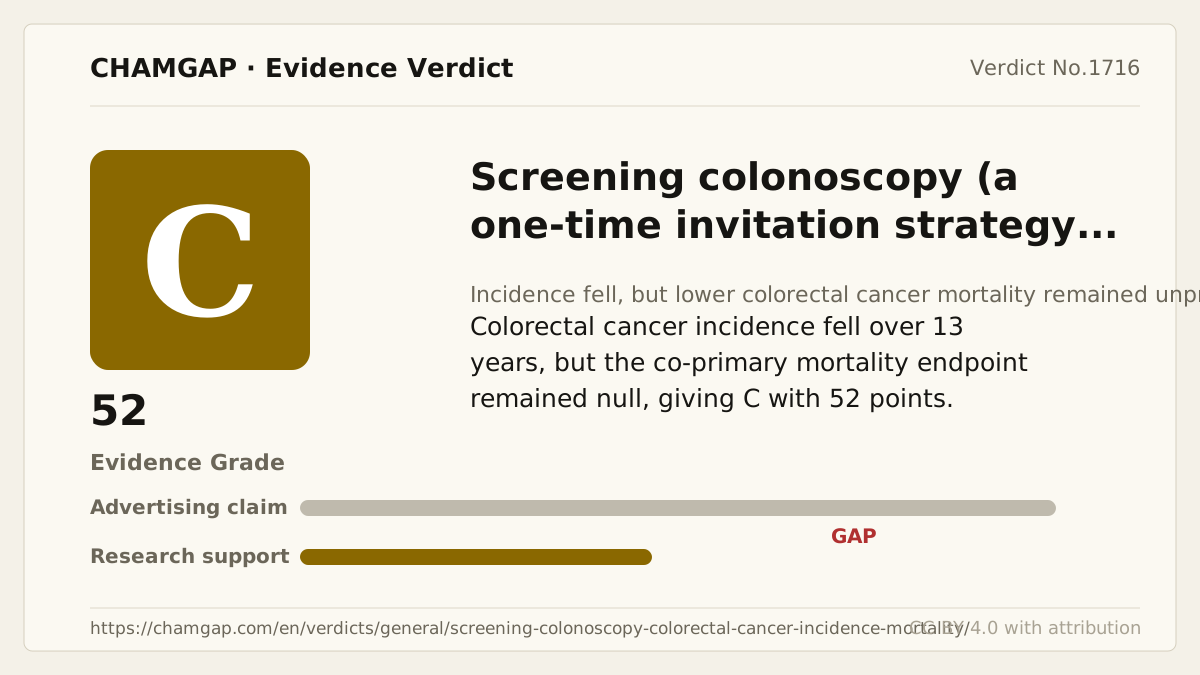
research showsA one-time invitation to screening colonoscopy is rated C because it reduces colorectal cancer incidence but has not demonstrated lower colorectal cancer mortality. The prespecified co-primary endpoints were both colorectal cancer incidence and colorectal cancer mortality. Among 84,585 participants in ITT, incidence succeeded and mortality failed at both ten and thirteen years; at thirteen years, incidence RR was 0.81 (95% CI 0.71 to 0.90) and colorectal cancer mortality RR was 0.88 (0.68 to 1.08).
ads claimPromotion can imply that polyp removal automatically proves fewer colorectal cancer deaths. Randomized evidence establishes lower incidence for the invitation strategy, while mortality remained unconfirmed at 13 years.
Useful facts when choosing a product
- The target is population screening of asymptomatic average-risk adults, not diagnostic colonoscopy for symptoms.
- About 42% of invited NordICC participants underwent colonoscopy, so intention-to-screen estimates represent real-world program effectiveness.
- Starting age and interval vary with family history, prior polyps, inflammatory bowel disease, and national guidance.
Chamgap Semantic Classification Code
Candidate index · review held
P.screening-colonoscopy.diagnostic.colorectal-cancer-incidence-and-colorectal-cancer-death.prevent.UNKProcedures, devices and tests > Screening colonoscopy > Diagnostic or screening > colorectal cancer incidence and colorectal cancer death > Occurrence-prevention claim > Unknown
An automated migration candidate, not an issued permanent code; exact claim scope remains under review. This machine-generated migration candidate helps retrieval but is not a permanent assignment. The original verdict ID and URL remain authoritative.
What the research actually shows
NordICC randomized 84,585 adults aged 55 to 64 in a 1:2 ratio to an invitation for one colonoscopy or no screening and analyzed them by ITT. Both colorectal cancer incidence and colorectal cancer mortality were prespecified co-primary endpoints. At ten years, incidence RR 0.82 succeeded and mortality RR 0.90 failed; at thirteen years, incidence RR 0.81 (0.71 to 0.90) succeeded and mortality RR 0.88 (0.68 to 1.08) failed. Adjusted per-protocol analyses among actual attendees gave stronger estimates but do not replace the randomized ITT conclusion.
Why this is classified as C (52)
Colorectal cancer incidence succeeded at ten and thirteen years, but prespecified co-primary colorectal cancer mortality failed at both times. Adjusted per-protocol analyses among actual attendees gave stronger estimates, but they do not replace the randomized ITT conclusion and were not used to upgrade the grade under rule 5, giving C with 52 points.
Counterpoint. Uncertain mortality benefit does not mean that a person should abandon recommended screening. Individual risk and alternative screening methods should be discussed under applicable guidance.
Rejudgment record. Cross-check applied — Both colorectal cancer incidence and mortality were prespecified co-primary endpoints; incidence succeeded and mortality failed at both ten and thirteen years. The conservative rule 1-c ceiling was applied to conflicting co-primary findings from the only direct trial.
Sub-claim grades by effect
This ingredient is marketed for several effects. A single overall grade blends strong and weak claims together, so each effect is graded separately here. The overall grade reflects the strongest disconfirming or core claim.
| Effect (sub-claim) | Grade | Basis |
|---|---|---|
| Prevention of colorectal cancer incidence | B | The direct clinical outcome fell significantly at thirteen years with ITT RR 0.81. |
| Prevention of colorectal cancer death | D | The co-primary mortality endpoint was nonsignificant at both ten and thirteen years. |
| Prevention of all-cause death | D | All-cause mortality showed no difference at thirteen years, with RR 1.00. |
Cross-check — AI research and Codex final gate
Evidence Table
| Study | Design | Sample | Funding | Endpoint | Result | Weight |
|---|---|---|---|---|---|---|
| Kaminski MF et al. 2025 | Multicountry population-based randomized screening trial with thirteen-year follow-up | 84,585 randomized and analyzed by ITT | Norwegian Research Council, Nordic Cancer Union, Norwegian Cancer Society, and Health Fund of South-East Norway; not manufacturer-led | Prespecified co-primary colorectal cancer incidence and mortality | Incidence succeeded with RR 0.81 (0.71 to 0.90); mortality failed with RR 0.88 (0.68 to 1.08). | Latest key long-term direct evidence |
| Bretthauer M et al. 2022 | Ten-year randomized NordICC report | 84,585 with follow-up data in the ITT analysis | Public and cancer-foundation grants with donated bowel preparation; not manufacturer-led | Co-primary colorectal cancer incidence and related death | Incidence succeeded with RR 0.82; mortality failed with RR 0.90. | Initial long-term direct evidence |
Receipt — 2 References
All 2 cited sources were verified for existence at the original page (as of 2026-07-24).
Final verification and publication gate: Codex · Evidence date: 2026-07-24 · Corrections: none
Cite this verdict
[Chamgap] Screening colonoscopy x prevention of colorectal cancer incidence and death — Evidence Grade C·52. 2 cited sources checked. Source: https://chamgap.com/en/verdicts/general/screening-colonoscopy-colorectal-cancer-incidence-mortality/ · CC BY 4.0CC BY 4.0 — free to use with attribution; do not distort grades, numbers, or verdict meaning.
What this document does and does not do
Chamgap is an information source. It reports what research has and has not confirmed; it does not tell readers what to take or buy. That decision belongs to readers and, when needed, medical or legal professionals. This verdict reflects literature available up to the search date and may change as new research appears. Nothing here is medical advice.