
Saline nasal irrigation,
does it really help with Relief of chronic sinonasal symptoms in cement-dust workers?
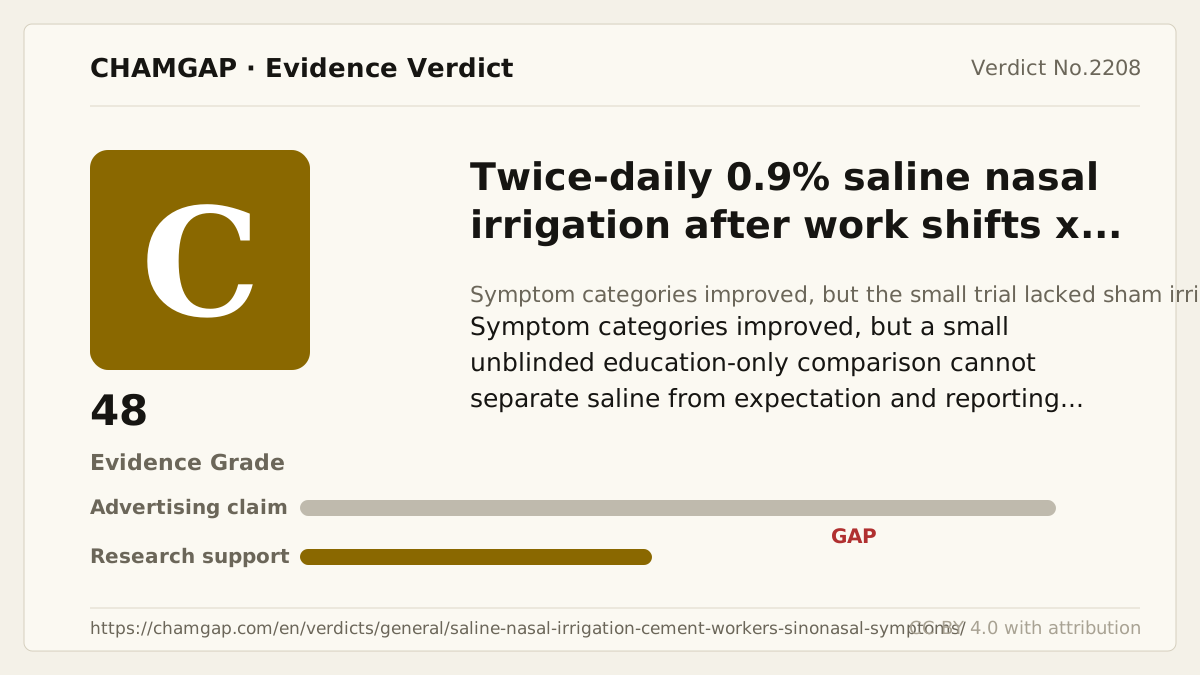
research showsThe grade is C with 50 points. Ninety cement workers were assigned 45 per group to education plus twice-daily 0.9% saline irrigation or education alone. Symptoms were assessed at six months, but controls also improved and there was no sham irrigation, blinding, standardized total symptom score, or between-group confidence interval. Individual adherence was not verified.
ads claimSaline passing through the nose is not proof that it reduces occupational dose or prevents disease. This trial did not measure expelled particles, personal inhaled concentration, or long-term disease incidence.
Useful facts when choosing a product
- The protocol used 0.9% saline and a rinse bottle twice daily after morning and afternoon shifts.
- The control received the same education without sham irrigation.
- Occupational assessment was mentioned, but personal dust concentration and particles removed by rinsing were not verified in the reported results.
- Verdict 1785 is C with 50 points for general chronic sinonasal symptoms, and verdict 1887 is C with 56 points for allergic rhinitis; this verdict is limited to cement-dust workers.
Chamgap Semantic Classification Code
Candidate index · review held
UNK.twice-0-9-percent-saline-nasal-irrigation-after-work-shifts.intranasal.chronic-sinonasal-symptoms-in-cement-dust-workers.relieve.UNKUnknown > Twice- 0.9% saline nasal irrigation after work shifts > Intranasal > chronic sinonasal symptoms in cement-dust workers > Symptom-relief claim > Unknown
An automated migration candidate, not an issued permanent code; exact claim scope remains under review. This machine-generated migration candidate helps retrieval but is not a permanent assignment. The original verdict ID and URL remain authoritative.
What the research actually shows
At Hai Phong Cement Plant, 1,054 workers were screened, 94 had chronic rhinosinusitis, and 90 were randomized to education plus irrigation or education alone, 45 each. The intervention used 0.9% saline twice daily after shifts, with assessment at six months. Individual adherence was not verified. Moderate rhinorrhea changed from 17/45 to 2/45 and moderate obstruction from 23/45 to 3/45; controls also improved. This verdict recalculated fractions rather than copying the article's erroneous percentages: 7/45 is 15.6%, not 7.8%, and 3/45 is 6.7%, not 36.7%. Contribution initials do not match Nguyen Quang Hung, Vo Hoang Long, and Nguyen Quang Truong. The article declares no financial support and no conflicts of interest. Those findings increased independence, while arithmetic and reporting errors were retained as limitations.
Why this is classified as C (50)
Declarations of no funding and no conflicts increase independence, but 90 participants, no sham, no blinding, unverified adherence, and article errors give C with 50 points.
Counterpoint. Evidence for irrigation in other rhinitis or chronic-symptom settings was not counted as replication of this occupational-dust question because indication, control, and scales differ.
Rejudgment record. Cross-check applied — Declarations of no funding and no conflicts increased independence; six-month ordinal symptoms, no sham or blinding, unverified adherence, and article arithmetic errors were weighed as limitations
| Endpoint | P | Symptom or function itself is the target - including patient reports and performance tests |
| Replication | R1 | Single confirmatory trial |
| Independence | I2 | Decisive evidence is publicly or non-profit funded |
| Effect size | EX | The clinical size of the effect could not be judged |
Stored derived and displayed grades match; this is not a current recalculation or validity check (C).
Sub-claim grades by effect
This ingredient is marketed for several effects. A single overall grade blends strong and weak claims together, so each effect is graded separately here. The overall grade reflects the strongest disconfirming or core claim.
| Effect (sub-claim) | Grade | Basis |
|---|---|---|
| Relief of sinonasal symptoms in dust-exposed workers | C | Ordinal symptoms improved in a small unblinded education-controlled trial. |
| Nasal irrigation expels inhaled fine particles or dust from the body | ? | Removed particles and personal inhaled dose were not measured. |
Cross-check — AI research and Codex final gate
Evidence Table
| Study | Design | Sample | Funding | Endpoint | Result | Weight |
|---|---|---|---|---|---|---|
| Nguyen Quang Hung et al. 2025 Hai Phong cement-plant trial | Simple-randomized education-controlled intervention trial | 1,054 screened, 94 diagnosed, and 90 randomized and analyzed, 45 per group | Declared no financial support and no conflicts of interest | Six-month ordinal rhinorrhea, obstruction, olfaction, and clinical findings | Moderate rhinorrhea changed 17 to 2 and moderate obstruction 23 to 3; no between-group effect size or CI. | Only direct occupational-dust trial |
Receipt — 1 References
All 1 cited sources were verified for existence at the original page (as of 2026-08-04).
Final verification and publication gate: Codex · Evidence date: 2026-08-04 · Corrections: none
Cite this verdict
[Chamgap] Saline nasal irrigation x sinonasal symptoms in dust-exposed workers — Evidence Grade C·50. 1 cited sources checked. Source: https://chamgap.com/en/verdicts/general/saline-nasal-irrigation-cement-workers-sinonasal-symptoms/ · CC BY 4.0CC BY 4.0 — free to use with attribution; do not distort grades, numbers, or verdict meaning.
What this document does and does not do
Chamgap is an information source. It reports what research has and has not confirmed; it does not tell readers what to take or buy. That decision belongs to readers and, when needed, medical or legal professionals. This verdict reflects literature available up to the search date and may change as new research appears. Nothing here is medical advice.