
Safety-engineered needle devices,
does it really help with Reduction in occupational needlestick injuries among healthcare personnel?
research showsThe grade is C with 54 points. Reported injuries at a German university hospital fell from 448, or 69.0 per 1,000 full-time workers, before implementation to 350, or 52.4 per 1,000, afterward. These were actual percutaneous injuries, but mandatory staff training was introduced at the same time and there was no concurrent control hospital, so the decline cannot be assigned to the devices alone.
ads claimA shield or retraction mechanism physically covers an exposed needle, which is a genuine product feature. The study's 21.9% hospital-wide decline also includes training and secular changes and must not be marketed as a guaranteed reduction from one product.
Useful facts when choosing a product
- The rollout included active mechanisms for hypodermic needles and butterfly systems and passive mechanisms for peripheral venous catheters, lancets, and port needles.
- An injury was defined as percutaneous contact with a sharp object contaminated by blood or body fluid; mucosal exposures were excluded.
- Verdict 2575 is D with 28 points for double gloving during surgery; it evaluates glove perforation, whereas this verdict evaluates hospital-wide needle-injury events.
Chamgap Semantic Classification Code
Candidate index · review held
UNK.hospital-wide-adoption-of-safety-engineered-needles-and-blood-collection-devices.UNK.occupational-needlestick-injuries-among-healthcare-personnel.reduce.baselineUnknown > Hospital-wide adoption of safety-engineered needles and blood-collection devices > Unknown > occupational needlestick injuries among healthcare personnel > Reduction claim > Within-group baseline comparison
An automated migration candidate, not an issued permanent code; exact claim scope remains under review. This machine-generated migration candidate helps retrieval but is not a permanent assignment. The original verdict ID and URL remain authoritative.
What the research actually shows
Hoffmann was a single-center before-after analysis of mandatory occupational-health reports at Heidelberg University Hospital. Active and passive safety devices were introduced throughout the hospital in 2008 together with mandatory Occupational Health Service training. Patient volume rose 6.6%, from 199,726 to 213,847, and full-time personnel rose 2.8%, from 6,493 to 6,683. The article did not report a funding source; the authors declared no conflict of interest.
Why this is classified as C (54)
A sizable, statistically clear reduction occurred in an actual injury outcome, but the uncontrolled before-after study introduced safety devices and mandatory training together. Two avoidable sources of confounding cap the verdict at C with 54 points.
Counterpoint. This verdict concerns hospital-wide implementation. Effects of a particular model, procedure, or blood-borne infection outcome require separate comparisons.
Rejudgment record. Cross-check applied — Cross-checked event counts, workforce denominators, concurrent training, uncontrolled design, reporting method, and conflict statement in the full article
| Endpoint | H | Hard endpoint - actual events such as death |
| Replication | R1 | Single confirmatory trial |
| Independence | I1 | Mixed funding sources |
| Effect size | E+ | Meets the clinically important threshold |
Stored derived and displayed grades match; this is not a current recalculation or validity check (C).
Sub-claim grades by effect
This ingredient is marketed for several effects. A single overall grade blends strong and weak claims together, so each effect is graded separately here. The overall grade reflects the strongest disconfirming or core claim.
| Effect (sub-claim) | Grade | Basis |
|---|---|---|
| Reduction in hospital-wide needlestick injuries | C | The rate fell from 69.0 to 52.4 per 1,000 workers. |
| Independent effect of the devices alone | ? | There was no control separating mandatory training and secular change. |
Cross-check — AI research and Codex final gate
Evidence Table
| Study | Design | Sample | Funding | Endpoint | Result | Weight |
|---|---|---|---|---|---|---|
| Hoffmann C, Buchholz L, Schnitzler P. 2013 | Uncontrolled before-after study at one university hospital | 6,493 full-time workers and 448 events in 2007 versus 6,683 and 350 events in 2009 | No funding source reported; authors declared no conflict of interest | Percutaneous needlestick injuries in mandatory report forms | 69.0 to 52.4 per 1,000, a 21.9% decline; reconstructed rate ratio about 0.76, approximate 95% CI 0.66 to 0.87 | Actual injury events from before-after evidence bundled with training |
Receipt — 1 References
All 1 cited sources were verified for existence at the original page (as of 2026-08-15).
Final verification and publication gate: Codex · Evidence date: 2026-08-15 · Corrections: none
Cite this verdict
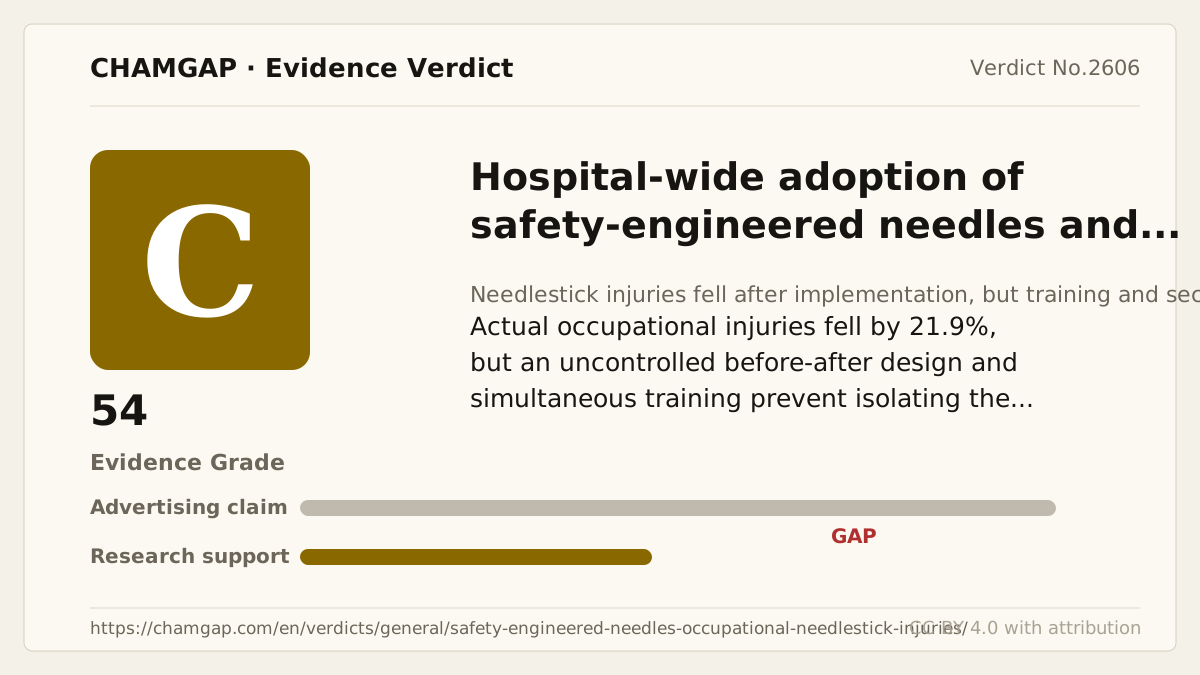
[Chamgap] Safety-engineered needle devices x occupational needlestick injuries — Evidence Grade C·54. 1 cited sources checked. Source: https://chamgap.com/en/verdicts/general/safety-engineered-needles-occupational-needlestick-injuries/ · CC BY 4.0CC BY 4.0 — free to use with attribution; do not distort grades, numbers, or verdict meaning.
What this document does and does not do
Chamgap is an information source. It reports what research has and has not confirmed; it does not tell readers what to take or buy. That decision belongs to readers and, when needed, medical or legal professionals. This verdict reflects literature available up to the search date and may change as new research appears. Nothing here is medical advice.