
Routine scale and polish,
does it really help with Prevention of gingival bleeding and early periodontal disease?
research showsThe grade is D with 28 points. IQuaD randomized 1,877 participants and analyzed clinical outcomes in 1,327 at three years. Bleeding-site differences were 0.87 points (95% CI -1.6 to 3.3, P=.481) for six-monthly versus no scheduled treatment and 0.11 (-2.3 to 2.5, P=.929) for six- versus twelve-monthly treatment. No reduction was shown, but 7.5 points was not a validated minimum clinically important difference, so the intervals cannot be said to exclude every meaningful benefit.
ads claimThe universal message that everyone needs six-monthly scaling to prevent gingival bleeding is not supported in low-risk regular attenders. Treatment of diagnosed periodontitis and removal of calculus are different questions.
Useful facts when choosing a product
- Calculus-site prevalence was 8.0 points higher without scheduled treatment than with six-monthly treatment in IQuaD.
- The 7.5-point value was a power-design assumption, not a validated minimum clinically important difference.
- Verdict 701 is A with 92 points for fluoride toothpaste and caries prevention, a different intervention.
Chamgap Semantic Classification Code
Candidate index · review held
UNK.six-or-routine-scale-and-polish-in-regular-attenders-without-established-or-advanced-periodontitis.UNK.gingival-bleeding-and-early-periodontal-disease.prevent.factorialUnknown > Six- or routine scale and polish in regular attenders without established or advanced periodontitis > Unknown > gingival bleeding and early periodontal disease > Occurrence-prevention claim > Defined factorial contrast
An automated migration candidate, not an issued permanent code; exact claim scope remains under review. This machine-generated migration candidate helps retrieval but is not a permanent assignment. The original verdict ID and URL remain authoritative.
What the research actually shows
IQuaD randomized regular attenders across 63 practices to six-monthly, twelve-monthly, or no scheduled instrumentation, with blinded clinical examiners. Mean actual treatments were 3.0, 2.0, and 1.1. ISRCTN56465715 specified the percentage of gingival bleeding sites at three years as the primary clinical endpoint. Jones randomized 369 participants, 125, 122, and 122, and reported 24-month bleeding prevalence of 78.5%, 78.0%, and 82.0%, P=.746. Funding came from the UK National Institute for Health Research Health Technology Assessment programme, and no oral-products or dental-device industry funding was verified; investigators disclosed grants and committee roles from the same institution, and some investigators appeared in both studies.
Why this is classified as D (28)
Two trials did not show less bleeding in low-risk regular attenders, but investigator overlap and the absence of a validated clinical threshold prevent precise refutation, giving D with 28 points.
Counterpoint. D does not deny calculus reduction or indicated treatment for symptomatic or established periodontitis.
Rejudgment record. Cross-check applied — Separated calculus reduction from bleeding prevention and accounted for investigator overlap and the limits of a power-design value as a clinical threshold
| Endpoint | S | Surrogate marker - laboratory or imaging measures |
| Replication | RX | Repeatedly refuted in the same indication |
| Independence | I1 | Mixed funding sources |
| Effect size | E0 | Null |
| Precision | C0 | The confidence interval leaves room for benefit |
Stored derived and displayed grades match; this is not a current recalculation or validity check (D).
Sub-claim grades by effect
This ingredient is marketed for several effects. A single overall grade blends strong and weak claims together, so each effect is graded separately here. The overall grade reflects the strongest disconfirming or core claim.
| Effect (sub-claim) | Grade | Basis |
|---|---|---|
| Prevention of gingival bleeding in low-risk regular attenders | D | Two trials did not show less bleeding, but neither a validated clinical threshold nor fully independent replication was verified. |
| Reduction in calculus | B | Six-monthly treatment reduced calculus-site prevalence versus no scheduled treatment. |
Cross-check — AI research and Codex final gate
Evidence Table
| Study | Design | Sample | Funding | Endpoint | Result | Weight |
|---|---|---|---|---|---|---|
| Ramsay et al. IQuaD 2018 | Multicenter cluster and individual factorial randomized trial | 1,877 randomized; 1,327 in the three-year clinical analysis | UK NIHR Health Technology Assessment programme; no relevant industry funding verified | Percentage of gingival bleeding sites at three years | Six-monthly versus none: 0.87 points (-1.6 to 3.3, P=.481); six- versus twelve-monthly: 0.11 (-2.3 to 2.5, P=.929). | Pivotal null bleeding evidence; no validated clinical threshold was verified |
| Jones et al. 2011 | Practice-based randomized trial | 369 randomized, 125, 122, and 122; 24 months | Public support; some investigators overlapped with IQuaD | Prevalence of gingival bleeding at 24 months | Six-, twelve-, and twenty-four-month groups: 78.5%, 78.0%, and 82.0%, P=.746. | Additional null evidence with some investigator overlap |
Receipt — 2 References
All 2 cited sources were verified for existence at the original page (as of 2026-08-04).
Final verification and publication gate: Codex · Evidence date: 2026-08-04 · Corrections: none
Cite this verdict
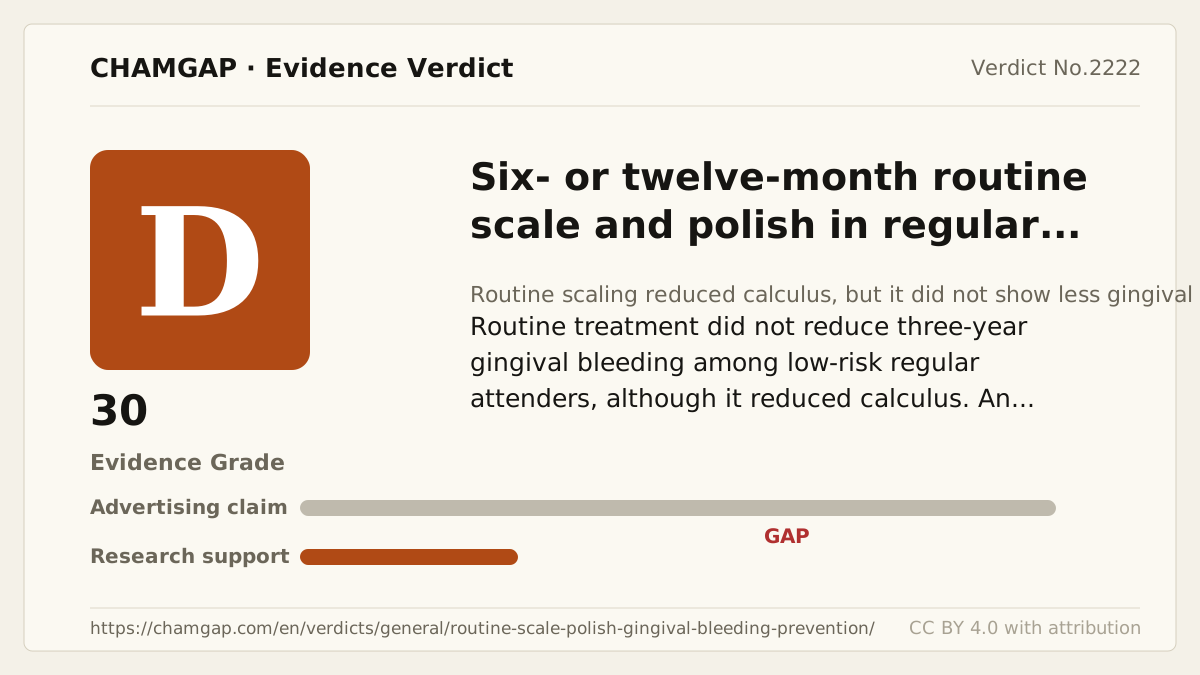
[Chamgap] Routine scale and polish x prevention of gingival bleeding — Evidence Grade D·28. 2 cited sources checked. Source: https://chamgap.com/en/verdicts/general/routine-scale-polish-gingival-bleeding-prevention/ · CC BY 4.0CC BY 4.0 — free to use with attribution; do not distort grades, numbers, or verdict meaning.
What this document does and does not do
Chamgap is an information source. It reports what research has and has not confirmed; it does not tell readers what to take or buy. That decision belongs to readers and, when needed, medical or legal professionals. This verdict reflects literature available up to the search date and may change as new research appears. Nothing here is medical advice.