
Riluzole,
does it really help with Delayed death or tracheostomy and prolonged survival in amyotrophic lateral sclerosis?
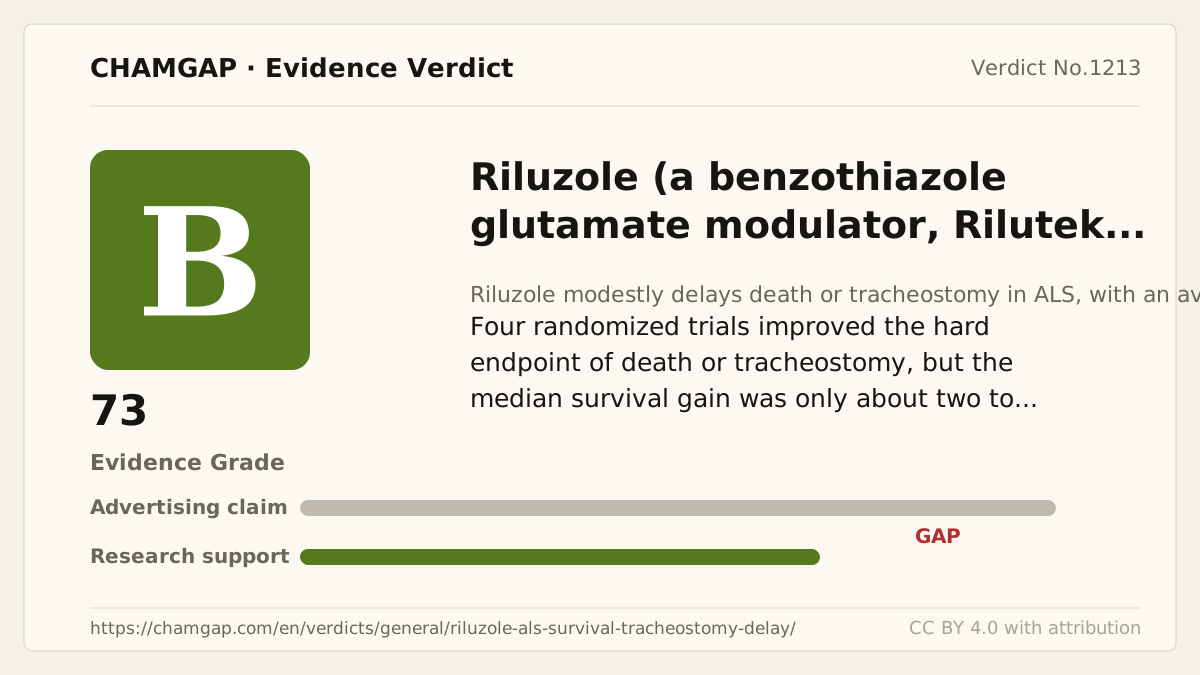
research showsRiluzole is rated B because it modestly delays death or tracheostomy and prolongs median survival by about two to three months in amyotrophic lateral sclerosis (ALS). The Cochrane review identified four randomized trials with 1,477 participants, and the overall analysis of comparable tracheostomy-free survival data gave an HR of 0.84 (95% CI 0.698 to 0.997). This is ingredient-specific randomized evidence on a direct hard endpoint, but the effect is small and clear improvements in function, strength, or quality of life are limited, so it does not merit A. Elevated liver enzymes, asthenia, nausea, and rare severe neutropenia are recorded separately under safety.
ads claimSummaries or promotion can broaden the phrase slows ALS progression into disease arrest or functional recovery. The most secure evidence is that riluzole modestly delays death or tracheostomy on average, and the size and timing of benefit can vary between individuals.
Useful facts when choosing a product
- Riluzole is a prescription benzothiazole glutamate modulator marketed under names including Rilutek. A common tablet regimen is 50 mg twice daily, taken at least one hour before or two hours after a meal.
- Riluzole does not cure ALS or restore lost motor function. The most directly supported randomized effect is a modest delay to death or tracheostomy.
- Serum aminotransferases should be checked before and during treatment. Elevated liver enzymes and hepatic injury can occur, and asthenia, nausea, and dizziness are common adverse reactions.
- Rare severe neutropenia has been reported, so fever early in treatment should be reported promptly. Symptoms suggesting interstitial lung disease also require rapid assessment.
Chamgap Semantic Classification Code
Candidate index · review held
M.riluzole.UNK.delayed-death-or-tracheostomy-and-prolonged-survival-in-amyotrophic-lateral-sclerosis.reduce.placeboMedicinal interventions > Riluzole > Unknown > Delayed death or tracheostomy and prolonged survival in amyotrophic lateral sclerosis > Reduction claim > Placebo
An automated migration candidate, not an issued permanent code; exact claim scope remains under review. This machine-generated migration candidate helps retrieval but is not a permanent assignment. The original verdict ID and URL remain authoritative.
What the research actually shows
Bensimon 1994 randomized 155 ALS outpatients under double masking to riluzole 100 mg per day or placebo. Twelve-month survival was 74% versus 58%, and death and tracheostomy were the principal survival events. Lacomblez 1996 randomized 959 participants to placebo or riluzole 50, 100, or 200 mg per day. At 18 months, tracheostomy-free survival was 56.8% with 100 mg and 50.4% with placebo. The unadjusted risk for 100 mg was 0.79 (P=0.076), whereas the risk after adjustment for prognostic factors was 0.65 (P=0.002), and functional scales did not differ significantly. The 2012 Miller Cochrane review synthesized four randomized trials with 1,477 participants, reporting an overall HR of 0.84 and about two to three months of additional median survival. These findings support a small survival extension, not motor recovery or a large quality-of-life improvement.
Why this is classified as B (73)
Ingredient-specific randomized trials and a Cochrane synthesis of four trials show improvement in the direct hard endpoint of death or tracheostomy and about two to three months of additional median survival. The overall HR of 0.84 represents a small, borderline-significant effect with heterogeneity and limited functional or strength benefits, resulting in B with 73 points rather than A. Elevated liver enzymes, asthenia, nausea, and rare neutropenia are separate safety concerns.
Counterpoint. Even a small average survival gain can matter in a progressive fatal disease such as ALS. Riluzole does not replace respiratory, nutritional, communication, and multidisciplinary support, and treatment goals and adverse-effect monitoring should be discussed together.
Rejudgment record. Cross-check applied — Accepted the ingredient-specific direct hard-endpoint benefit for death or tracheostomy and the two-to-three-month median survival extension in the Cochrane synthesis of four riluzole randomized trials, while applying B for the small effect, borderline significance, heterogeneity, and limited functional benefit
Sub-claim grades by effect
This ingredient is marketed for several effects. A single overall grade blends strong and weak claims together, so each effect is graded separately here. The overall grade reflects the strongest disconfirming or core claim.
| Effect (sub-claim) | Grade | Basis |
|---|---|---|
| Prolonged survival in ALS | B | The Cochrane synthesis of four randomized trials found about two to three months of additional median survival, but the effect was small. |
| Delayed time to tracheostomy in ALS | B | Ingredient-specific randomized evidence was positive for the hard composite of death or tracheostomy. |
| Slowed motor-functional decline in ALS | C | The synthesis found small signals for bulbar and limb function, but muscle strength and functional scales in the large individual trial were not clearly improved. |
Cross-check — AI research and Codex final gate
Evidence Table
| Study | Design | Sample | Funding | Endpoint | Result | Weight |
|---|---|---|---|---|---|---|
| Miller RG et al. 2012 Cochrane review | Systematic review and meta-analysis of randomized placebo-controlled trials | Four riluzole randomized trials with 1,477 people with ALS | Cochrane review; some included trials had manufacturer involvement, and two reviewers disclosed investigator roles in the second large trial without participation in its analysis or manuscript | Tracheostomy-free survival over all time points, death, function, strength, and adverse events | The overall HR was 0.84 (95% CI 0.698 to 0.997), one-year survival probability was 58% versus 49%, and median survival was 14.8 versus 11.8 months, an extension of about two to three months. | Key pooled hard-endpoint evidence |
| Bensimon G et al. 1994 | Prospective randomized double-blind placebo-controlled trial | 155 ALS outpatients | Rhône-Poulenc Rorer supplied riluzole and placebo tablets | Survival including death or tracheostomy and change in functional status | Twelve-month survival was 74% with riluzole versus 58% with placebo (P=0.014), but the sample was small and effects differed by site of onset. | Initial direct hard-endpoint randomized trial |
| Lacomblez L et al. 1996 | Multicenter randomized double-blind placebo-controlled dose-ranging trial | 959 people with ALS assigned to placebo or riluzole 50, 100, or 200 mg per day | Manufacturer involvement was reported within the riluzole clinical development program | Tracheostomy-free survival at 18 months and functional scales | Tracheostomy-free survival with 100 mg was 56.8% versus 50.4% with placebo; the unadjusted risk was 0.79 (P=0.076), the prognostic-factor-adjusted risk was 0.65 (P=0.002), and functional scales did not differ significantly. | Large confirmatory direct randomized trial |
Receipt — 3 References
All 3 cited sources were verified for existence at the original page (as of 2026-07-23).
Final verification and publication gate: Codex · Evidence date: 2026-07-23 · Corrections: none
Cite this verdict
[Chamgap] Riluzole x delayed death or tracheostomy and prolonged survival in amyotrophic lateral sclerosis — Evidence Grade B·73. 3 cited sources checked. Source: https://chamgap.com/en/verdicts/general/riluzole-als-survival-tracheostomy-delay/ · CC BY 4.0CC BY 4.0 — free to use with attribution; do not distort grades, numbers, or verdict meaning.
What this document does and does not do
Chamgap is an information source. It reports what research has and has not confirmed; it does not tell readers what to take or buy. That decision belongs to readers and, when needed, medical or legal professionals. This verdict reflects literature available up to the search date and may change as new research appears. Nothing here is medical advice.