
Restrictive red-cell transfusion,
does it really help with Improved six-week survival versus a liberal 9 g/dL threshold?
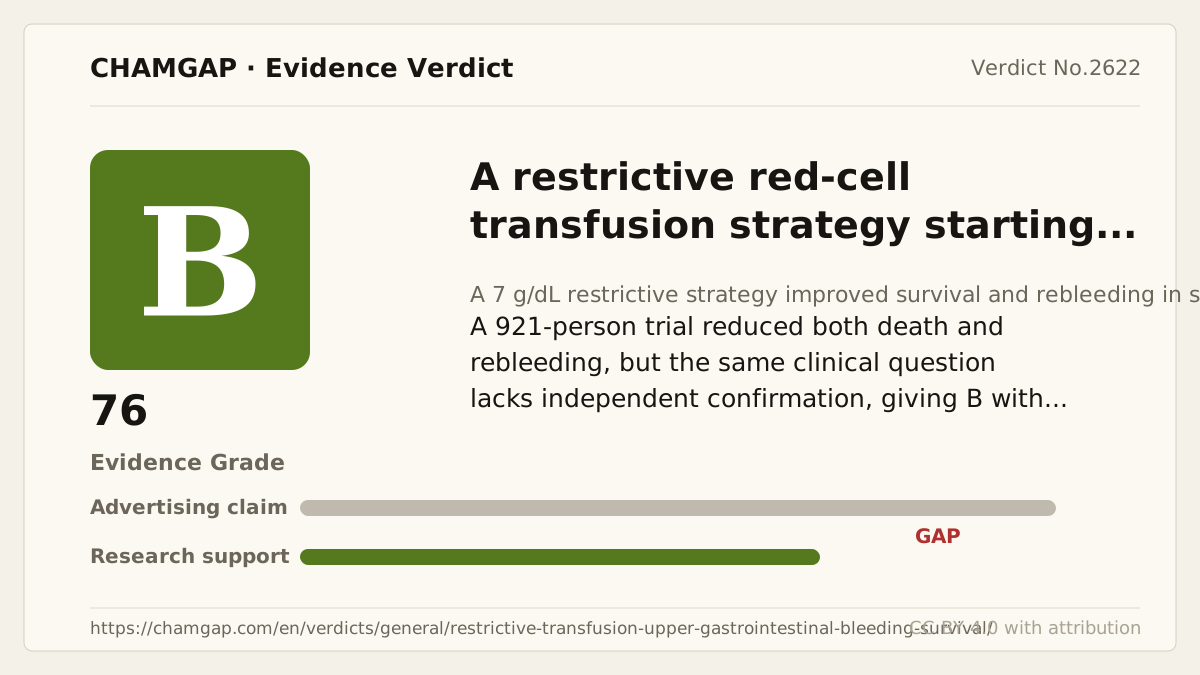
research showsThe grade is B. Villanueva randomized 921 patients, 461 versus 460. Six-week mortality was 23 (5.0%) with the restrictive strategy and 41 (8.9%) with the liberal strategy, HR 0.55 (95% CI 0.33 to 0.92). Further bleeding was 10% versus 16%. No independent trial confirmed the same mortality question, giving B with 76 points.
ads claimRestrictive transfusion does not mean refusing transfusion. It is a hospital protocol combining a hemoglobin threshold and target with bleeding control, vital signs, and ischemic symptoms.
Useful facts when choosing a product
- The trial started transfusion below 7 g/dL and targeted 7 to 9 g/dL.
- All 921 were randomized; six-week deaths were 23/461 versus 41/460.
- Several high-risk cardiovascular conditions were excluded and require separate judgment.
Chamgap Semantic Classification Code
Candidate index · review held
UNK.restrictive-red-cell-transfusion-strategy-starting-below-hemoglobin-dl-in-severe-acute-upper-gastrointestinal-bleeding.UNK.survival.improve.UNKUnknown > restrictive red-cell transfusion strategy starting below hemoglobin /dL in severe acute upper gastrointestinal bleeding > Unknown > survival > Improvement claim > Unknown
An automated migration candidate, not an issued permanent code; exact claim scope remains under review. This machine-generated migration candidate helps retrieval but is not a permanent assignment. The original verdict ID and URL remain authoritative.
What the research actually shows
Villanueva randomized 921 patients to transfusion below 7 g/dL with a 7-to-9 target or below 9 g/dL with a 9-to-11 target. Six-week survival was 95% versus 91%, mortality HR 0.55 (0.33 to 0.92), and rebleeding 10% versus 16%. Fundacio Investigacio Sant Pau funded the trial. NHS Blood and Transplant Research and Development funded TRIGGER, but its cluster-feasibility design, thresholds, and primary clinical outcome differed.
Why this is classified as B (76)
A large nonprofit-funded randomized trial reduced death and rebleeding, but independent confirmation of the same 7-versus-9 g/dL survival question is absent, giving B with 76 points.
Counterpoint. Verdict 2324 is D with 34 points for transfusion in acute myocardial infarction, a different population and threshold question that was not pooled here.
Rejudgment record. Cross-check applied — The Villanueva paper and NCT00414713 were compared with TRIGGER and ISRCTN85757829 for thresholds, populations, primary outcomes, analysis, and funding
| Endpoint | H | Hard endpoint - actual events such as death |
| Replication | R1 | Single confirmatory trial |
| Independence | I2 | Decisive evidence is publicly or non-profit funded |
| Effect size | E+ | Meets the clinically important threshold |
Stored derived and displayed grades match; this is not a current recalculation or validity check (B).
Sub-claim grades by effect
This ingredient is marketed for several effects. A single overall grade blends strong and weak claims together, so each effect is graded separately here. The overall grade reflects the strongest disconfirming or core claim.
| Effect (sub-claim) | Grade | Basis |
|---|---|---|
| Improved six-week survival | B | Mortality was 5.0% versus 8.9%, HR 0.55. |
| Reduced further bleeding | B | Further bleeding was 10% versus 16%. |
Cross-check — AI research and Codex final gate
Evidence Table
| Study | Design | Sample | Funding | Endpoint | Result | Weight |
|---|---|---|---|---|---|---|
| Villanueva C et al. 2013 | Single-center stratified randomized clinical trial | 921 randomized, 461 versus 460 | Fundacio Investigacio Sant Pau | Six-week survival and further bleeding | Deaths 23/461 (5.0%) versus 41/460 (8.9%), HR 0.55 (0.33 to 0.92); rebleeding 10% versus 16% | Pivotal nonprofit-funded large hard-outcome trial |
| Jairath V et al. 2015 TRIGGER | Six-hospital cluster-randomized feasibility trial | 936 enrolled; 849 in the primary clinical analysis | NHS Blood and Transplant Research and Development | Feasibility and 28-day further-bleeding clinical outcome | It evaluated feasibility of 8 versus 10 g/dL policies and was not a confirmatory mortality trial. | Contextual evidence not counted as direct mortality replication |
Receipt — 2 References
All 2 cited sources were verified for existence at the original page (as of 2026-08-15).
Final verification and publication gate: Codex · Evidence date: 2026-08-15 · Corrections: none
Cite this verdict
[Chamgap] Restrictive red-cell transfusion x improved survival in acute upper gastrointestinal bleeding — Evidence Grade B·76. 2 cited sources checked. Source: https://chamgap.com/en/verdicts/general/restrictive-transfusion-upper-gastrointestinal-bleeding-survival/ · CC BY 4.0CC BY 4.0 — free to use with attribution; do not distort grades, numbers, or verdict meaning.
What this document does and does not do
Chamgap is an information source. It reports what research has and has not confirmed; it does not tell readers what to take or buy. That decision belongs to readers and, when needed, medical or legal professionals. This verdict reflects literature available up to the search date and may change as new research appears. Nothing here is medical advice.