
Restrictive fluid therapy,
does it really help with Reducing disability and complications after major abdominal surgery?
research showsRestricting perioperative fluids did not improve disability-free survival at one year and increased acute kidney injury from 5.0% to 8.6%, an absolute increase of 3.6 percentage points. The trial therefore does not support routine restriction as a recovery-improving strategy.
ads claimA blanket claim that giving less fluid reduces edema and complications and speeds recovery is inconsistent with this trial: disability-free survival was unchanged and kidney harm increased.
Useful facts when choosing a product
- This verdict concerns a restrictive perioperative intravenous-fluid strategy versus a liberal strategy in major abdominal surgery.
- It is not an efficacy verdict on one branded fluid product.
Chamgap Semantic Classification Code
Candidate index · review held
UNK.restrictive-fluid-therapy.UNK.reducing-disability-and-complications-after-major-abdominal-surgery.reduce.UNKUnknown > Restrictive fluid therapy > Unknown > Reducing disability and complications after major abdominal surgery > Reduction claim > Unknown
An automated migration candidate, not an issued permanent code; exact claim scope remains under review. This machine-generated migration candidate helps retrieval but is not a permanent assignment. The original verdict ID and URL remain authoritative.
What the research actually shows
RELIEF was an international, 47-center randomized trial with patients and outcome assessors masked. Allocation used a computer-generated list and a 24-hour interactive telephone or web service. However, 17 randomized patients whose anesthesia was not induced were excluded from the prespecified modified intention-to-treat analysis, so the primary analysis did not retain every randomized participant. One-year outcomes were available for 2,901 patients. The blinded sample-size review increased enrollment from 2,800 to 3,000; the trial was not stopped early. Hazard ratios of 0.80 initially and 0.75 after recalculation were power assumptions, not values designated by the investigators as minimum clinically important differences.
Why this is classified as D (34)
This was a large publicly and noncommercially funded randomized trial with clinical outcomes, but it is a single confirmatory trial and its primary modified analysis excluded 17 participants after randomization. Primary efficacy was null and prespecified kidney injury significantly increased, supporting grade D.
Counterpoint. Renal-replacement therapy occurred in 0.9% versus 0.3% (RR 3.27, 95% CI 1.01–13.8), but did not cross the multiplicity-adjusted significance threshold. Surgical-site infection was also 16.5% versus 13.6% without meeting that threshold.
Rejudgment record. New verdict
| Endpoint | H | Hard endpoint - actual events such as death |
| Replication | R1 | Single confirmatory trial |
| Independence | I2 | Decisive evidence is publicly or non-profit funded |
| Effect size | E- | Harm increased in the trials |
| Precision | C0 | The confidence interval leaves room for benefit |
Stored derived and displayed grades match; this is not a current recalculation or validity check (D).
Sub-claim grades by effect
This ingredient is marketed for several effects. A single overall grade blends strong and weak claims together, so each effect is graded separately here. The overall grade reflects the strongest disconfirming or core claim.
| Effect (sub-claim) | Grade | Basis |
|---|---|---|
| Restrictive fluid therapy improves one-year disability-free survival. | D | The result was null: 81.9% versus 82.3%, HR 1.05 (95% CI 0.88–1.24). |
| Restrictive fluid therapy reduces postoperative kidney complications. | D | Acute kidney injury instead increased significantly by 3.6 percentage points. |
Cross-check — AI research and Codex final gate
Evidence Table
| Study | Design | Sample | Funding | Endpoint | Result | Weight |
|---|---|---|---|---|---|---|
| RELIEF | 47-center international pragmatic randomized trial with patient and outcome-assessor masking | 3,000 randomized; 2,983 in the prespecified modified intention-to-treat primary analysis; 2,901 with one-year outcomes | Australian NHMRC grant ID1043755, Australian and New Zealand College of Anaesthetists, Monash University, Health Research Council of New Zealand grant ID14/222, and UK National Institute for Health Research. The protocol disclosed external Baxter and B. Braun grants and consultancy fees to one author, but no company provision of trial fluids or assessment tools was identified. | Disability-free survival 81.9% vs 82.3%; death or disability HR 1.05 (95% CI 0.88–1.24), p=.61. Acute kidney injury 8.6% vs 5.0%; RR 1.71 (95% CI 1.29–2.27), p<.001. |
Receipt — 3 References
All 3 cited sources were verified for existence at the original page (as of 2026-08-18).
Final verification and publication gate: Codex · Evidence date: 2026-08-18 · Corrections: none
Cite this verdict
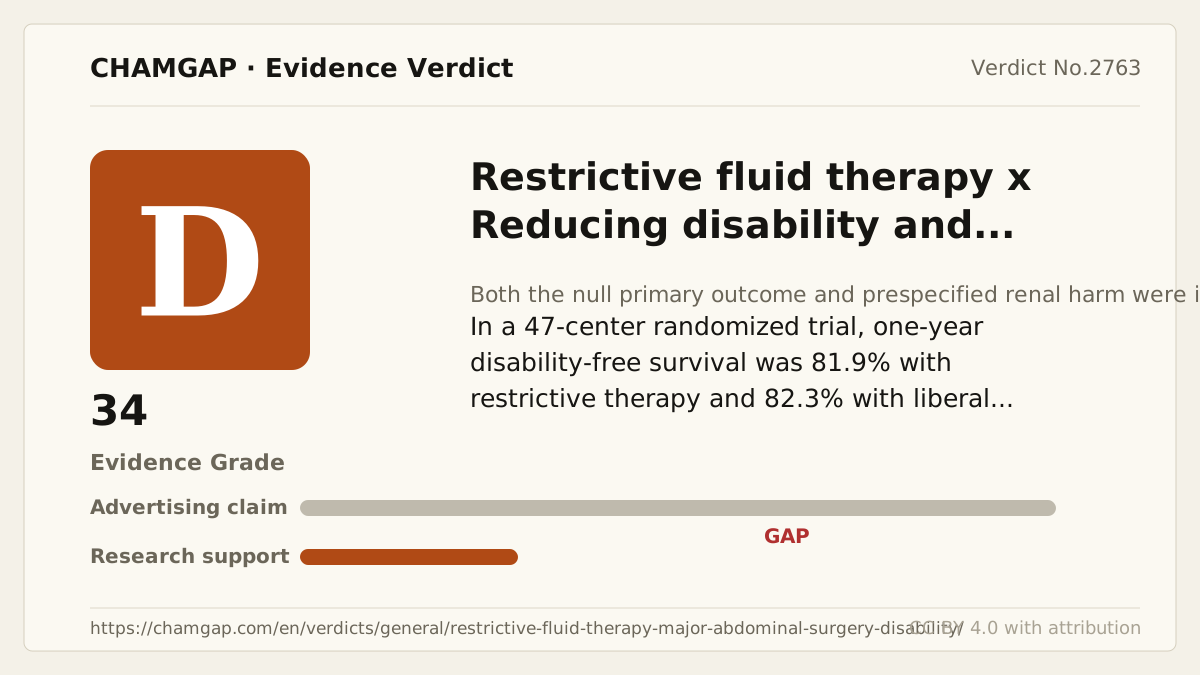
[Chamgap] Restrictive fluid therapy × disability and complications after major abdominal surgery — Evidence Grade D·34. 3 cited sources checked. Source: https://chamgap.com/en/verdicts/general/restrictive-fluid-therapy-major-abdominal-surgery-disability/ · CC BY 4.0CC BY 4.0 — free to use with attribution; do not distort grades, numbers, or verdict meaning.
What this document does and does not do
Chamgap is an information source. It reports what research has and has not confirmed; it does not tell readers what to take or buy. That decision belongs to readers and, when needed, medical or legal professionals. This verdict reflects literature available up to the search date and may change as new research appears. Nothing here is medical advice.