
Residential radon exposure,
does it really help with Increased lung-cancer incidence?
research showsThe grade is B with 76 points. The European and North American individual-data analyses had no authors in common and reported different funding sources, providing independent replication in the same direction. Jay H. Lubin participated in both the North American and Chinese analyses, so those two were not counted as independent replications of each other.
ads claimA radon reading is a physical exposure measurement, whereas lung cancer is a clinical event. Measurement alone does not determine one person's cancer probability, but regional pooled data do show higher lung-cancer odds with higher long-term concentration.
Useful facts when choosing a product
- Bq/m3 expresses radioactive decays per second in one cubic metre of air.
- All three pivotal analyses pooled individual data from residential-radon case-control studies.
- The European analysis corrected separately for regression dilution from temporal variability and missing historical homes.
- The European and North American analyses shared neither authors nor funding sources.
- The North American and Chinese analyses shared Jay H. Lubin and were not independent of each other.
Chamgap Semantic Classification Code
Candidate index · review held
X.residential-radon-exposure.environmental.lung-cancer-incidence.increase.UNKBehaviors, exposures and policies > Residential radon exposure > Environmental exposure > lung-cancer incidence > Increase claim > Unknown
An automated migration candidate, not an issued permanent code; exact claim scope remains under review. This machine-generated migration candidate helps retrieval but is not a permanent assignment. The original verdict ID and URL remain authoritative.
What the research actually shows
Darby's thirteen-study European analysis and Krewski's seven-study North American analysis shared no authors. Europe reported support from Cancer Research UK and the European Commission (contract FIGH-CT1999-00008); North America reported CIHR, NSERC, Health Canada, and the US NIEHS. They therefore provide independent replication. Jay H. Lubin appeared in both the North American analysis and Lubin's two-study Chinese analysis, so those two were not independent of each other. Neither European nor North American funding statements listed radon-mitigation, housing, or tobacco-industry funding. Funding for the Chinese analysis could not be verified. Both pooled analyses collected smoking histories by interviewing participants or close proxies and did not report a self-respondent-only analysis. Smoking is the dominant confounder for lung cancer. Retrospective exposure reconstruction, moving homes, and missing measurements were unavoidable in this design and were not counted as separate flaws. Control recruitment differed across included studies, but neither pooled analysis presented this as a major limitation. Failure to list these matters as limitations does not establish that they pose no problem.
Why this is classified as B (76)
Independent European and North American analyses found the same direction. Smoking histories came from participants or close proxies and no self-respondent-only analysis was reported, which is why the grade is B with 76 points rather than A.
Counterpoint. Author overlap prevents counting North America and China as separate replications, but independence between Europe and North America is established.
Rejudgment record. Cross-check applied — Cross-checked pooled estimates, independent authorship and funding, proxy smoking histories, and author overlap across Europe, North America, and China
| Endpoint | H | Hard endpoint - actual events such as death |
| Replication | R2 | Independently replicated across trials |
| Independence | I2 | Decisive evidence is publicly or non-profit funded |
| Effect size | E+ | Meets the clinically important threshold |
Stored derived and displayed grades match; this is not a current recalculation or validity check (B).
Sub-claim grades by effect
This ingredient is marketed for several effects. A single overall grade blends strong and weak claims together, so each effect is graded separately here. The overall grade reflects the strongest disconfirming or core claim.
| Effect (sub-claim) | Grade | Basis |
|---|---|---|
| Residential radon and lung cancer in Europe | C | Measured-concentration RR was 1.084 per 100 Bq/m3. |
| Residential radon and lung cancer in North America | C | OR was 1.11 per 100 Bq/m3. |
| Residential radon and lung cancer in China | C | OR was 1.13 per 100 Bq/m3. |
Cross-check — AI research and Codex final gate
Evidence Table
| Study | Design | Sample | Funding | Endpoint | Result | Weight |
|---|---|---|---|---|---|---|
| Darby et al. 2005 European pooled analysis | Pooled individual data from 13 case-control studies | 7,148 lung-cancer cases and 14,208 controls | Cancer Research UK and the European Commission (contract FIGH-CT1999-00008); no radon-mitigation, housing, or tobacco-industry funding was listed | Lung cancer per 100 Bq/m3 residential radon | Measured-concentration RR 1.084 (95% CI 1.030-1.158), excluding one; random-error-corrected long-term mean RR 1.16 (1.05-1.31), excluding one | Independent replication with no author or funding-source overlap with North America |
| Krewski et al. 2005 North American pooled analysis | Pooled individual data from seven case-control studies | 3,662 cases and 4,966 controls | CIHR, NSERC, Health Canada, and the US NIEHS; no radon-mitigation, housing, or tobacco-industry funding was listed | Lung cancer per 100 Bq/m3 time-weighted residential radon | Main OR 1.11 (95% CI 1.00-1.28), not excluding one; restricted analysis with one or two homes and complete 25-year measurements, 1.21 (1.03-1.52), excluding one | Independent of Europe but shares Lubin with the Chinese analysis |
| Lubin et al. 2004 Chinese pooled analysis | Pooled individual data from two case-control studies | 1,050 cases and 1,996 controls | Funding could not be verified | Lung cancer per 100 Bq/m3 time-weighted residential radon | OR 1.13 (95% CI 1.01-1.36), excluding one | Not independent of North America because Jay H. Lubin overlapped |
Receipt — 3 References
All 3 cited sources were verified for existence at the original page (as of 2026-08-05).
Final verification and publication gate: Codex · Evidence date: 2026-08-05 · Corrections: none
Cite this verdict
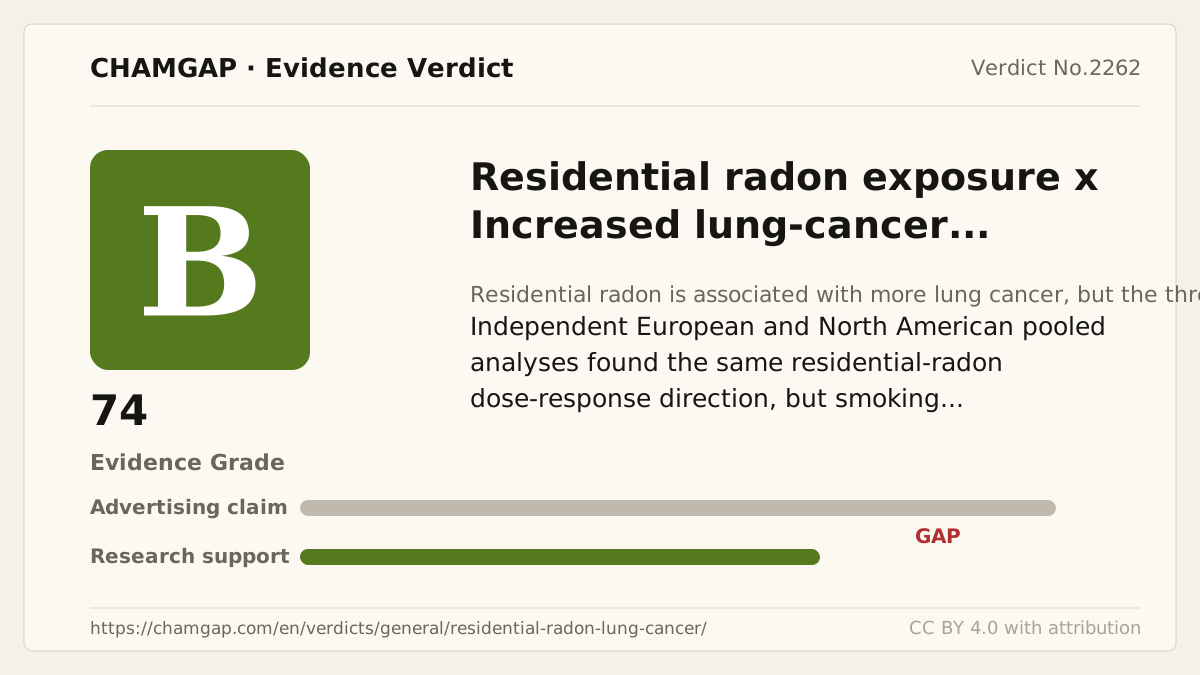
[Chamgap] Residential radon exposure x lung cancer — Evidence Grade B·76. 3 cited sources checked. Source: https://chamgap.com/en/verdicts/general/residential-radon-lung-cancer/ · CC BY 4.0CC BY 4.0 — free to use with attribution; do not distort grades, numbers, or verdict meaning.
What this document does and does not do
Chamgap is an information source. It reports what research has and has not confirmed; it does not tell readers what to take or buy. That decision belongs to readers and, when needed, medical or legal professionals. This verdict reflects literature available up to the search date and may change as new research appears. Nothing here is medical advice.