
Residential dampness and mold,
does it really help with Increased asthma onset and respiratory symptoms?
research showsThe grade is C. A synthesis of 16 longitudinal observational studies of asthma onset found estimates of 1.33 for dampness, 1.29 for visible mold, and 1.73 for mold odor. These are distinct exposures. Most were assessed by questionnaires or resident and inspector sight or smell, so they cannot be recast as effects of measured airborne mold spores.
ads claimVisible mold or a musty odor is not the same exposure as a measured spore count. Current evidence is strongest for associations between qualitative home dampness or mold indicators and asthma or respiratory symptoms.
Useful facts when choosing a product
- Visible mold, dampness or water damage, mold odor, and measured spores are different exposure definitions.
- The asthma-onset synthesis included 11 cohorts and five case-control studies.
- Most exposure assessment used questionnaires, resident reports, or qualitative home inspection.
- Quantitative microbial and spore measurements were limited and inconsistent and were not merged with qualitative exposure results.
Chamgap Semantic Classification Code
Candidate index · review held
UNK.residential-dampness-and-mold.UNK.asthma-onset-and-respiratory-symptoms.increase.UNKUnknown > Residential dampness and mold > Unknown > asthma onset and respiratory symptoms > Increase claim > Unknown
An automated migration candidate, not an issued permanent code; exact claim scope remains under review. This machine-generated migration candidate helps retrieval but is not a permanent assignment. The original verdict ID and URL remain authoritative.
What the research actually shows
Quansah and colleagues pooled 11 cohort and five incident case-control studies of new asthma in 2012. Many studies assessed water damage, dampness marks, visible mold, or mold odor by resident questionnaire or interview, but exposure was not entirely self-reported. Some used trained home inspectors, and one used biological analysis of dust samples. The pooled estimate was 2.24 (1.47-3.41) for inspector-assessed studies and 1.29 (1.11-1.48) for self-reported studies. The meta-analysis received Research Council for Health, Academy of Finland grants 129419 (SALVE) and 138691, but funding of a meta-analysis does not establish independence of its original studies. Funding across all original studies could not be verified.
Why this is classified as C (50)
Multiple longitudinal studies and exposure-specific positive associations are strengths. Questionnaire, inspection, and sample-analysis methods differed; some outcomes were self-reported, residual confounding remained, and funding across original studies could not be verified, giving C with 50 points.
Counterpoint. C does not mean dampness and mold should be ignored. It means that a causal dose from a particular spore concentration has not been established.
Rejudgment record. Cross-check applied — Separated questionnaires, inspections, and sample analysis while accounting for unverified funding across original studies
| Endpoint | P | Symptom or function itself is the target - including patient reports and performance tests |
| Replication | R1 | Single confirmatory trial |
| Independence | I1 | Mixed funding sources |
| Effect size | E+ | Meets the clinically important threshold |
Stored derived and displayed grades match; this is not a current recalculation or validity check (C).
Sub-claim grades by effect
This ingredient is marketed for several effects. A single overall grade blends strong and weak claims together, so each effect is graded separately here. The overall grade reflects the strongest disconfirming or core claim.
| Effect (sub-claim) | Grade | Basis |
|---|---|---|
| Dampness and new asthma | C | The pooled estimate was 1.33, 95% CI 1.12-1.56. |
| Visible mold and new asthma | C | The pooled estimate was 1.29, 95% CI 1.04-1.60. |
| Mold odor and new asthma | C | The pooled estimate was 1.73, 95% CI 1.19-2.50. |
| Measured mold spores and respiratory outcomes | ? | Quantitative measurement studies were limited and inconsistent. |
Cross-check — AI research and Codex final gate
Evidence Table
| Study | Design | Sample | Funding | Endpoint | Result | Weight |
|---|---|---|---|---|---|---|
| Quansah et al. 2012 asthma-onset meta-analysis | Meta-analysis of 11 cohort and five case-control observational studies | 16 longitudinal studies | Meta-analysis funded by Research Council for Health, Academy of Finland grants 129419 (SALVE) and 138691; funding across all original studies could not be verified | Incident asthma | Dampness 1.33 (1.12-1.56), visible mold 1.29 (1.04-1.60), odor 1.73 (1.19-2.50), water damage 1.12 (0.98-1.27); inspector assessment 2.24 (1.47-3.41), self-report 1.29 (1.11-1.48) | Many used questionnaires or interviews, but inspector assessment and dust-sample analysis were also represented |
| Fisk et al. 2007 respiratory-health meta-analysis | Meta-analysis of observational studies | Multiple residential studies | US Department of Energy support | Current asthma, wheeze, cough, and related outcomes | Current asthma OR 1.56, wheeze 1.50, and cough 1.67 | Broadens respiratory outcomes but combines broad exposure definitions |
Receipt — 3 References
All 3 cited sources were verified for existence at the original page (as of 2026-08-05).
Final verification and publication gate: Codex · Evidence date: 2026-08-05 · Corrections: none
Cite this verdict
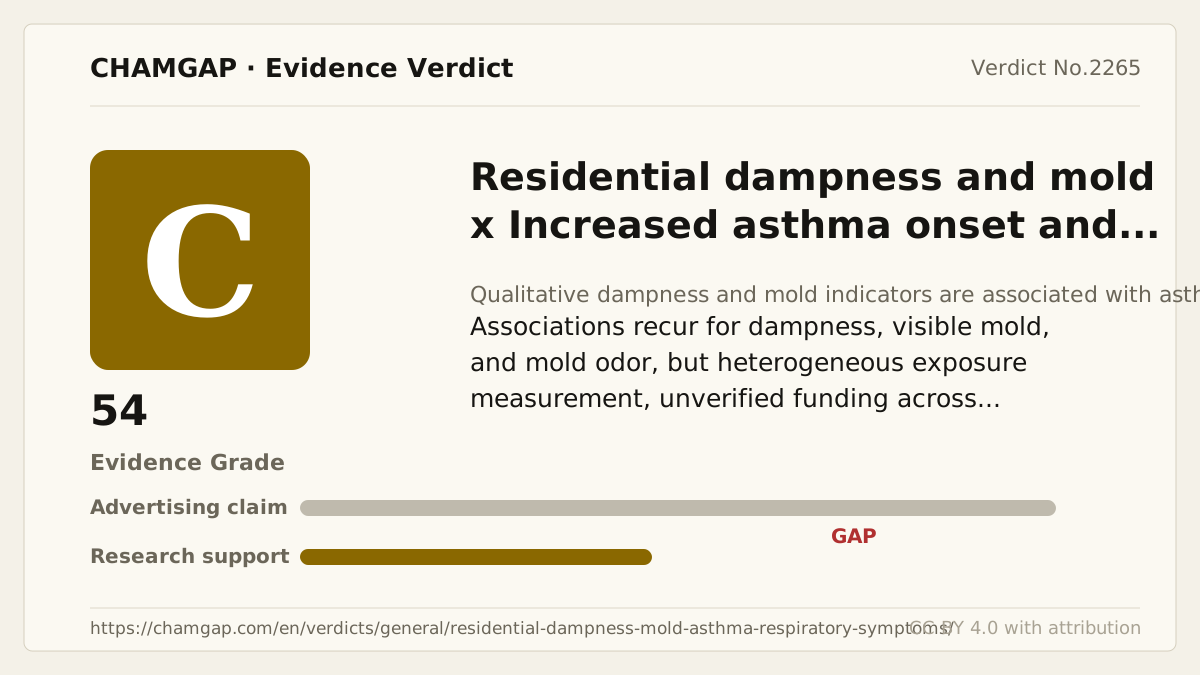
[Chamgap] Residential dampness and mold x asthma and respiratory symptoms — Evidence Grade C·50. 3 cited sources checked. Source: https://chamgap.com/en/verdicts/general/residential-dampness-mold-asthma-respiratory-symptoms/ · CC BY 4.0CC BY 4.0 — free to use with attribution; do not distort grades, numbers, or verdict meaning.
What this document does and does not do
Chamgap is an information source. It reports what research has and has not confirmed; it does not tell readers what to take or buy. That decision belongs to readers and, when needed, medical or legal professionals. This verdict reflects literature available up to the search date and may change as new research appears. Nothing here is medical advice.