
Repeated fist clenching during phlebotomy,
does it really help with No alteration of the serum or plasma potassium result?
research showsThe grade is D. Don found that repeated fist clenching raised plasma potassium by about 1.0 mmol/L in both a patient and controls in blood from the exercised arm. In Seimiya's quality-improvement work, potassium fell by at least 0.2 mmol/L between samples in 25.6% after prior clenching versus 6.7% without it. The claim of no effect runs opposite to human evidence and receives D with 28 points.
ads claimRepeated pumping to make a vein visible can distort potassium testing. If hand closure is needed, a gentle static hold is preferable; an unexpected high result should prompt review of collection conditions and hemolysis.
Useful facts when choosing a product
- Repeated forearm contraction increased local venous potassium in the exercised arm while the contralateral arm did not change.
- The 2025 Korean Society for Laboratory Medicine venous-collection guideline explicitly advises against repeated fist clenching and releasing.
- No duplicate verdict or matching PMID or DOI was found.
Chamgap Semantic Classification Code
Candidate index · review held
M.repeated-fist-clenching-and-releasing-under-a-tourniquet-during-venepuncture.intravenous.no-alteration-of-the-serum-or-plasma-potassium-result.assess.UNKMedicinal interventions > Repeated fist clenching and releasing under a tourniquet during venepuncture > Intravenous > No alteration of the serum or plasma potassium result > Association or change assessment > Unknown
An automated migration candidate, not an issued permanent code; exact claim scope remains under review. This machine-generated migration candidate helps retrieval but is not a permanent assignment. The original verdict ID and URL remain authoritative.
What the research actually shows
Don compared tourniquet alone, tourniquet plus fist clenching, and the contralateral arm in one patient and repeated the maneuver in healthy controls. Tourniquet alone had no effect, and potassium rose only in the exercised arm. NIH grant support was reported. Seimiya combined a seven-person time-course experiment, an 86-person repeated-sampling experiment, and a large hospital before-after quality project. Its full funding statement was not verified. Distinct teams alone were not counted as independently funded replication because funding was not confirmed for both.
Why this is classified as D (28)
Potassium elevation appeared in two research programs and large quality-improvement data, but evidence was nonrandomized, the major before-after project changed two procedures simultaneously, and one funding source was unverified. No strength axis remains, giving D with 28 points.
Counterpoint. D does not mean the change is small. It means the no-effect claim is contradicted, but the endpoint is a laboratory surrogate and the study designs are limited.
Rejudgment record. Cross-check applied — We cross-checked participant counts, exercise conditions, potassium changes, before-after pseudohyperkalemia counts, and funding against Don, Seimiya, and the Korean collection guideline.
| Endpoint | S | Surrogate marker - laboratory or imaging measures |
| Replication | R1 | Single confirmatory trial |
| Independence | I1 | Mixed funding sources |
| Effect size | E- | Harm increased in the trials |
| Precision | C0 | The confidence interval leaves room for benefit |
Stored derived and displayed grades match; this is not a current recalculation or validity check (D).
Sub-claim grades by effect
This ingredient is marketed for several effects. A single overall grade blends strong and weak claims together, so each effect is graded separately here. The overall grade reflects the strongest disconfirming or core claim.
| Effect (sub-claim) | Grade | Basis |
|---|---|---|
| Repeated fist clenching does not alter serum or plasma potassium. | D | Potassium rose by about 1.0 mmol/L in the exercised arm, with corroborating experiments and quality-improvement data. |
| Avoiding fist clenching reduces pseudohyperkalemic specimens. | C | A large before-after decline occurred, but specimen order changed at the same time. |
Cross-check — AI research and Codex final gate
Evidence Table
| Study | Design | Sample | Funding | Endpoint | Result | Weight |
|---|---|---|---|---|---|---|
| Seimiya et al., Am J Kidney Dis 2010 | Repeated-sampling volunteer experiments plus hospital before-after quality improvement | Seven in the time-course experiment; 86 in repeated sampling; 73,846 pre-protocol and 171,053 post-protocol samples | The full Funding/Acknowledgement statement was not verified in the accessible source set | Within-person potassium change and pseudohyperkalemic specimen frequency | At least 0.2 mmol/L decrease in 25.6% versus 6.7%; pseudohyperkalemia 8/73,846 versus 1/171,053, P=0.001; the source's 0.0081% is inconsistent with the calculated 0.0108% from 8/73,846 | Pivotal experimental and large quality-improvement evidence |
| Don et al., N Engl J Med 1990 | Case report with physiologic experiments in healthy controls | One patient and a small number of healthy controls | US NIH grants HL-11046, DK-39964, RR-79, and RR-83 | Plasma potassium in the exercised and contralateral arms | Patient 4.1 to 5.1 mmol/L after tourniquet plus clenching; controls mean +1.0±0.1 mmol/L, P<0.001 | Earlier human evidence directly showing mechanism and magnitude |
Receipt — 3 References
All 3 cited sources were verified for existence at the original page (as of 2026-08-14).
Final verification and publication gate: Codex · Evidence date: 2026-08-14 · Corrections: none
Cite this verdict
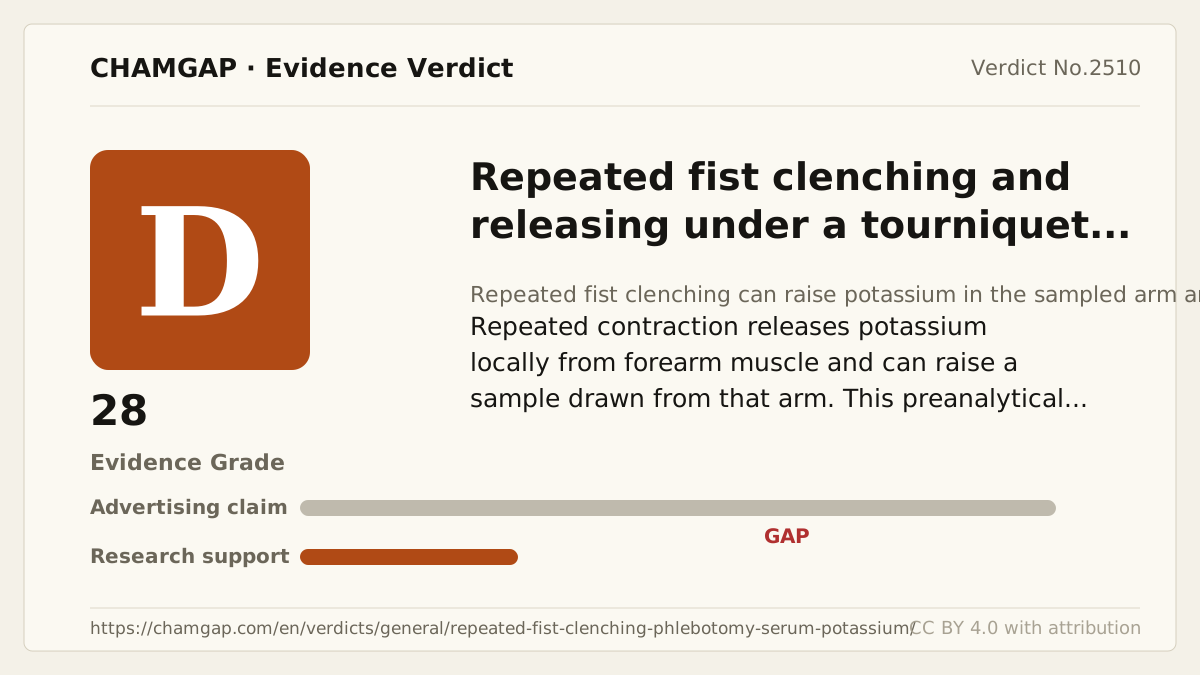
[Chamgap] Repeated fist clenching during phlebotomy x no effect on potassium — Evidence Grade D·28. 3 cited sources checked. Source: https://chamgap.com/en/verdicts/general/repeated-fist-clenching-phlebotomy-serum-potassium/ · CC BY 4.0CC BY 4.0 — free to use with attribution; do not distort grades, numbers, or verdict meaning.
What this document does and does not do
Chamgap is an information source. It reports what research has and has not confirmed; it does not tell readers what to take or buy. That decision belongs to readers and, when needed, medical or legal professionals. This verdict reflects literature available up to the search date and may change as new research appears. Nothing here is medical advice.