
Prednisolone,
does it really help with Increased complete facial-function recovery at three and nine months in adults with Bell palsy treated within 72 hours?
research showsPrednisolone is rated A for increasing complete facial-function recovery in adults treated within 72 hours of Bell palsy onset. The publicly funded Sullivan trial randomized 551 participants; complete recovery was 83.0% versus 63.6% at three months and 94.4% versus 81.6% at nine months for prednisolone versus no prednisolone. A separate large double-blind Engström trial analyzed 829 participants and found that prednisolone shortened time to complete recovery, hazard ratio 1.40. A 2016 Cochrane review of seven trials and 895 participants found incomplete recovery at six months or later in 17% versus 28%, relative risk 0.63, with a number needed to treat of about 10. Complete facial-function recovery is the treatment goal itself, not a surrogate, and its consistency across two independent Class I trials and Cochrane supports A with 82 points. Because this is not a fully hard outcome such as mortality or hospitalization and the trials used clinical scales in a condition with high natural recovery, the score remains at the low end of A. Short-course insomnia, mood change, hyperglycemia, gastrointestinal symptoms, and worsening infection remain separate safety issues.
ads claimA simplified message can treat every facial paralysis as Bell palsy and encourage immediate unsupervised corticosteroid use. Stroke, herpes zoster, Lyme disease, and middle-ear or parotid disease require different management, while incomplete eye closure needs immediate corneal protection. Evidence most directly supports a short oral course in adults clinically diagnosed with Bell palsy within 72 hours, not repeated long-term use.
Useful facts when choosing a product
- Pivotal adult trials started treatment within 72 hours and used a ten-day short course, but total doses and tapering differed, so the individual prescription should be followed.
- Prednisolone is a systemic anti-inflammatory corticosteroid and does not eradicate a latent virus as an antiviral medicine would.
- Even a short course can cause insomnia, agitation or mood change, increased appetite, dyspepsia, and higher blood pressure or glucose, and diabetes, active infection, and peptic-ulcer risk require review before prescribing.
- If the eye cannot close completely, artificial tears, ointment, and nighttime eyelid protection may be needed separately, and sudden facial paralysis with other neurologic symptoms requires emergency assessment first.
Chamgap Semantic Classification Code
Candidate index · review held
M.prednisolone.oral.complete-facial-function-recovery-at-three-and-with-bell-palsy-treated-within.increase.MULTIMedicinal interventions > Prednisolone > Oral > complete facial-function recovery at three and with Bell palsy treated within > Increase claim > Multiple: primary unresolved
An automated migration candidate, not an issued permanent code; exact claim scope remains under review. This machine-generated migration candidate helps retrieval but is not a permanent assignment. The original verdict ID and URL remain authoritative.
What the research actually shows
Sullivan and colleagues assigned patients treated within 72 hours to ten days of prednisolone, ten days of acyclovir, both, or double placebo and assessed complete recovery on the House-Brackmann scale. Final outcomes were available for 496 of 551 randomized participants; prednisolone improved recovery at three and nine months, whereas acyclovir alone or added to prednisolone did not. Engström and colleagues assigned 839 adults aged 18 to 75 years to four groups and included 829 in the modified intention-to-treat analysis; prednisolone 60 mg daily for five days followed by a five-day taper shortened time to a Sunnybrook score of 100. Cochrane combined seven older and newer trials and found less incomplete recovery and motor synkinesis. Both pivotal large trials started therapy within 72 hours, so the same benefit cannot be assumed with later treatment.
Why this is classified as A (82)
The 551-person Sullivan and 839-person Engström randomized double-blind Class I trials significantly improved complete-recovery rate or time to complete recovery, and seven trials with 895 participants in Cochrane yielded a relative risk of incomplete recovery of 0.63. Complete facial-function recovery is the treatment goal itself rather than a surrogate, so replication in two independent large trials plus the consistent synthesis supports A. Clinical-scale assessment, absence of a fully hard outcome such as mortality or hospitalization, and high natural recovery place the result at the low end of A with 82 points. Short-course corticosteroid adverse effects and misdiagnosis risk remain separate from efficacy.
Counterpoint. Onset beyond 72 hours or recurrent, bilateral, progressive, vesicular, or neurologically complex facial paralysis requires reassessment rather than automatic application of this evidence. Benefit from adding an antiviral remains much less certain than the recovery effect of prednisolone itself.
Rejudgment record. Cross-check applied — Applied low A because independent Class I randomized double-blind trials in 551 and 839 adults treated within 72 hours consistently improved complete facial-function recovery rate or time, a direct functional outcome that is the treatment goal itself, and seven trials with 895 participants yielded an incomplete-recovery relative risk of 0.63. Clinical-scale assessment, the absence of a fully hard outcome such as mortality or hospitalization, and high natural recovery kept the score at the low end of A
Sub-claim grades by effect
This ingredient is marketed for several effects. A single overall grade blends strong and weak claims together, so each effect is graded separately here. The overall grade reflects the strongest disconfirming or core claim.
| Effect (sub-claim) | Grade | Basis |
|---|---|---|
| Increased complete facial-function recovery at three months when started within 72 hours | A | In the Sullivan trial, complete recovery increased significantly to 83.0% with prednisolone versus 63.6% without it. |
| Increased complete recovery and shorter recovery time at nine to twelve months when started within 72 hours | A | Nine-month recovery was 94.4% versus 81.6% in Sullivan, and the recovery-time hazard ratio was 1.40 in Engström. |
| Reduced long-term incomplete recovery and motor synkinesis | A | Cochrane reported an incomplete-recovery relative risk of 0.63 after six months and a motor-synkinesis relative risk of 0.64. |
Cross-check — AI research and Codex final gate
Evidence Table
| Study | Design | Sample | Funding | Endpoint | Result | Weight |
|---|---|---|---|---|---|---|
| Sullivan FM et al. 2007 | Multicenter 2-by-2 factorial randomized double-blind placebo-controlled trial | 551 randomized and 496 assessed at final follow-up; treated within 72 hours | Public funding from the United Kingdom NIHR Health Technology Assessment Programme and Scottish public primary-care support | Complete facial-function recovery on the House-Brackmann scale at three and nine months | Complete recovery with versus without prednisolone was 83.0% versus 63.6% at three months and 94.4% versus 81.6% at nine months; added acyclovir provided no benefit. | Pivotal publicly funded direct functional-recovery randomized trial |
| Engström M et al. 2008 | Multicenter randomized double-blind placebo-controlled four-group trial | 839 randomized and 829 in modified intention-to-treat analysis; ages 18 to 75 and treated within 72 hours | Funding was not reported in the PubMed abstract | Time to complete facial-function recovery, defined as a Sunnybrook score of 100 | Complete recovery was faster among 416 receiving prednisolone than 413 not receiving it, HR 1.40 (95% CI 1.18 to 1.64). | Independent large replication randomized trial |
| Madhok VB et al. 2016 Cochrane review | Systematic review and meta-analysis of randomized and quasi-randomized trials | Seven trials and 895 evaluable participants | Cochrane Neuromuscular Group systematic review; funding varied across individual trials | Incomplete recovery at six months or later, motor synkinesis, and adverse effects | Incomplete recovery was 17% versus 28%, RR 0.63 (95% CI 0.50 to 0.80), NNT 10 (95% CI 6 to 20), and motor synkinesis was also reduced. | High-certainty synthesis showing consistency across trials |
Receipt — 3 References
All 3 cited sources were verified for existence at the original page (as of 2026-07-23).
Final verification and publication gate: Codex · Evidence date: 2026-07-23 · Corrections: none
Cite this verdict
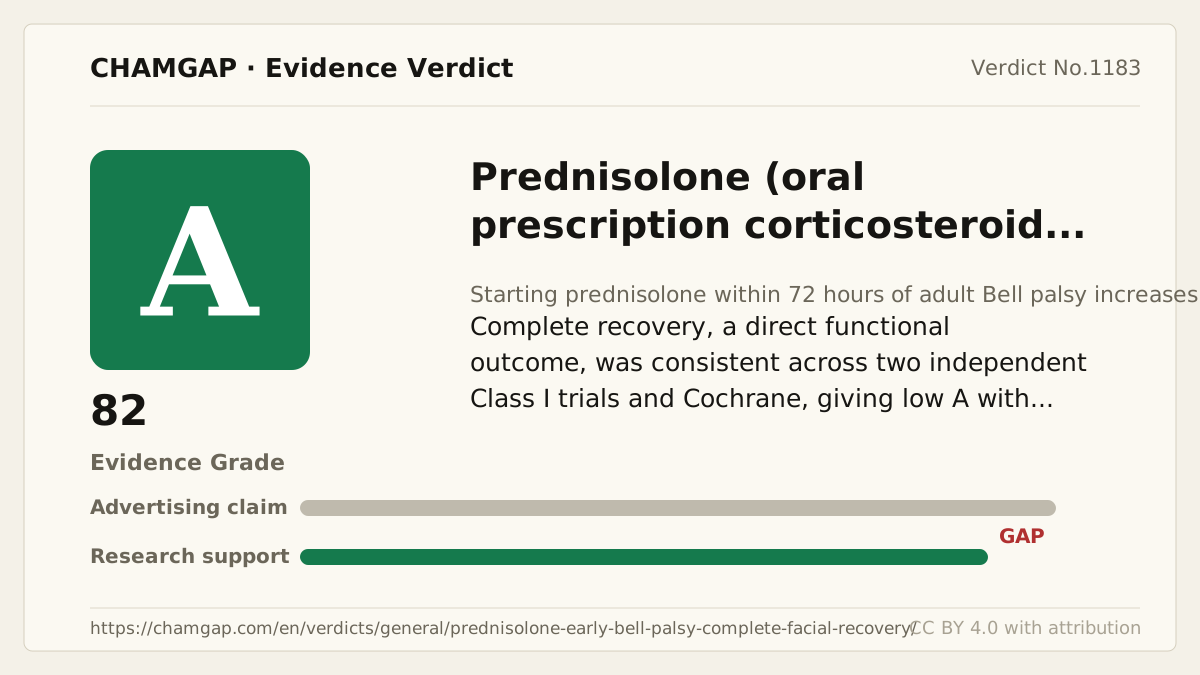
[Chamgap] Prednisolone x increased complete facial-function recovery in adults with Bell palsy treated within 72 hours — Evidence Grade A·82. 3 cited sources checked. Source: https://chamgap.com/en/verdicts/general/prednisolone-early-bell-palsy-complete-facial-recovery/ · CC BY 4.0CC BY 4.0 — free to use with attribution; do not distort grades, numbers, or verdict meaning.
What this document does and does not do
Chamgap is an information source. It reports what research has and has not confirmed; it does not tell readers what to take or buy. That decision belongs to readers and, when needed, medical or legal professionals. This verdict reflects literature available up to the search date and may change as new research appears. Nothing here is medical advice.