
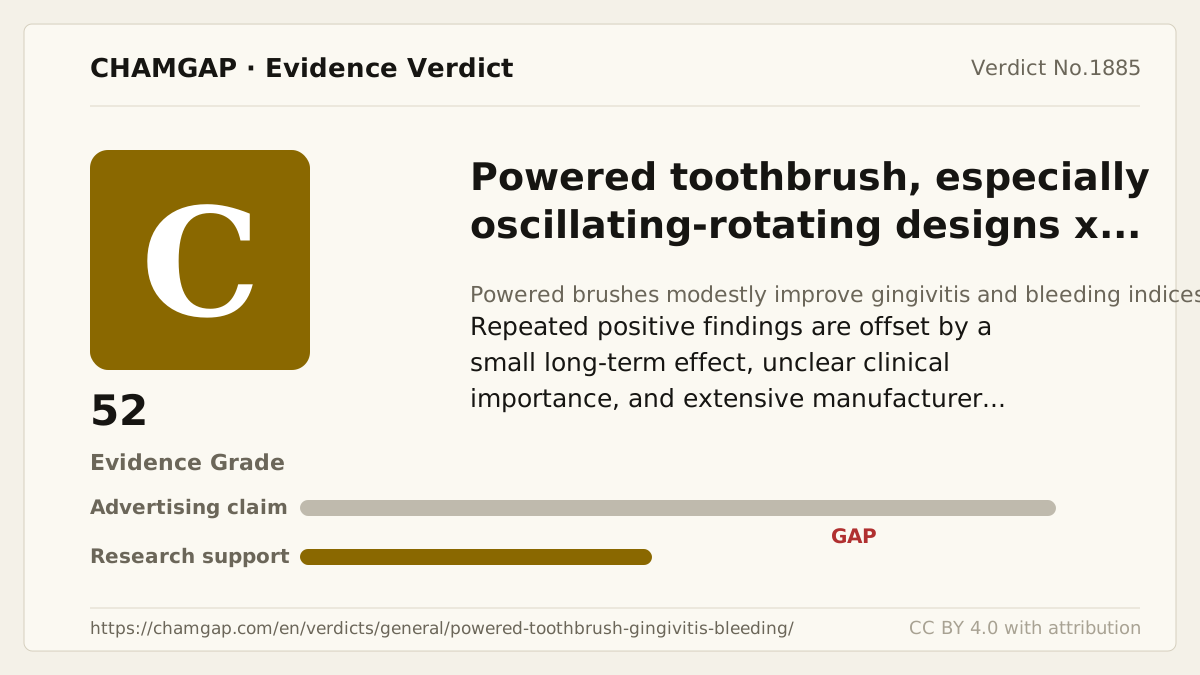
Powered toothbrush,
does it really help with Improved gingivitis and gingival-bleeding indices versus a manual toothbrush?
research showsPowered toothbrushes earn C with 50 points because they produce a small gingivitis-index improvement of unclear clinical importance. The review included 56 trials and 5,068 participants, with 51 trials suitable for meta-analysis; the beyond-three-month estimate, SMD -0.21 (95% CI -0.31 to -0.12), came from 16 trials and 1,645 participants, I-squared 51%.
ads claimThe evidence does not show that a powered brush treats periodontitis or prevents tooth loss. It shows a modest average improvement in gingivitis and bleeding indices.
Useful facts when choosing a product
- The review included 56 trials and 5,068 participants, and 51 trials were suitable for meta-analysis.
- The beyond-three-month estimate came from 16 trials and 1,645 participants.
- Funding was manufacturer support in 37 trials, a government scholarship in one, and unclear in 18.
Chamgap Semantic Classification Code
Candidate index · review held
UNK.powered-toothbrush.UNK.gingivitis-and-gingival-bleeding-indices.improve.activeUnknown > Powered toothbrush > Unknown > gingivitis and gingival-bleeding indices > Improvement claim > Active comparator
An automated migration candidate, not an issued permanent code; exact claim scope remains under review. This machine-generated migration candidate helps retrieval but is not a permanent assignment. The original verdict ID and URL remain authoritative.
What the research actually shows
Cochrane included 56 trials and 5,068 participants, with 51 trials suitable for meta-analysis. The beyond-three-month gingivitis estimate, SMD -0.21 (95% CI -0.31 to -0.12), came specifically from 16 trials and 1,645 participants, I-squared 51%, not from all 51 trials. Whether the roughly 11% index reduction was clinically important remained unclear.
Why this is classified as C (50)
Repeated positive findings are limited by a small long-term effect, unclear clinical importance, extensive manufacturer support, and few low-bias trials, giving C with 50 points.
Counterpoint. Timers, pressure sensors, and powered movement may still help people with technique or dexterity limitations.
Rejudgment record. Cross-check applied — Repeated statistical improvement in gingivitis indices, limited by a small long-term effect, unclear clinical importance, extensive manufacturer support, and heterogeneity
| Endpoint | P | Symptom or function itself is the target - including patient reports and performance tests |
| Replication | R2 | Independently replicated across trials |
| Independence | I1 | Mixed funding sources |
| Effect size | E~ | Statistically positive but below the threshold |
Stored derived and displayed grades match; this is not a current recalculation or validity check (C).
Sub-claim grades by effect
This ingredient is marketed for several effects. A single overall grade blends strong and weak claims together, so each effect is graded separately here. The overall grade reflects the strongest disconfirming or core claim.
| Effect (sub-claim) | Grade | Basis |
|---|---|---|
| Improved gingivitis indices at eight weeks | C | The manufacturer trial succeeded but was short-term. |
| Reduced gingivitis beyond three months | C | SMD -0.21 was small and of unclear clinical importance. |
| Reduced gingival bleeding | C | Findings were repeatedly positive, but measures and products were heterogeneous. |
Cross-check — AI research and Codex final gate
Evidence Table
| Study | Design | Sample | Funding | Endpoint | Result | Weight |
|---|---|---|---|---|---|---|
| Grender J et al. 2020 | Eight-week examiner-blinded randomized active-control trial | 110 randomized and 110 completers analyzed | Conducted and supported by manufacturer Procter & Gamble; two authors were P&G employees | Primary efficacy measures of MGI, GBI, and bleeding sites | All succeeded with P<0.001; healthy gingiva in 82% versus 24% | Short-term manufacturer direct trial |
| Yaacob M et al. 2014 | Cochrane systematic review and meta-analysis of randomized trials | 56 trials and 5,068 randomized; 51 trials and 4,624 pooled | Among included trials, 37 had manufacturer support, one a government scholarship, and 18 unclear funding | Short- and long-term gingivitis indices | Beyond-three-month gingivitis SMD -0.21 (95% CI -0.31 to -0.12), 16 trials and 1,645 participants, I-squared 51%; clinical importance unclear | Repeated positive evidence with a small effect |
Receipt — 2 References
All 2 cited sources were verified for existence at the original page (as of 2026-07-24).
Final verification and publication gate: Codex · Evidence date: 2026-07-24 · Corrections: none
Cite this verdict
[Chamgap] Powered toothbrush x gingivitis and gingival bleeding — Evidence Grade C·50. 2 cited sources checked. Source: https://chamgap.com/en/verdicts/general/powered-toothbrush-gingivitis-bleeding/ · CC BY 4.0CC BY 4.0 — free to use with attribution; do not distort grades, numbers, or verdict meaning.
What this document does and does not do
Chamgap is an information source. It reports what research has and has not confirmed; it does not tell readers what to take or buy. That decision belongs to readers and, when needed, medical or legal professionals. This verdict reflects literature available up to the search date and may change as new research appears. Nothing here is medical advice.