
Povidone-iodine gargle or throat spray,
does it really help with Prevention of common-cold or COVID-19 infection and progression to severe disease?
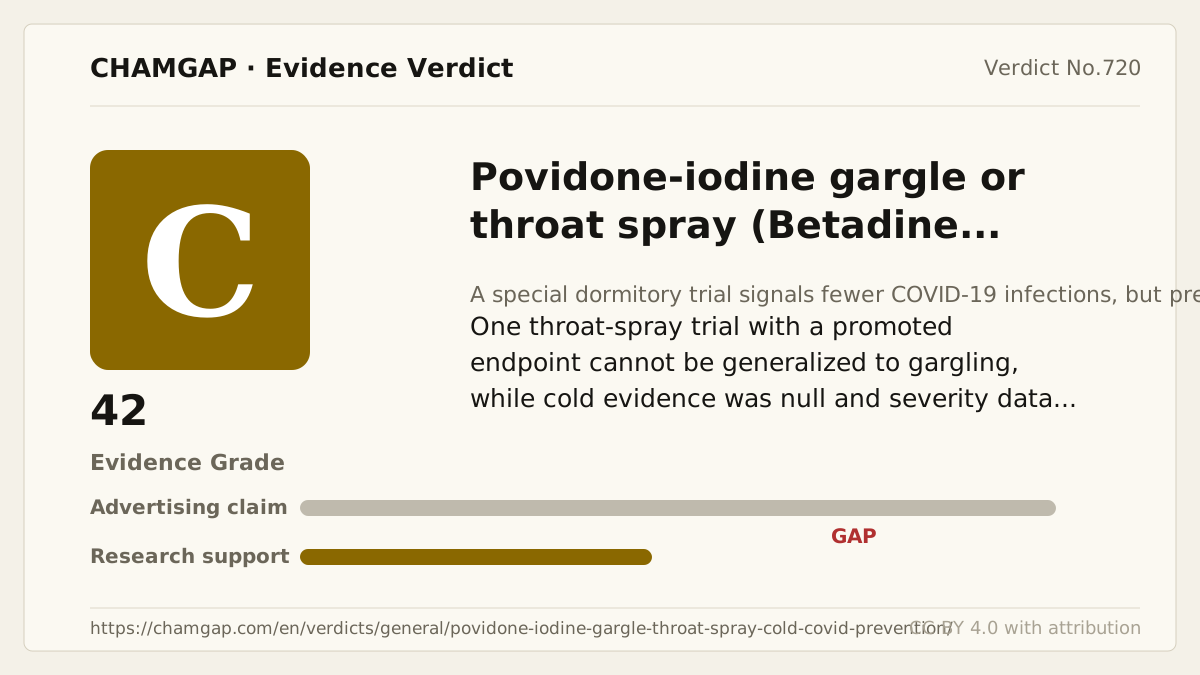
research showsPovidone-iodine receives an overall C because one randomized trial measured infection directly. The Seet 2021 intervention was not gargling: it used 0.45% povidone-iodine throat spray three times daily, and laboratory-confirmed infection was promoted from a registered secondary outcome to the primary outcome. In an open-label cluster trial across 40 Singapore dormitory floors and 3,037 men, infection occurred in 46% with spray and 70% with vitamin C. A nonplacebo comparator, one special male setting, and no independent replication prevent attribution to gargling generally. The common-cold gargle trial was null, with IRR 0.89 and 95% CI 0.60 to 1.33, while hospitalization, severe disease, and death had zero events and no efficacy data. The overall score is 42.
ads claimClaims of eliminating 99.99% of virus often convert in vitro killing or a brief reduction in oral viral load into prevention of infection, transmission, or hospitalization. Even the large effect in the single dormitory trial requires independent replication and does not justify replacing respirators, ventilation, vaccination, or proven treatment.
Useful facts when choosing a product
- Povidone-iodine gargles and throat sprays are intended for local oral and pharyngeal antisepsis, and concentration, dilution, and frequency differ by formulation and national label.
- Authorization for oral or pharyngeal antisepsis does not automatically establish clinical prevention of COVID-19 infection or hospitalization.
- The product should not be swallowed, and prolonged or excessive use can cause iodine absorption that affects thyroid function, as well as mucosal irritation, altered taste, or allergic reactions.
- Product-specific contraindications and medical advice should be checked for iodine hypersensitivity, thyroid disease, radioactive-iodine testing or treatment, pregnancy or breastfeeding, and use in children.
Chamgap Semantic Classification Code
Candidate index · review held
M.povidone-iodine-gargle-or-throat-spray.oromucosal.common-cold-or-covid-19-infection-and-progression-to-severe-disease.prevent.MULTIMedicinal interventions > Povidone-iodine gargle or throat spray > Oromucosal > common-cold or COVID-19 infection and progression to severe disease > Occurrence-prevention claim > Multiple: primary unresolved
An automated migration candidate, not an issued permanent code; exact claim scope remains under review. This machine-generated migration candidate helps retrieval but is not a permanent assignment. The original verdict ID and URL remain authoritative.
What the research actually shows
Seet 2021 cluster-randomized 40 floors of a Singapore migrant-worker dormitory to five prophylactic regimens. The relevant intervention was 0.45% povidone-iodine throat spray three times daily, not gargling. Among 3,037 baseline-seronegative men, infection occurred in 46.0% of 735 assigned to spray and 70.0% of 619 assigned to vitamin C, with a cluster-bootstrap absolute risk reduction of 24% and RR 0.66. Laboratory-confirmed infection was promoted from a registered secondary outcome to the primary outcome; each arm had eight clusters, the trial was open label, and every participant was male. Mundipharma donated product but had no design or analysis role. Satomura 2005 found povidone-iodine gargling null versus usual care, with IRR 0.89 and 95% CI 0.60 to 1.33. The prevention trial recorded zero hospitalizations and deaths in every arm, leaving no severe-outcome evidence.
Why this is classified as C (42)
A 3,037-participant cluster trial of 0.45% throat spray three times daily found fewer laboratory-confirmed infections, but the infection outcome was promoted from secondary to primary and the intervention was not gargling. One open-label male-dormitory study with 40 clusters, a nonplacebo comparator, no independent replication, a null common-cold gargle trial, and zero severe events cannot be generalized to gargling overall, yielding C with 42 points.
Counterpoint. Label-directed local antisepsis and a strategy for preventing infection are separate uses. Even if prevention is replicated, whether iodine exposure and mucosal irritation are worth accepting will depend on individual risk and duration of use.
Rejudgment record. New verdict — Accepted fewer laboratory-confirmed infections in a 3,037-man, 40-cluster trial of 0.45% povidone-iodine throat spray three times daily, but accounted for promotion of infection from a registered secondary to primary outcome, a non-gargle intervention, one open-label male dormitory, a nonplacebo comparator, no independent replication, null cold-gargle evidence, and zero severe events; Mundipharma donated product without a design or analysis role
Sub-claim grades by effect
This ingredient is marketed for several effects. A single overall grade blends strong and weak claims together, so each effect is graded separately here. The overall grade reflects the strongest disconfirming or core claim.
| Effect (sub-claim) | Grade | Basis |
|---|---|---|
| Reduction in laboratory-confirmed COVID-19 infection | C | A promoted outcome was positive in one open-label, nonplacebo male-dormitory trial of 0.45% throat spray three times daily, but independent replication is absent and the result cannot be assigned to gargling. |
| Prevention of common colds and upper respiratory tract infections | D | Povidone-iodine gargling was null in the Satomura trial, with IRR 0.89 and a 95% CI of 0.60 to 1.33. |
| Prevention of progression, hospitalization, and death after infection | ? | The prophylaxis trial recorded zero relevant events, leaving no evidence for an efficacy determination. |
Cross-check — AI research and Codex final gate
Evidence Table
| Study | Design | Sample | Funding | Endpoint | Result | Weight |
|---|---|---|---|---|---|---|
| Seet RCS et al. 2021 | Open-label parallel cluster-randomized controlled trial | 3,037 baseline-seronegative men across 40 dormitory-floor clusters; 735 assigned to 0.45% throat spray three times daily and 619 to vitamin C | Singapore public and philanthropic support; Mundipharma donated povidone-iodine and reportedly had no role in design or analysis | SARS-CoV-2 infection confirmed by PCR during 42 days or serology at day 42, promoted from a registered secondary outcome to the primary outcome | Infection occurred in 46.0% with povidone-iodine and 70.0% with vitamin C; cluster-bootstrap ARR was 24% (98.75% CI 7 to 39) and RR was 0.66 (0.48 to 0.88). | Positive promoted endpoint from one throat-spray trial, not gargling, without independent replication |
| Satomura K et al. 2005 | Randomized controlled trial | 384 healthy adults analyzed: 122 water gargling, 132 povidone-iodine gargling, and 130 usual care | Academic and community-health research; no product-company role reported | First upper respiratory tract infection and symptom severity over 60 days | Water gargling was effective, but the incidence-rate ratio for povidone-iodine was 0.89 (95% CI 0.60 to 1.33), not significant versus usual care. | Direct null evidence for common-cold prevention |
| Guenezan J et al. 2021 | Randomized controlled clinical trial | Twenty-four outpatients with mild COVID-19 and high viral load | Academic research; one author disclosed outside relationships with relevant companies | Seven-day nasopharyngeal viral RNA, infectious titer, and safety | Viral RNA trajectory was unaffected, nearly all titers were negative by day 3 in both groups, and transient TSH abnormalities occurred in 42% of exposed participants. | Small surrogate and safety study |
| Alzahrani MM et al. 2023 | Single-center randomized double-blind six-arm placebo-controlled trial | Fifty-five patients with COVID-19; six assigned to povidone-iodine | Saudi academic-institution research | Salivary SARS-CoV-2 RNA load at 5, 30, and 60 minutes after rinsing | At 60 minutes, povidone-iodine was lower than no rinse, but distilled water showed the same difference, suggesting mechanical washing; infection and hospitalization were not assessed. | Very small short-term surrogate evidence |
Receipt — 4 References
All 4 cited sources were verified for existence at the original page (as of 2026-07-19).
Final verification and publication gate: Codex · Evidence date: 2026-07-19 · Corrections: none
Cite this verdict
[Chamgap] Povidone-iodine gargle or throat spray x prevention of colds, COVID-19 infection, and severe disease — Evidence Grade C·42. 4 cited sources checked. Source: https://chamgap.com/en/verdicts/general/povidone-iodine-gargle-throat-spray-cold-covid-prevention/ · CC BY 4.0CC BY 4.0 — free to use with attribution; do not distort grades, numbers, or verdict meaning.
What this document does and does not do
Chamgap is an information source. It reports what research has and has not confirmed; it does not tell readers what to take or buy. That decision belongs to readers and, when needed, medical or legal professionals. This verdict reflects literature available up to the search date and may change as new research appears. Nothing here is medical advice.