
Pork,
does it really help with Elimination of inhaled fine dust or occupational heavy metals?
research showsThe grade is D with 28 points. Human evidence exists for the heavy-metal claim, but it is one uncontrolled before-after study of 45 auto-engine-part and leather-dye workers. The measurements were serum lead, cadmium, and zinc, urinary NAG, and blood lipids; serum-metal changes were null. No human trial directly measuring fine-particle elimination was found within this search scope.
ads claimEating pork is not the same event as particles or metals leaving the lungs or blood. A nonsignificant serum trend cannot establish increased excretion, and fine dust itself was never measured.
Useful facts when choosing a product
- The study food was a 150-g pork dish and was not restricted to pork belly.
- It was given twice weekly for six weeks without a control group.
- Serum lead, cadmium, and zinc tended to decrease without statistical significance; exact table values were not verified in the accessible material.
- Verdict 271 is ? with no score for activated charcoal and whole-body toxin removal; this verdict concerns pork, occupational metal biomarkers, and a fine-dust folklore claim.
Chamgap Semantic Classification Code
Candidate index · review held
UNK.pork.oral.elimination-of-inhaled-fine-dust-or-occupational-heavy-metals.assess.UNKUnknown > Pork > Oral > Elimination of inhaled fine dust or occupational heavy metals > Association or change assessment > Unknown
An automated migration candidate, not an issued permanent code; exact claim scope remains under review. This machine-generated migration candidate helps retrieval but is not a permanent assignment. The original verdict ID and URL remain authoritative.
What the research actually shows
Claim one, heavy-metal elimination: the 2008 study gave 45 auto-engine-part and leather-dye workers 150 g of pork twice weekly for six weeks. It measured serum zinc, lead, and cadmium, urinary NAG, and total, HDL, and LDL cholesterol plus triglycerides. Serum metals showed nonsignificant trends, urinary NAG decreased, and triglycerides increased. Without a control, changes over time, other foods, workplace exposure changes, and measurement variation cannot be separated from pork. Metal excretion was not measured. Claim two, fine-particle elimination: no trial directly measuring personal PM2.5, body particle burden, or expelled particles in humans was found within this search. Search date: 2026-08-04. Sources: PubMed, Google Scholar, KoreaScience, and the journal DOI page. Queries: the English article title; DOI 10.5851/kosfa.2008.28.1.91; pork dust detox; pork heavy metal workers; samgyeopsal mise meonji baechul, meaning pork-belly fine-dust elimination; and dwaejigogi junggeumsok baechul, meaning pork heavy-metal elimination. Result: one uncontrolled human metal-biomarker study and no direct human fine-particle-elimination trial found.
Why this is classified as D (28)
Human biomarker data exist, but the core metal result was null in an uncontrolled 45-person study and neither particles nor excretion were measured, giving D with 28 points. There is no repeated same-indication refutation for F.
Counterpoint. Pork provides protein and nutrients, but that separate fact does not establish elimination of inhaled pollutants.
Rejudgment record. Cross-check applied — After Korean and English repeat searches, the null serum-metal findings, no comparator, no fine-particle or excretion measurement, and unverified confidence intervals in the sole 45-person study were assessed
| Endpoint | S | Surrogate marker - laboratory or imaging measures |
| Replication | R1 | Single confirmatory trial |
| Independence | I1 | Mixed funding sources |
| Effect size | E0 | Null |
| Precision | CX | No pooled confidence interval could be confirmed |
Stored derived and displayed grades match; this is not a current recalculation or validity check (D).
Sub-claim grades by effect
This ingredient is marketed for several effects. A single overall grade blends strong and weak claims together, so each effect is graded separately here. The overall grade reflects the strongest disconfirming or core claim.
| Effect (sub-claim) | Grade | Basis |
|---|---|---|
| Reduction in serum lead and cadmium | D | Trends were not statistically significant and there was no control. |
| Elimination of inhaled fine particles | ? | The human study did not measure fine particles or particle excretion. |
Cross-check — AI research and Codex final gate
Evidence Table
| Study | Design | Sample | Funding | Endpoint | Result | Weight |
|---|---|---|---|---|---|---|
| Han CK, Rho JH, and Lee BH. 2008 | Uncontrolled single-group before-after study | 45 workers occupationally exposed to unclean environments | Specific funding not verified | Serum Zn, Pb, Cd, urinary NAG, and blood lipids | Zn, Pb, and Cd showed nonsignificant downward trends; NAG decreased; triglycerides increased (P<0.005). | Only relevant human evidence |
Receipt — 1 References
All 1 cited sources were verified for existence at the original page (as of 2026-08-04).
Final verification and publication gate: Codex · Evidence date: 2026-08-04 · Corrections: none
Cite this verdict
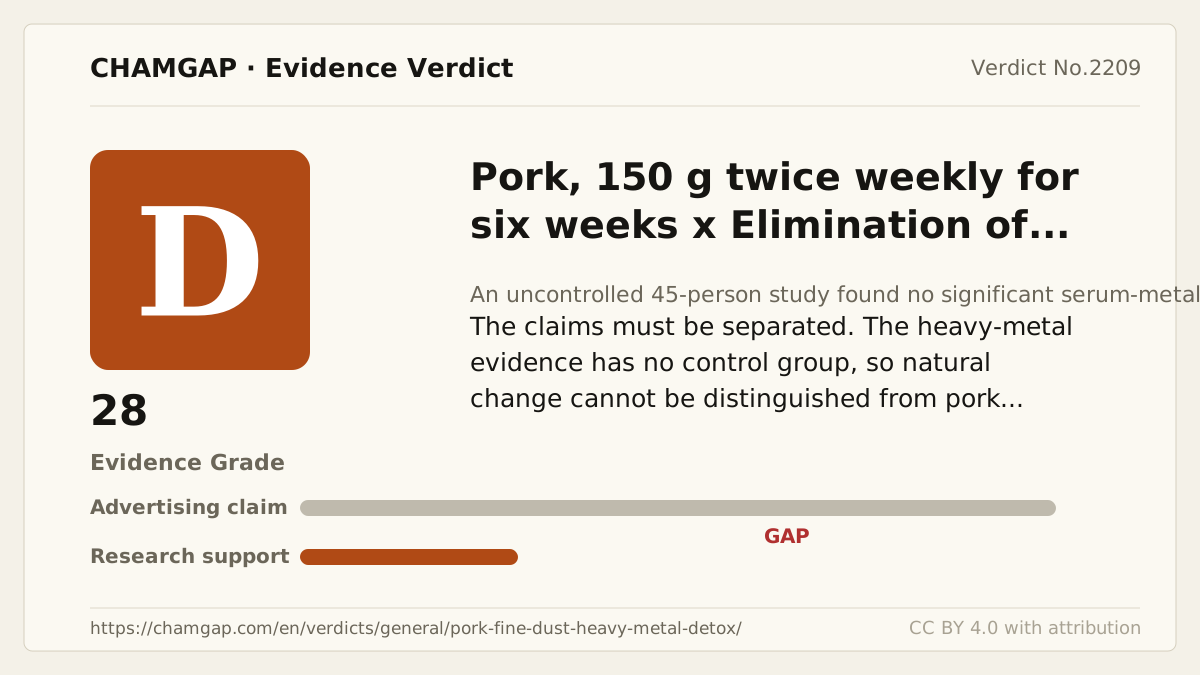
[Chamgap] Pork x fine-dust and heavy-metal detoxification — Evidence Grade D·28. 1 cited sources checked. Source: https://chamgap.com/en/verdicts/general/pork-fine-dust-heavy-metal-detox/ · CC BY 4.0CC BY 4.0 — free to use with attribution; do not distort grades, numbers, or verdict meaning.
What this document does and does not do
Chamgap is an information source. It reports what research has and has not confirmed; it does not tell readers what to take or buy. That decision belongs to readers and, when needed, medical or legal professionals. This verdict reflects literature available up to the search date and may change as new research appears. Nothing here is medical advice.