
Poractant alfa,
does it really help with Reduction of neonatal mortality and pneumothorax in preterm respiratory distress syndrome?
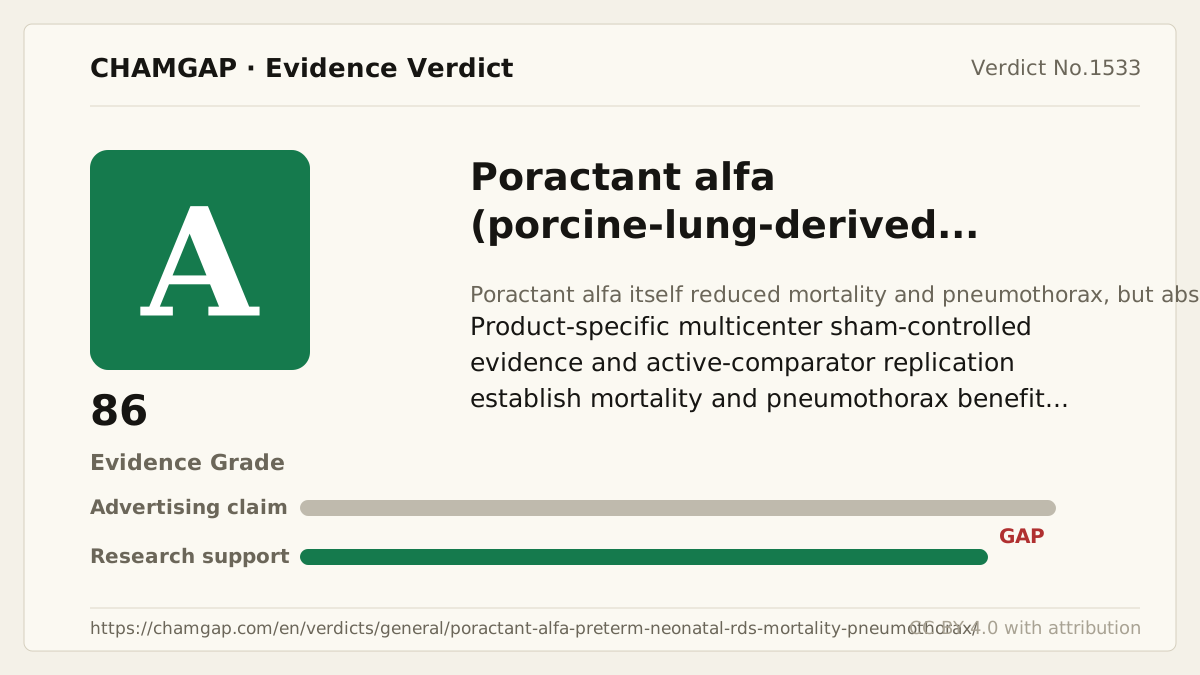
research showsPoractant alfa is rated A because product-specific randomized evidence directly reduced mortality and pneumothorax in preterm respiratory distress syndrome. A 1988 multicenter sham-controlled trial and FDA label Study 1 reported 28-day mortality of 31% versus 48% and pneumothorax of 21% versus 36%. A repeat-dose trial added product- and regimen-specific support, and an active-comparator trial against pumactant reproduced lower predischarge mortality at 14.1% versus 31.0%. However, the pivotal trials date from the 1980s and 1990s, and current standard care uses early CPAP followed by selective surfactant, so the historical absolute benefit may not be reproduced unchanged today.
ads claimClass-wide surfactant results may be expanded to every dose and regimen of one product. This verdict is restricted to poractant alfa itself under the tested intratracheal conditions.
Useful facts when choosing a product
- Poractant alfa is a natural surfactant purified from porcine lung and contains phospholipids and hydrophobic proteins SP-B and SP-C.
- It is a prescription intratracheal medicine for preterm RDS; initial and repeat dosing follow the product label and neonatal intensive-care protocol.
- Transient bradycardia, oxygen desaturation, hypotension, endotracheal-tube blockage, or reflux can occur during administration, requiring ventilation and oxygenation monitoring.
- Unlike antenatal corticosteroids or delayed cord clamping, this is a postnatal intratracheal treatment for pulmonary surfactant deficiency.
Chamgap Semantic Classification Code
Candidate index · review held
M.poractant-alfa.UNK.neonatal-mortality-and-pneumothorax-in-preterm-respiratory-distress-syndrome.reduce.MULTIMedicinal interventions > Poractant alfa > Unknown > neonatal mortality and pneumothorax in preterm respiratory distress syndrome > Reduction claim > Multiple: primary unresolved
An automated migration candidate, not an issued permanent code; exact claim scope remains under review. This machine-generated migration candidate helps retrieval but is not a permanent assignment. The original verdict ID and URL remain authoritative.
What the research actually shows
The 1988 Collaborative European Multicenter Study Group trial randomized 146 preterm infants with severe RDS to poractant alfa 200 mg/kg or sham disconnection and manual ventilation. In FDA-verified data, 28-day mortality was 24/78 (31%) versus 32/67 (48%), pneumothorax was 21% versus 36%, and pulmonary interstitial emphysema was 21% versus 38%. Speer 1992 randomized 343 infants who all received an initial 200 mg/kg dose to one dose or up to two additional doses; pneumothorax was 18% versus 9% and 28-day mortality 21% versus 13%, while death or BPD was 33% versus 27% (p=0.08). Ainsworth 2000 randomized 212 infants to poractant alfa or pumactant and found predischarge mortality of 14.1% versus 31.0%, OR 0.37, but this was an early-stopped active-comparator trial.
Why this is classified as A (86)
A poractant-specific multicenter sham-controlled trial reported 28-day mortality of 31% versus 48% and pneumothorax of 21% versus 36%, and an active-comparator trial reproduced a predischarge mortality benefit. Because the pivotal trials date from the 1980s and 1990s and current care uses early CPAP followed by selective surfactant, the historical absolute benefit may not be reproduced unchanged today, giving A with 86 points.
Counterpoint. BPD was 18% versus 22% and nonsignificant in the early sham-controlled trial, while the death-or-BPD composite in the repeat-dose trial had p=0.08.
Rejudgment record. Cross-check applied — A multicenter sham-controlled randomized trial of poractant alfa itself directly reduced 28-day mortality and pneumothorax, while repeat-dose and active-comparator trials added product- and regimen-specific hard-endpoint support. The score reflects that pivotal trials date from the 1980s and 1990s and that modern standard care uses early CPAP followed by selective surfactant
Sub-claim grades by effect
This ingredient is marketed for several effects. A single overall grade blends strong and weak claims together, so each effect is graded separately here. The overall grade reflects the strongest disconfirming or core claim.
| Effect (sub-claim) | Grade | Basis |
|---|---|---|
| Reduction in neonatal mortality | A | A poractant-specific multicenter sham-controlled trial and repeat-dose and active-comparator trials directly established lower mortality. |
| Reduction in pneumothorax and air leak | A | Multicenter sham-controlled and repeat-dose trials directly established reductions in pneumothorax and air leak. |
| Reduction in bronchopulmonary dysplasia | C | BPD alone in the early direct trial and the death-or-BPD composite in the repeat-dose trial were not significant. |
Cross-check — AI research and Codex final gate
Evidence Table
| Study | Design | Sample | Funding | Endpoint | Result | Weight |
|---|---|---|---|---|---|---|
| Collaborative European Multicenter Study Group. 1988 | Multicenter randomized sham-controlled trial | 146 preterm infants with severe RDS; verified analysis included 78 poractant and 67 control infants | European multicenter academic and product-development context; detailed reporting was limited | 28-day mortality, pneumothorax, pulmonary interstitial emphysema, and BPD | Poractant favored 28-day mortality (31% vs 48%), pneumothorax (21% vs 36%), and interstitial emphysema (21% vs 38%); BPD was nonsignificant at 18% versus 22%. | Pivotal product-specific no-treatment comparison |
| Speer CP et al. 1992 | Multicenter randomized single- versus multiple-dose trial | 343 preterm infants with severe RDS | European multicenter study in a manufacturer product-development context | 28-day mortality, pneumothorax, and death-or-BPD composite | Multiple versus single dosing yielded mortality of 13% versus 21% and pneumothorax of 9% versus 18%; death or BPD was 27% versus 33% (p=0.08). | Product- and regimen-specific supporting trial |
| Ainsworth SB et al. 2000 | Multicenter randomized active-comparator trial | 212 neonates born at 25 to 29 weeks; 199 analyzed | United Kingdom non-government research support in a product-comparison context | Predischarge mortality | Mortality was 14.1% with poractant versus 31.0% with pumactant, OR 0.37 (95% CI 0.18 to 0.76; p=0.006), but the trial stopped early. | Active-comparator support limited by early stopping |
Receipt — 4 References
All 4 cited sources were verified for existence at the original page (as of 2026-07-23).
Final verification and publication gate: Codex · Evidence date: 2026-07-23 · Corrections: none
Cite this verdict
[Chamgap] Poractant alfa x reduction of neonatal mortality and pneumothorax in preterm respiratory distress syndrome — Evidence Grade A·86. 4 cited sources checked. Source: https://chamgap.com/en/verdicts/general/poractant-alfa-preterm-neonatal-rds-mortality-pneumothorax/ · CC BY 4.0CC BY 4.0 — free to use with attribution; do not distort grades, numbers, or verdict meaning.
What this document does and does not do
Chamgap is an information source. It reports what research has and has not confirmed; it does not tell readers what to take or buy. That decision belongs to readers and, when needed, medical or legal professionals. This verdict reflects literature available up to the search date and may change as new research appears. Nothing here is medical advice.