
Personal permanent hair-dye use,
does it really help with Higher incidence of hematopoietic cancer?
research showsThe grade is D. A prospective cohort followed 117,200 nurses for 36 years and found no association between personal permanent-dye use and 1,807 hematopoietic cancers overall. A positive result appeared in the small Hodgkin lymphoma subgroup among women with naturally dark hair, while actual dye shade was not measured, so the overall null result neither proves harm nor establishes safety.
ads claimThis verdict concerns personal application of permanent dye. Occupational exposure in hairdressers involves different mixtures and intensity and was not pooled into this assessment.
Useful facts when choosing a product
- The study recorded ever-use, frequency, total years, and age at first permanent-dye use.
- Temporary rinses were excluded and semipermanent dye was not a separately measured exposure.
- Actual dye shade and ingredients were not measured; natural hair color was recorded.
- There were 1,807 hematopoietic cancers overall and 70 Hodgkin lymphomas.
Chamgap Semantic Classification Code
Candidate index · review held
UNK.personal-use-of-permanent-hair-dye.UNK.higher-incidence-of-hematopoietic-cancer.increase.UNKUnknown > Personal use of permanent hair dye > Unknown > Higher incidence of hematopoietic cancer > Increase claim > Unknown
An automated migration candidate, not an issued permanent code; exact claim scope remains under review. This machine-generated migration candidate helps retrieval but is not a permanent assignment. The original verdict ID and URL remain authoritative.
What the research actually shows
Zhang and colleagues followed 117,200 cancer-free participants in the Nurses' Health Study for as long as 36 years. The 1976 questionnaire covered ever-use, duration, and age at first permanent-dye use; 1978, 1980, and 1982 updates asked current use and the interval between applications. Cumulative dose combined average frequency and duration. Temporary rinses were excluded, and semipermanent products were not measured separately. Natural hair color was used for stratification, but dye darkness was not asked. The cohort was supported through US National Institutes of Health funding. The original wording on hair-dye manufacturer funding could not be confirmed. Although 1,807 total events were reported, exposure-group-specific absolute incidence was not provided.
Why this is classified as D (34)
A large prospective cohort was null overall, but it remains one cohort with dated self-reported exposure and many subtype comparisons. Precision did not exclude a meaningful increase, giving D with 34 points.
Counterpoint. D does not prove that risk is absent. No overall association was observed, but the small Hodgkin subgroup signal and exposure limitations prevent either harm or safety from being established.
Rejudgment record. Cross-check applied — Overall and subtype findings from the prospective cohort, with exposure definition and long-term misclassification considered
| Endpoint | H | Hard endpoint - actual events such as death |
| Replication | R1 | Single confirmatory trial |
| Independence | I2 | Decisive evidence is publicly or non-profit funded |
| Effect size | E0 | Null |
| Precision | C0 | The confidence interval leaves room for benefit |
Stored derived and displayed grades match; this is not a current recalculation or validity check (D).
Sub-claim grades by effect
This ingredient is marketed for several effects. A single overall grade blends strong and weak claims together, so each effect is graded separately here. The overall grade reflects the strongest disconfirming or core claim.
| Effect (sub-claim) | Grade | Basis |
|---|---|---|
| Higher overall hematopoietic-cancer incidence | D | Across 1,807 events, HR was 1.00, 95% CI 0.91-1.10. |
| Higher Hodgkin lymphoma incidence in a subgroup | C | A dose analysis among 24 cases in women with dark natural hair was positive, but it was a small result among multiple subgroups. |
| Higher incidence of other hematopoietic subtypes | D | Follicular lymphoma, CLL/SLL, multiple myeloma, and myeloid leukemia showed no consistent increase. |
Cross-check — AI research and Codex final gate
Evidence Table
| Study | Design | Sample | Funding | Endpoint | Result | Weight |
|---|---|---|---|---|---|---|
| Zhang et al. 2020 Nurses' Health Study | Prospective cohort | 117,200 participants, up to 36 years, 1,807 hematopoietic cancers | Public cohort supported by the US NIH; the original wording on hair-dye manufacturer funding could not be confirmed | Incident hematopoietic cancers overall and by subtype | Overall HR 1.00, 95% CI 0.91-1.10; a positive signal was limited to Hodgkin lymphoma in the dark-natural-hair stratum | Large prospective evidence, but one cohort with dated exposure measurement |
Receipt — 1 References
All 1 cited sources were verified for existence at the original page (as of 2026-08-05).
Final verification and publication gate: Codex · Evidence date: 2026-08-05 · Corrections: none
Cite this verdict
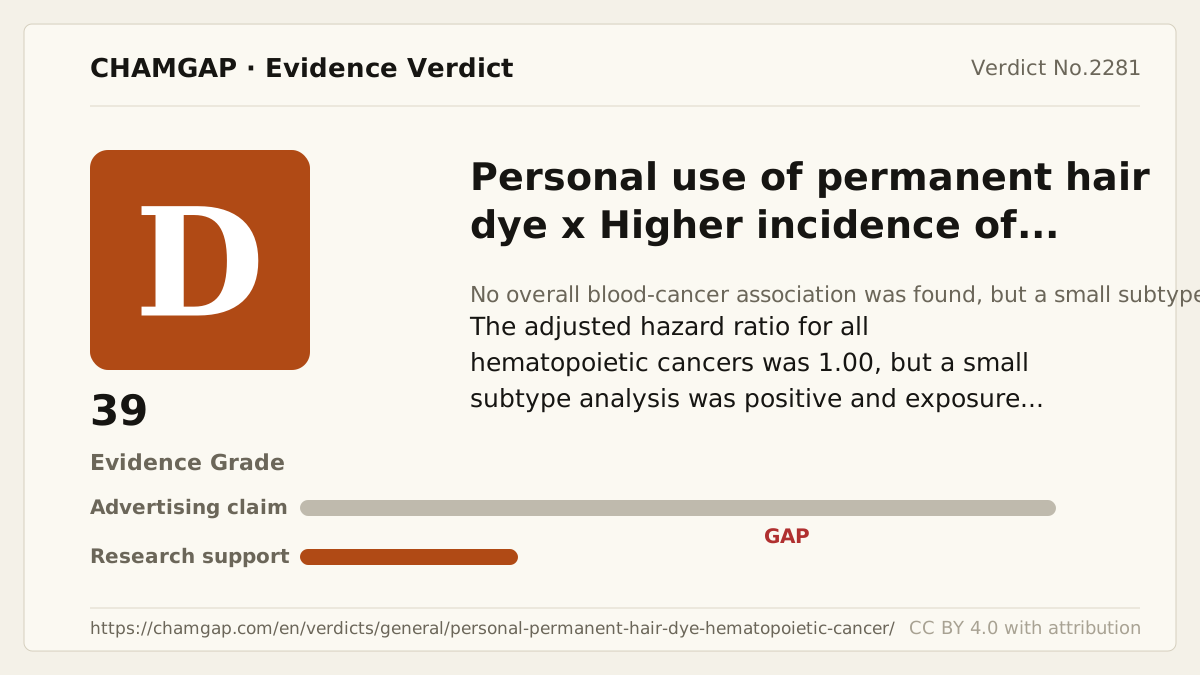
[Chamgap] Personal permanent hair-dye use x hematopoietic cancer — Evidence Grade D·34. 1 cited sources checked. Source: https://chamgap.com/en/verdicts/general/personal-permanent-hair-dye-hematopoietic-cancer/ · CC BY 4.0CC BY 4.0 — free to use with attribution; do not distort grades, numbers, or verdict meaning.
What this document does and does not do
Chamgap is an information source. It reports what research has and has not confirmed; it does not tell readers what to take or buy. That decision belongs to readers and, when needed, medical or legal professionals. This verdict reflects literature available up to the search date and may change as new research appears. Nothing here is medical advice.