
Pegfilgrastim,
does it really help with Primary prevention of febrile neutropenia and related hospitalization during myelosuppressive chemotherapy?
research showsPrimary pegfilgrastim prophylaxis is rated at the top of B. In a double-blind placebo-controlled trial of 928 patients with breast cancer, febrile neutropenia fell from 17% to 1%, related hospitalization from 14% to 1%, and intravenous anti-infective use from 10% to 2% (all P<0.001). A synthesis comparing pegfilgrastim with no primary prophylaxis also found a febrile-neutropenia risk ratio of 0.30. However, this is supportive care, the pivotal placebo evidence comes from one cancer setting and one manufacturer program, and infection mortality or overall survival has not been independently replicated for the pegfilgrastim molecule itself. It is therefore B with 79 points rather than A.
ads claimClaims that pegfilgrastim boosts general immunity or improves cancer survival exceed the evidence. The established benefit is prevention of febrile neutropenia and related hospitalization or intravenous anti-infective use during high-risk myelosuppressive chemotherapy; it does not treat the cancer itself.
Useful facts when choosing a product
- A common adult regimen is 6 mg subcutaneously once per chemotherapy cycle. It is administered at least 24 hours after cytotoxic chemotherapy and generally not within 14 days before the next chemotherapy dose.
- Primary prophylaxis is considered when the chemotherapy regimen has about a 20% or greater febrile-neutropenia risk, or at lower regimen risk when age, previous neutropenia, or comorbidity raises individual risk.
- Bone pain and pain in the extremities are the most common adverse effects. Splenic rupture, acute respiratory distress syndrome, severe allergy, capillary leak syndrome, and glomerulonephritis are rare but important.
- Fever still requires urgent evaluation for infection and febrile neutropenia even after pegfilgrastim. The drug is not an antibiotic for an established infection and requires oncology prescribing and follow-up.
Chamgap Semantic Classification Code
Candidate index · review held
M.pegfilgrastim.UNK.primary-prevention-of-febrile-neutropenia-and-related-hospitalization-during-myelosuppressive-chemotherapy.prevent.placeboMedicinal interventions > Pegfilgrastim > Unknown > Primary prevention of febrile neutropenia and related hospitalization during myelosuppressive chemotherapy > Occurrence-prevention claim > Placebo
An automated migration candidate, not an issued permanent code; exact claim scope remains under review. This machine-generated migration candidate helps retrieval but is not a permanent assignment. The original verdict ID and URL remain authoritative.
What the research actually shows
Vogel and colleagues double-masked 928 patients with breast cancer to pegfilgrastim 6 mg or placebo on day 2 of each three-week docetaxel cycle, with 463 assigned to pegfilgrastim and 465 to placebo. Febrile neutropenia was 1% versus 17%, related hospitalization 1% versus 14%, and intravenous anti-infective use 2% versus 10%. The Cooper systematic review estimated a febrile-neutropenia risk ratio of 0.30 (95% CI 0.14 to 0.65) across five pegfilgrastim studies versus no primary prophylaxis, but it was supported by Amgen. Kuderer's meta-analysis of 17 randomized trials found that primary prophylaxis with multiple G-CSFs reduced febrile neutropenia, infection-related mortality, and early mortality during chemotherapy, while data on disease-free and overall survival were insufficient. Reductions in overall or infection-related mortality are class effects of G-CSFs and cannot be attributed specifically to pegfilgrastim alone.
Why this is classified as B (79)
The 928-patient placebo-controlled trial found febrile neutropenia of 1% versus 17% and related hospitalization of 1% versus 14%, a large molecule-specific clinical effect; five pegfilgrastim studies yielded a pooled risk ratio of 0.30. Yet the pivotal direct and pooled evidence is manufacturer-linked and centered on supportive care and selected chemotherapy settings, while reductions in overall or infection-related mortality are G-CSF class effects that cannot be attributed specifically to pegfilgrastim alone. This places the verdict at the A boundary but within B, with 79 points.
Counterpoint. For chemotherapy with high baseline febrile-neutropenia risk, the absolute benefit is large and can reduce hospitalization and treatment disruption. For low-risk regimens, smaller absolute benefit must be weighed against cost, bone pain, and rare serious harm.
Rejudgment record. Cross-check applied — Applied high B because a 928-patient placebo-controlled trial showed very large molecule-specific reductions in febrile neutropenia and related hospitalization and meta-analysis agreed, but this is supportive care based on a manufacturer-linked pivotal trial in one cancer setting and manufacturer-supported synthesis, while mortality data combine multiple G-CSFs and fail the molecule-specific requirement in rule ⑤
Sub-claim grades by effect
This ingredient is marketed for several effects. A single overall grade blends strong and weak claims together, so each effect is graded separately here. The overall grade reflects the strongest disconfirming or core claim.
| Effect (sub-claim) | Grade | Basis |
|---|---|---|
| Primary prevention of febrile neutropenia | B | The 928-patient trial found 1% versus 17% and the pooled risk ratio was 0.30, but the evidence is manufacturer-linked. |
| Prevention of febrile-neutropenia-related hospitalization | B | The pivotal trial found 1% versus 14%, but this was a secondary clinical endpoint in one chemotherapy setting. |
| Reduced intravenous anti-infective use related to febrile neutropenia | B | The pivotal trial found a reduction from 10% to 2%. |
Cross-check — AI research and Codex final gate
Evidence Table
| Study | Design | Sample | Funding | Endpoint | Result | Weight |
|---|---|---|---|---|---|---|
| Vogel CL et al. 2005 | Multicenter randomized double-blind placebo-controlled phase 3 trial | 928 docetaxel-treated patients with breast cancer; 463 pegfilgrastim and 465 placebo | Sponsored by Amgen | Febrile neutropenia across chemotherapy cycles; related hospitalization and intravenous anti-infective use | Febrile neutropenia was 1% versus 17%, related hospitalization 1% versus 14%, and intravenous anti-infective use 2% versus 10%; all P<0.001. | Core molecule-specific clinical randomized trial |
| Cooper KL et al. 2011 | Systematic review and random-effects meta-analysis | Twenty studies versus no primary prophylaxis; five pegfilgrastim studies | Supported by Amgen Ltd and Amgen Europe | Incidence of febrile neutropenia | Risk ratio 0.30 for pegfilgrastim versus no primary prophylaxis (95% CI 0.14 to 0.65). | Consistency synthesis limited by industry support |
| Kuderer NM et al. 2007 | Systematic review and meta-analysis of randomized trials of primary G-CSF prophylaxis | 17 randomized trials and 3,493 adults with cancer | Academic synthesis; included trials covered multiple G-CSFs and funding sources | Febrile neutropenia, infection-related mortality, early mortality during chemotherapy, and relative dose intensity | Across G-CSFs, risk ratios were 0.54 for febrile neutropenia, 0.55 for infection-related mortality, and 0.60 for early mortality; disease-free and overall-survival data were insufficient. | Class-level evidence, not molecule-specific mortality evidence |
Receipt — 3 References
All 3 cited sources were verified for existence at the original page (as of 2026-07-24).
Final verification and publication gate: Codex · Evidence date: 2026-07-24 · Corrections: none
Cite this verdict
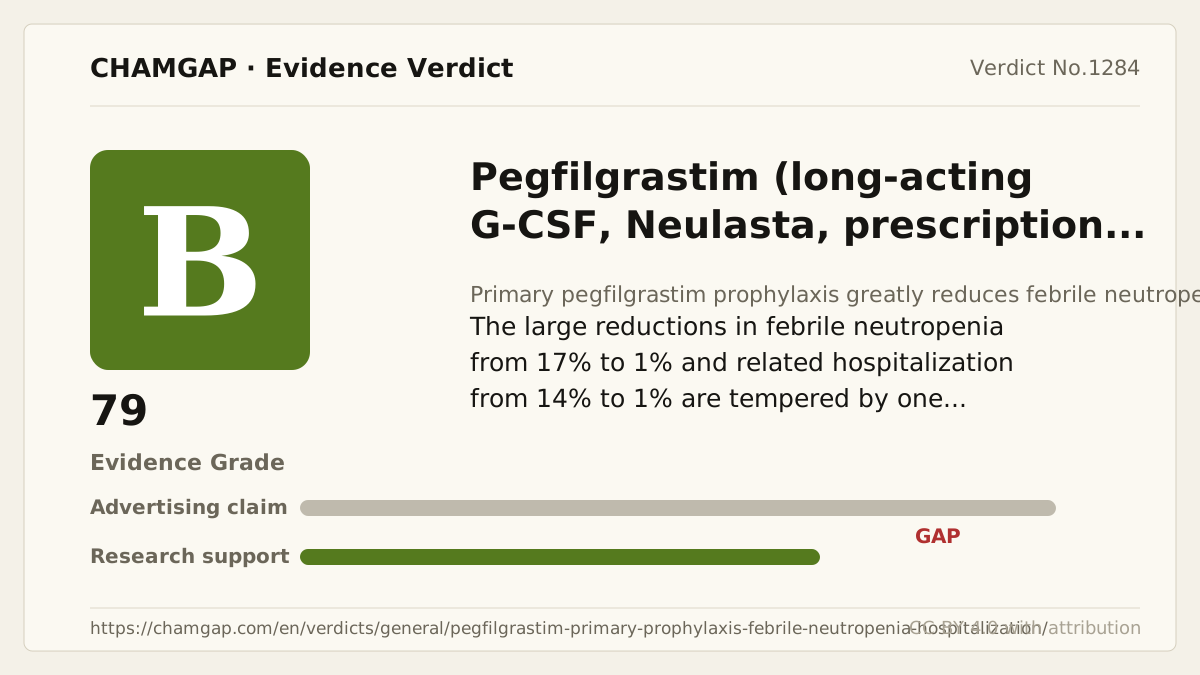
[Chamgap] Pegfilgrastim x primary prevention of febrile neutropenia and related hospitalization — Evidence Grade B·79. 3 cited sources checked. Source: https://chamgap.com/en/verdicts/general/pegfilgrastim-primary-prophylaxis-febrile-neutropenia-hospitalization/ · CC BY 4.0CC BY 4.0 — free to use with attribution; do not distort grades, numbers, or verdict meaning.
What this document does and does not do
Chamgap is an information source. It reports what research has and has not confirmed; it does not tell readers what to take or buy. That decision belongs to readers and, when needed, medical or legal professionals. This verdict reflects literature available up to the search date and may change as new research appears. Nothing here is medical advice.