
Osimertinib,
does it really help with Prolonged overall survival with adjuvant therapy after complete resection of stage IB to IIIA EGFR-mutated non-small-cell lung cancer?
research showsOsimertinib is rated A because adjuvant treatment prolongs overall survival after complete resection of stage IB to IIIA non-small-cell lung cancer with an EGFR exon 19 deletion or exon 21 L858R mutation. ADAURA randomized 682 patients under double masking to osimertinib 80 mg daily or placebo. In the planned final survival analysis, five-year overall survival in stage II to IIIA disease was 85% versus 73%, HR for death 0.49 (95.03% CI 0.33 to 0.73), and in the full stage IB to IIIA population it was 88% versus 78%, HR 0.49 (95.03% CI 0.34 to 0.70). Disease-free survival and CNS recurrence also improved substantially. The single manufacturer-funded program and three-year treatment burden reduce the score, but a molecule-specific overall-survival hard-endpoint benefit in a placebo-controlled randomized trial supports A.
ads claimMarketing may describe osimertinib as a cure that nearly eliminates recurrence after surgery. The evidence applies to up to three years of adjuvant treatment after complete resection in tumors with specified common sensitizing EGFR mutations. It does not automatically apply to every EGFR mutation, unresectable lung cancer, or omission of indicated standard adjuvant chemotherapy.
Useful facts when choosing a product
- ADAURA used osimertinib 80 mg once daily for up to three years, with earlier discontinuation for recurrence or unacceptable toxicity.
- Adjuvant treatment applies when a completely resected tumor has an EGFR exon 19 deletion or exon 21 L858R mutation confirmed by an appropriate test. ADAURA results cannot automatically be extended to other rare EGFR variants.
- Diarrhea, rash, paronychia, and stomatitis are common, and liver enzymes can rise. Liver tests should be assessed according to clinical status and routine oncology monitoring.
- New or worsening dyspnea, cough, or fever requires evaluation for interstitial lung disease or pneumonitis. Patients at risk for QTc prolongation or cardiomyopathy may require electrocardiographic, electrolyte, and left-ventricular-function monitoring.
Chamgap Semantic Classification Code
Candidate index · review held
M.osimertinib.UNK.prolonged-overall-survival-with-adjuvant-therapy-after-complete-resection-of-stage-ib-to-iiia-egfr-mutated-non-small-cell-lung-cancer.assess.placeboMedicinal interventions > Osimertinib > Unknown > Prolonged overall survival with adjuvant therapy after complete resection of stage IB to IIIA EGFR-mutated non-small-cell lung cancer > Association or change assessment > Placebo
An automated migration candidate, not an issued permanent code; exact claim scope remains under review. This machine-generated migration candidate helps retrieval but is not a permanent assignment. The original verdict ID and URL remain authoritative.
What the research actually shows
The 2020 primary analysis by Wu and the ADAURA Investigators treated 682 patients with completely resected stage IB to IIIA EGFR-mutated disease with osimertinib 80 mg daily for up to three years. At 24 months, disease-free survival in stage II to IIIA disease was 90% versus 44%, HR for recurrence or death 0.17 (99.06% CI 0.11 to 0.26), and the HR in the full stage IB to IIIA population was 0.20. The planned final overall-survival analysis by Tsuboi and the ADAURA Investigators in 2023 found five-year survival of 85% versus 73% in stage II to IIIA disease and 88% versus 78% overall, with HR for death 0.49 in both populations. The CNS disease-free-survival advantage persisted, with HR 0.36 for CNS recurrence or death in the updated analysis. ADAURA allowed enrollment with or without prior adjuvant chemotherapy, but it was not designed to show that osimertinib replaces platinum chemotherapy whenever chemotherapy is indicated.
Why this is classified as A (86)
In the 682-participant placebo-controlled ADAURA phase 3 trial, planned final overall survival improved to 88% versus 78% at five years in stage IB to IIIA disease, HR for death 0.49. Disease-free survival and CNS recurrence findings were consistent and molecular attribution was clear. Concentration of all pivotal data in one AstraZeneca program and sample size reduce the score to 86 within grade A.
Counterpoint. EGFR mutation, stage, completeness of resection, indication for adjuvant chemotherapy, and cardiopulmonary risk should be assessed in a multidisciplinary setting. For lower-risk patients, the absolute benefit and burden of three years of treatment require individualized discussion.
Rejudgment record. Cross-check applied — Applied rule ⑤ to the molecule-specific hard-endpoint benefit in the 682-participant, double-blind, placebo-controlled ADAURA phase 3 trial, where randomized adjuvant osimertinib after complete resection improved five-year overall survival with HR for death 0.49, while deducting for concentration in a single AstraZeneca program
Sub-claim grades by effect
This ingredient is marketed for several effects. A single overall grade blends strong and weak claims together, so each effect is graded separately here. The overall grade reflects the strongest disconfirming or core claim.
| Effect (sub-claim) | Grade | Basis |
|---|---|---|
| Prolonged overall survival after complete resection of stage IB to IIIA EGFR-mutated NSCLC | A | Five-year survival was 88% versus 78%, with HR for death 0.49 (95.03% CI 0.34 to 0.70). |
| Prolonged disease-free survival after complete resection of stage IB to IIIA EGFR-mutated NSCLC | B | HR for recurrence or death was 0.20 overall, a large effect that persisted with longer follow-up. |
| Reduction in central nervous system recurrence | C | HR for CNS recurrence or death was 0.18 in the primary analysis and 0.36 in the updated analysis, but event counts were lower than for overall recurrence. |
Cross-check — AI research and Codex final gate
Evidence Table
| Study | Design | Sample | Funding | Endpoint | Result | Weight |
|---|---|---|---|---|---|---|
| Tsuboi M et al.; ADAURA Investigators. 2023 | Planned final overall-survival analysis of a phase 3 double-blind randomized placebo-controlled trial | 682 patients with completely resected stage IB to IIIA EGFR-mutated disease; 339 osimertinib and 343 placebo | Funded by AstraZeneca | Overall survival and five-year survival | Five-year survival was 85% versus 73%, HR 0.49, in stage II to IIIA disease and 88% versus 78%, HR 0.49, in the full stage IB to IIIA population. | Pivotal molecule-specific overall-survival hard endpoint |
| Wu YL et al.; ADAURA Investigators. 2020 | Primary disease-free-survival analysis of a phase 3 double-blind randomized placebo-controlled trial | 682 patients with completely resected stage IB to IIIA EGFR-mutated disease | Funded by AstraZeneca | Disease-free survival in stage II to IIIA and overall populations and CNS recurrence | HR for recurrence or death was 0.17 in stage II to IIIA disease and 0.20 overall; 24-month disease-free survival in stage II to IIIA disease was 90% versus 44%. | Strong supportive disease-free and CNS evidence |
| Herbst RS et al.; ADAURA Investigators. 2023 | Updated long-term disease-free-survival and CNS analysis from ADAURA | 682 randomized ADAURA participants | Funded by AstraZeneca | Long-term disease-free survival and CNS disease-free survival | The disease-free-survival benefit persisted with longer follow-up, and updated HR for CNS recurrence or death was 0.36. | Supportive durability and CNS evidence |
Receipt — 3 References
All 3 cited sources were verified for existence at the original page (as of 2026-07-23).
Final verification and publication gate: Codex · Evidence date: 2026-07-23 · Corrections: none
Cite this verdict
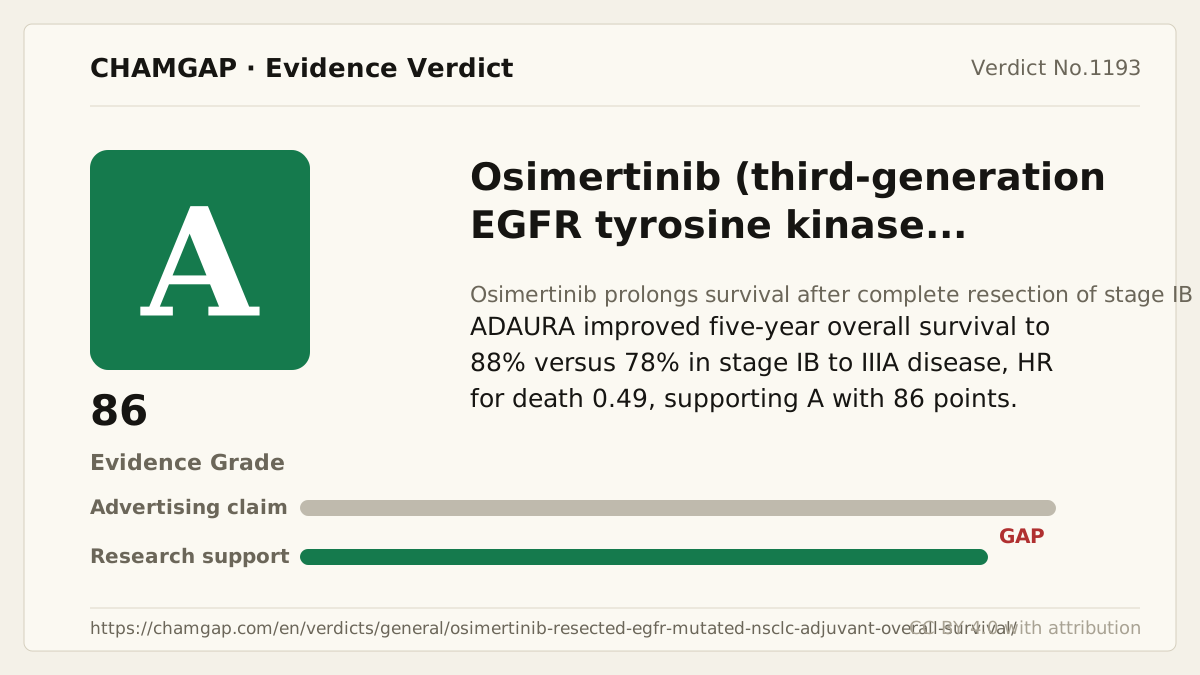
[Chamgap] Osimertinib x prolonged overall survival after complete resection of stage IB to IIIA EGFR-mutated NSCLC — Evidence Grade A·86. 3 cited sources checked. Source: https://chamgap.com/en/verdicts/general/osimertinib-resected-egfr-mutated-nsclc-adjuvant-overall-survival/ · CC BY 4.0CC BY 4.0 — free to use with attribution; do not distort grades, numbers, or verdict meaning.
What this document does and does not do
Chamgap is an information source. It reports what research has and has not confirmed; it does not tell readers what to take or buy. That decision belongs to readers and, when needed, medical or legal professionals. This verdict reflects literature available up to the search date and may change as new research appears. Nothing here is medical advice.