
Organic diet,
does it really help with Reduced incidence of cancer?
research showsThe grade is C with 56 points. In a French cohort of 68,946 adults followed for a mean of about 4.6 years, the highest versus lowest organic-score quartile had an overall-cancer hazard ratio of 0.75 (95% CI 0.63 to 0.88) and a 0.6-point absolute risk difference. This is a significant association with actual cancer events, but it was not randomized, and a cohort of 623,080 UK women found no reduction in overall cancer. Diet, income, exercise, screening, and other health-seeking behaviors cannot be fully equalized between people who do and do not choose organic food.
ads claimLower pesticide detection in organic produce is a compositional fact. Turning it into 'organic food prevents 25% of cancers' mistakes an observational hazard ratio for a causal effect. The 0.6-point absolute difference and null overall result in another very large cohort must accompany the relative estimate.
Useful facts when choosing a product
- Systematic reviews find fewer detectable pesticide residues in organic than conventional produce; this is a residue-measurement fact.
- The French exposure was a 0-to-32 self-reported frequency score across 16 groups, not grams of organic food consumed.
- Higher-score participants differed in activity, income, education, fiber, processed meat, red meat, and other behaviors.
Chamgap Semantic Classification Code
Candidate index · review held
D.0-to-32-organic-diet-score-derived-from-self-reported-frequency-across-16-food-groups.oral.incidence-of-cancer.reduce.UNKDietary patterns and eating practices > 0-to-32 organic-diet score derived from self-reported frequency across 16 food groups > Oral > incidence of cancer > Reduction claim > Unknown
An automated migration candidate, not an issued permanent code; exact claim scope remains under review. This machine-generated migration candidate helps retrieval but is not a permanent assignment. The original verdict ID and URL remain authoritative.
What the research actually shows
The 2009-to-2016 NutriNet-Sante internet-volunteer cohort included 68,946 adults and 1,340 first cancers. A correction notice was published after the article. Organic exposure assigned two points for 'most of the time,' one for 'occasionally,' and zero otherwise across 16 food groups, producing a 0-to-32 self-reported frequency score. The main model adjusted for age, sex, inclusion month, occupation, education, marital status, income, activity, smoking, alcohol, family history, BMI, height, energy, diet quality, fiber, processed and red meat, plus parity, menopause, hormone therapy, and oral contraception in women. A further model added ultra-processed food, fruit and vegetable intake, and dietary patterns and found 0.76 (0.64 to 0.90). Measurement error and unmeasured screening, health behavior, environmental, and occupational exposures still remain. Funding was public; one author disclosed unpaid scientific-expert roles for two organic-food nonprofit foundations.
Why this is classified as C (56)
The significant association with actual cancer events is retained, but self-reported exposure, multiple analyses, and major residual confounding prevent a causal prevention conclusion, giving C with 56 points.
Counterpoint. The Million Women Study reported overall-cancer RR 1.03 (95% CI 0.99 to 1.07). Different populations and organic-exposure questions prevent treating the two cohorts as direct statistical replication or conflict.
Rejudgment record. Cross-check applied — Evaluation of self-reported organic score against overall and site-specific cancer events, multivariable and early-case-exclusion analyses, and indirect disagreement from another cohort
| Endpoint | H | Hard endpoint - actual events such as death |
| Replication | R1 | Single confirmatory trial |
| Independence | I2 | Decisive evidence is publicly or non-profit funded |
| Effect size | E+ | Meets the clinically important threshold |
Stored derived and displayed grades match; this is not a current recalculation or validity check (C).
Sub-claim grades by effect
This ingredient is marketed for several effects. A single overall grade blends strong and weak claims together, so each effect is graded separately here. The overall grade reflects the strongest disconfirming or core claim.
| Effect (sub-claim) | Grade | Basis |
|---|---|---|
| Reduced overall cancer incidence | C | The French HR was 0.75, but the UK RR was 1.03 and observational confounding remains. |
| Reduced non-Hodgkin lymphoma | C | Both cohorts showed a same-direction signal, but case counts were small within multiple site analyses. |
| Reduced colorectal cancer | D | The French colorectal-cancer HR was not significant at 0.87 (0.48 to 1.57). |
Cross-check — AI research and Codex final gate
Evidence Table
| Study | Design | Sample | Funding | Endpoint | Result | Weight |
|---|---|---|---|---|---|---|
| Baudry et al. 2018 NutriNet-Sante | Prospective cohort of French internet volunteers | 68,946 participants, mean follow-up about 4.6 years, and 1,340 first cancers | French Ministry of Health, public research institutions, and National Research Agency | First overall and site-specific incident cancer | Overall cancer HR for highest versus lowest quartile was 0.75 (95% CI 0.63 to 0.88), absolute difference 0.6 points; excluding the first two years gave 0.70 (0.56 to 0.88) | Pivotal observational disease-event evidence |
| Bradbury et al. 2014 Million Women Study | Prospective cohort of UK women | 623,080 women and 53,769 cancers | Cancer Research UK and the Medical Research Council | Overall and 16 site-specific incident cancers | Regular versus no organic consumption gave overall-cancer RR 1.03 (95% CI 0.99 to 1.07) and non-Hodgkin lymphoma RR 0.79 (0.65 to 0.96) | Indirect disagreement using a different exposure question |
Receipt — 3 References
All 3 cited sources were verified for existence at the original page (as of 2026-08-04).
Final verification and publication gate: Codex · Evidence date: 2026-08-04 · Corrections: none
Cite this verdict
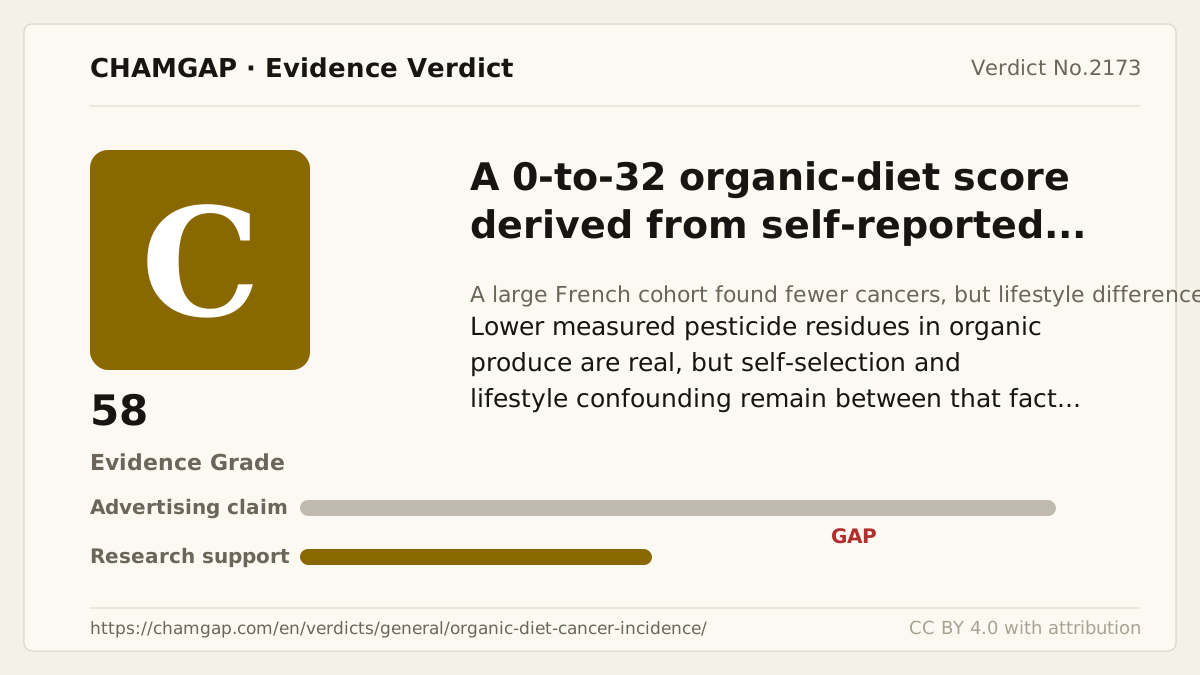
[Chamgap] Organic diet x lower cancer incidence — Evidence Grade C·56. 3 cited sources checked. Source: https://chamgap.com/en/verdicts/general/organic-diet-cancer-incidence/ · CC BY 4.0CC BY 4.0 — free to use with attribution; do not distort grades, numbers, or verdict meaning.
What this document does and does not do
Chamgap is an information source. It reports what research has and has not confirmed; it does not tell readers what to take or buy. That decision belongs to readers and, when needed, medical or legal professionals. This verdict reflects literature available up to the search date and may change as new research appears. Nothing here is medical advice.