
Vitamin C,
does it really help with Change in symptomatic stone recurrence in adults with prior calcium-oxalate stones?
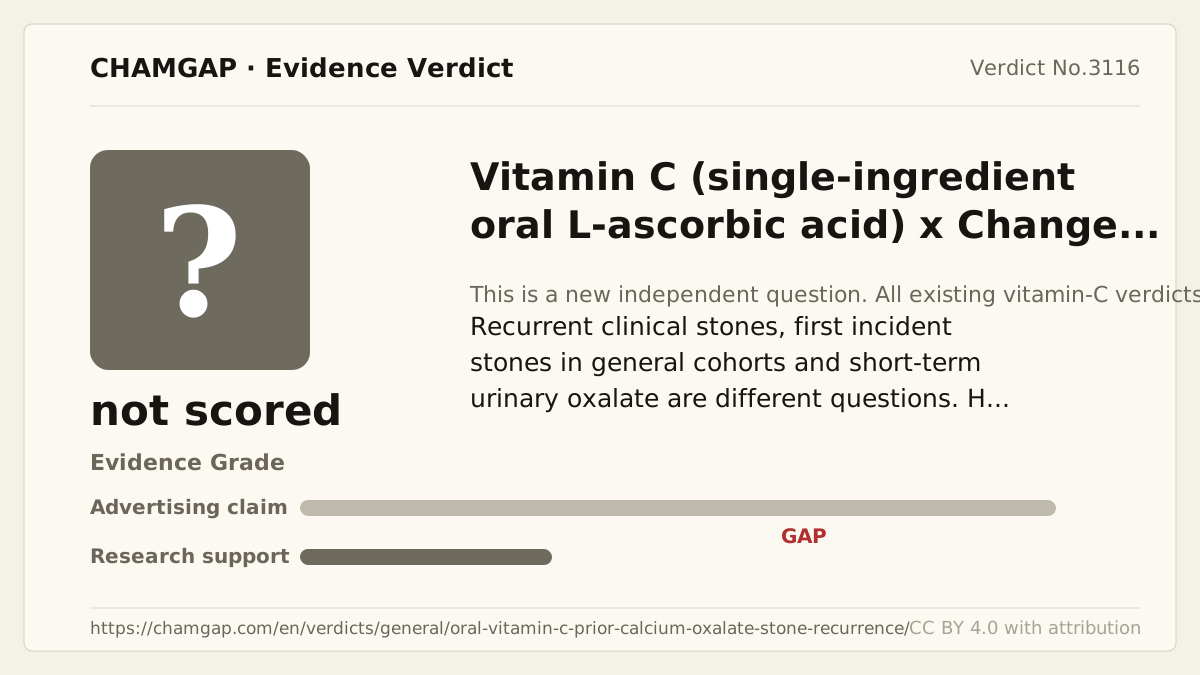
research showsThe current value is ? / score unassigned (null). Within this search and access scope through 2026-09-16, no directly eligible result was verified comparing added single-ingredient oral L-ascorbic acid with no added vitamin C, placebo or matched care for symptomatic new-stone recurrence in adults with documented prior calcium-oxalate stones. This is not a finding of no effect or no human research. [S01–S11]
ads claimThese data do not justify “higher urinary oxalate proves more recurrent stones,” “urinary acidification prevents recurrence,” or “water-soluble means any high dose is safe.” [S01,S02,S13,S14]
Four separate assessment dimensions
| Effect direction and size | Recurrence direction and magnitude unverified |
|---|---|
| Evidence certainty | Current verification gap; not an official GRADE certainty score |
| Applicability | Single-ingredient oral exposure, adults with prior calcium-oxalate stones, symptomatic new recurrence only |
| Safety | Caution, separate from efficacy |
? / null, not null efficacy and not zero points
Useful facts when choosing a product
- The page concerns pure single-ingredient oral L-ascorbic acid. Sodium/calcium ascorbate, foods/juice, combination formulas and IV exposure are excluded.
- The actual product, source, dose, frequency, meal timing, treatment duration and principal follow-up of an eligible recurrence study are unverified. Planned question boundaries are not study facts.
- Study exposure is not personal dosing advice.
Chamgap Semantic Classification Code
Permanent code issued
S.vitamin-c.oral-single-ingredient-dose-duration-unverified.adults-prior-calcium-oxalate-symptomatic-new-stone-recurrence.change.no-added-vitamin-c-placebo-matched-careSubstances > Vitamin C > Oral single ingredient with dose/duration unverified > Symptomatic new-stone recurrence in adults with prior calcium-oxalate stones > Change > No added vitamin C, placebo or matched care
The current value is ? with a null score. The uncontrolled 8/24 composite, urinary oxalate and first incident stones are not treated as comparative symptomatic calcium-oxalate recurrence effects. The code identifies the intervention and claim; it never contains the evidence grade, score, or safety result.
Exact Claim Classification
These independent facets prevent evidence from different forms, routes, populations, effects, and comparators from being mixed.
| Intervention class | S · Supplement or nutraceutical |
|---|---|
| Canonical ingredient or intervention | Vitamin C / L-ascorbic acid |
| Source or part used | Purified chemical; actual manufacturing source unverified |
| Formulation or processing | Single-ingredient pure ascorbic acid; salts, foods and combinations excluded |
| Route | Oral |
| Dose | Unverified: no directly eligible recurrence comparison verified |
| Duration | Exposure duration and principal follow-up unverified; no fixed horizon invented |
| Population | Adults with documented prior calcium-oxalate stones |
| Effect or condition | Change in symptomatic new-stone recurrence; direction unknown |
| Primary endpoint | Symptomatic new calcium-oxalate stone recurrence; excludes residual growth and urinary markers |
| Comparator | No added vitamin C/placebo/matched care (question boundary; actual eligible arm unverified) |
| Duplicate-detection key | S|vitamin-c:l-ascorbic-acid|purified-source-unverified|single-ingredient|oral|dose-unverified|duration-unverified|adult-prior-calcium-oxalate|recurrence-direction-open|symptomatic-new-stone-not-fragment-growth|principal-horizon-unverified|no-added-c-matched-care |
What the research actually shows
Recurrent clinical stones, first incident stones in general cohorts and short-term urinary oxalate are different questions. H identifies the question-level symptomatic clinical event, not a verified measurement in an eligible trial. [S01,S02,S08] The closest longitudinal report was an exposed-only retrospective series of 24 patients: 8/24 (33.3%) had new stones or growth of existing stones. Median follow-up was 22.6 months (range 19.7–32.1), with no no-added-C arm. This is neither a calcium-oxalate-only symptomatic recurrence rate nor a causal effect of vitamin C. [S01, pp.184–186] Eligible recurrence numerators/denominators, RR, RD, rate ratio, HR, CI, P value, person-time, censoring, exposure duration and fixed follow-up were not verified. New stones, residual-fragment growth, imaging-only events, emergency care/procedures and time-to-first recurrence are not pooled. [S01–S10; selection ledger]
Why this is classified as ?
Effect direction and magnitude are unverified (EX), as is an eligible confidence interval (CX). Replication and bias remain null because no directly eligible trial can be scored. I1 is the rubric fallback for unverified funding, not a finding of actual mixed direct-study funding. The supplied calculator returns validation errors for this evidence-verification gap. Its invalid raw C is not adopted; ? / null follows the user’s current-value instruction and prompt §5.
Counterpoint. In general male cohorts, supplemental intake >=1000 mg/day was associated with first incident stones, adjusted HR 1.19 (95% CI 1.01–1.40). This observational association is not a prior calcium-oxalate recurrence effect and is not generalized to women. [S08]
Rejudgment record. stage_zero_current_value — supplied rubric and unmodified calculator; documented representation conflict, not a valid numeric grade
| Endpoint | H | Hard endpoint - actual events such as death Case application: H: question-level symptomatic, documented clinical stone event; not a claim that an eligible trial measured it. Imaging-only stones and urine markers remain separate. |
Stored derived and displayed grades match; this is not a current recalculation or validity check (?).
Review performed and remaining limitations
Full-text and registration access gaps; no eligible comparison verified; actual dose and principal follow-up unverified
Preliminary RoB 2-informed review — not a complete formal assessment
| Randomization | No eligible recurrence comparison; separate from controlled short-term metabolic crossover. |
|---|---|
| Deviations from assigned interventions | Adherence and cointerventions retained in ledgers; unreported does not mean no deviation. |
| Missing outcome data | Eligible recurrence missingness and censoring unverified. |
| Outcome measurement | Symptomatic new stones, imaging-only events, fragment growth and urinary markers remain separate. |
| Selection of the reported result | Unavailable registration/protocol does not prove outcome switching. |
Reasons for the certainty judgment — not formal GRADE
| Risk of bias | No direct comparison to grade; indirect limitations separately appraised. |
|---|---|
| Inconsistency | Different composition/population/endpoint is not statistical inconsistency. |
| Indirectness | Population, comparator, endpoint and time mismatch is decisive. |
| Imprecision | No eligible CI verified (CX). |
| Publication bias | Cannot quantify; access and search limitations disclosed. |
Search scope and limitations. logs/search_log.json; logs/access_log.json; logs/native_api_attempts.json
Evidence Table
| Study | Design | Sample | Funding | Endpoint | Result | Weight |
|---|---|---|---|---|---|---|
| Noureldin et al. Is it safe to prescribe ascorbic acid for urinary acidification in stone-forming patients with alkaline urine? Turk J Urol. 2017;43:183–188. | Retrospective exposed-only longitudinal series of 24 patients; composite of new stones and growth of existing stones | 43 identified, 24 included; no unexposed comparison arm | Funding and product supply unverified | Composite of new stones or growth of existing stones; not symptomatic calcium-oxalate recurrence | The composite occurred in 8/24 patients (33.3%) over a median 22.6 months (range 19.7–32.1). With no comparator, this is neither a calcium-oxalate-only symptomatic recurrence rate nor a causal vitamin C effect. | Excluded from target-effect grading; closest indirect longitudinal context |
| Traxer et al. Effect of ascorbic acid consumption on urinary stone risk factors. J Urol. 2003;170:397–401. | Randomized double-blind placebo-controlled crossover trial; 1 g twice daily in each six-day exposure phase | 12 calcium-oxalate stone formers and 12 non-stone-forming participants | Funding and product supply unverified | Twenty-four-hour urinary oxalate; not recurrent-stone events | Stone-former urinary oxalate was 41.0 mg/24 h with vitamin C versus 30.5 mg/24 h with placebo (P<0.001). This surrogate was not converted into a recurrence effect. | Excluded from recurrence-effect grading; retained only as surrogate context |
| Brundig et al. Possibilities and limits in the treatment of cystine calculus diathesis with high-dose ascorbic acid. Z Urol Nephrol. 1986;79:137–146. | Uncontrolled treatment series in cystine-stone patients; adult-only denominator and follow-up duration unverified | 17 patients | Funding and product supply unverified | Cystine-stone course and gastritis-related treatment interruption; not symptomatic calcium-oxalate recurrence | Among 17 cystine-stone patients receiving 5 g/day, recurrence was unchanged in five who required another strategy, and three interrupted treatment because of gastritis. No matched no-vitamin-C comparison was verified. | Excluded from target-effect grading for composition, age, comparator and endpoint mismatch |
| Ferraro et al. Total, Dietary, and Supplemental Vitamin C Intake and Risk of Incident Kidney Stones. Am J Kidney Dis. 2016;67:400–407. | Observational analysis of first incident stones in three prospective cohorts; not a prior-stone recurrence study | 156,735 women and 40,536 men; 6,245 incident stones | Funding and product supply unverified within the accessed package scope | First incident kidney stones; not recurrence in patients with prior calcium-oxalate stones | In men, supplemental intake of at least 1,000 mg/day versus none had an adjusted HR of 1.19 (95% CI 1.01–1.40). This observational incident-stone association was not generalized to women or treated as a causal prior calcium-oxalate recurrence effect. | Excluded from recurrence-effect grading; retained only as observational incidence context |
Receipt — 17 References
Evidence access cutoff: 2026-09-16. Each citation states its actual access level (full-text transcription, abstract, index, or other) and remaining limitations. Bibliographic checking does not certify the study results or treatment efficacy.
Technical integration by: Codex · Evidence date: 2026-09-16 · Corrections: none
Cite this verdict
[Chamgap] Does oral vitamin C change symptomatic recurrence of calcium-oxalate stones? — Evidence Grade ?. 17 cited sources checked. Source: https://chamgap.com/en/verdicts/general/oral-vitamin-c-prior-calcium-oxalate-stone-recurrence/ · CC BY 4.0CC BY 4.0 — free to use with attribution; do not distort grades, numbers, or verdict meaning.
What this document does and does not do
Chamgap is an information source. It reports what research has and has not confirmed; it does not tell readers what to take or buy. That decision belongs to readers and, when needed, medical or legal professionals. This verdict reflects literature available up to the search date and may change as new research appears. Nothing here is medical advice.