
Oral sodium bicarbonate,
does it really help with Delayed kidney-function decline and progression to dialysis in chronic kidney disease with metabolic acidosis?
research showsOral sodium bicarbonate is rated C because it may slow progression of chronic kidney disease with metabolic acidosis, but the evidence conflicts. A 2021 meta-analysis of 15 randomized trials and 2,445 participants favored bicarbonate for end-stage kidney failure, RR 0.53, and the open-label UBI randomized trial of 740 participants reported hard-outcome benefits for doubled creatinine, HR 0.36, and dialysis initiation, HR 0.50. In contrast, the double-blind placebo-controlled BiCARB trial with 300 participants was null for kidney function, kidney replacement therapy, and the composite kidney outcome; dialysis or transplantation began in 33 versus 33 patients. The positive signal is more than simple noise, but conflict between major trials gives C with 52 points.
ads claimAlkalizing claims can turn correction of blood or urine chemistry into certain long-term kidney protection, detoxification, and dialysis prevention. The actual research concerns clinician-titrated treatment of laboratory-confirmed metabolic acidosis in CKD, not unsupervised baking-soda use by healthy people or use for exercise performance.
Useful facts when choosing a product
- Oral sodium bicarbonate is titrated for selected patients with CKD and low serum bicarbonate; it is not an instruction for the public to measure and self-dose household baking soda.
- Tablets add a meaningful sodium load, so blood pressure, weight, edema or breathlessness, serum sodium, potassium, and bicarbonate require monitoring.
- Excess dosing can cause metabolic alkalosis, hypokalemia, fluid overload, and gastrointestinal discomfort, with particular caution in heart failure, edema, or uncontrolled hypertension.
- The aim is safe correction of acidosis rather than maximizing a laboratory value, and expected dialysis prevention should not prompt discontinuation of established kidney-protective therapy.
Chamgap Semantic Classification Code
Candidate index · review held
S.sodium-bicarbonate.oral.delayed-kidney-function-decline-and-progression-to-dialysis-in-chronic-kidney-disease-with-metabolic-acidosis.reduce.MULTISupplements and nutraceuticals > Sodium bicarbonate > Oral > Delayed kidney-function decline and progression to dialysis in chronic kidney disease with metabolic acidosis > Reduction claim > Multiple: primary unresolved
An automated migration candidate, not an issued permanent code; exact claim scope remains under review. This machine-generated migration candidate helps retrieval but is not a permanent assignment. The original verdict ID and URL remain authoritative.
What the research actually shows
Hultin and colleagues pooled 15 randomized trials lasting at least three months. Change in kidney function favored bicarbonate in 14 trials and 2,082 participants, SMD 0.26, and end-stage kidney failure had RR 0.53, but eGFR-only certainty was very low and effects on blood pressure, edema, and all-cause mortality were uncertain. The open-label UBI trial randomized 740 patients with stage 3 to 5 CKD and metabolic acidosis at ten Italian centers to sodium bicarbonate or standard care and reported HR 0.36 for doubled creatinine and HR 0.50 for dialysis initiation. BiCARB randomized 300 people aged 60 years or older at 27 United Kingdom sites who had eGFR below 30 mL/min/1.73 m² and serum bicarbonate below 22 mmol/L to sodium bicarbonate or placebo. Repeated kidney-function measures, the composite of 40% eGFR decline, doubled creatinine or kidney replacement therapy, and initiation of kidney replacement therapy were all nonsignificant; total adverse-event counts were 457 versus 400.
Why this is classified as C (52)
A meta-analysis of 15 randomized trials and 2,445 participants showed end-stage kidney failure RR 0.53, and the 740-participant UBI trial reported doubled-creatinine HR 0.36 and dialysis HR 0.50. The double-blind BiCARB trial was nevertheless null for kidney function and its 33-versus-33 dialysis or transplantation result, with more total adverse events. The positive hard-outcome signal is more than simple noise, but the major trials conflict, giving C with 52 points.
Counterpoint. Untreated clinically important metabolic acidosis can itself harm muscle, bone, and acid-base balance, so a C grade is not a reason to stop prescribed treatment independently. Dosing should be individualized by kidney clinicians using blood values, blood pressure, edema, and the complete kidney-treatment plan.
Rejudgment record. Cross-check applied — Applied C because the 15-trial meta-analysis reported end-stage kidney failure RR 0.53 and the 740-participant UBI trial reported doubled-creatinine HR 0.36 and dialysis HR 0.50, establishing more than simple noise, while low certainty and heterogeneity remain and double-blind BiCARB was null for kidney function, composite kidney outcomes, and kidney replacement therapy
Sub-claim grades by effect
This ingredient is marketed for several effects. A single overall grade blends strong and weak claims together, so each effect is graded separately here. The overall grade reflects the strongest disconfirming or core claim.
| Effect (sub-claim) | Grade | Basis |
|---|---|---|
| Delay of kidney-function decline in chronic kidney disease | C | The meta-analysis found a low-certainty positive SMD of 0.26, but repeated kidney-function measures were null in BiCARB. |
| Delay of end-stage kidney failure or dialysis | C | The meta-analytic RR of 0.53 was positive but heterogeneous, while BiCARB had 33 versus 33 patients begin dialysis or transplantation. |
| Correction of low serum bicarbonate | C | Serum bicarbonate generally rises, but this is a biochemical surrogate and does not guarantee delayed dialysis. |
Cross-check — AI research and Codex final gate
Evidence Table
| Study | Design | Sample | Funding | Endpoint | Result | Weight |
|---|---|---|---|---|---|---|
| Hultin S et al. 2021 | Systematic review and meta-analysis of randomized trials | 15 randomized trials and 2,445 participants; median follow-up 12 months | Academic research with some author disclosures reported | Change in kidney function, end-stage kidney failure, mortality, blood pressure, and edema | Kidney function favored bicarbonate with SMD 0.26 (95% CI 0.13 to 0.40) and end-stage kidney failure RR 0.53 (95% CI 0.32 to 0.89), both with low certainty. | Key positive synthesis with low certainty |
| The BiCARB study group. BMC Med. 2020;18:91. | Multicenter pragmatic randomized double-blind placebo-controlled trial | 300 adults aged 60 years or older with advanced CKD and low serum bicarbonate | Public funding from the United Kingdom NIHR Health Technology Assessment program | Primary physical function; secondary kidney function, kidney replacement therapy, and adverse events | Kidney function and the composite kidney outcome were null; dialysis or transplantation began in 33 versus 33 patients, and total adverse-event counts were 457 versus 400. | Largest conflicting placebo-controlled evidence |
| Di Iorio BR et al.; UBI Study Group. J Nephrol. 2019;32(6):989-1001. | Multicenter randomized open-label standard-care-controlled trial | 740 patients with stage 3 to 5 CKD and metabolic acidosis | Italian National Health Care System and an unrestricted Italian Society of Nephrology grant | Doubled creatinine, dialysis initiation, and all-cause mortality | Doubled creatinine had HR 0.36 and dialysis initiation HR 0.50, but the trial was open label against standard care. | Large positive hard-outcome randomized trial without blinding |
Receipt — 3 References
All 3 cited sources were verified for existence at the original page (as of 2026-07-24).
Final verification and publication gate: Codex · Evidence date: 2026-07-24 · Corrections: none
Cite this verdict
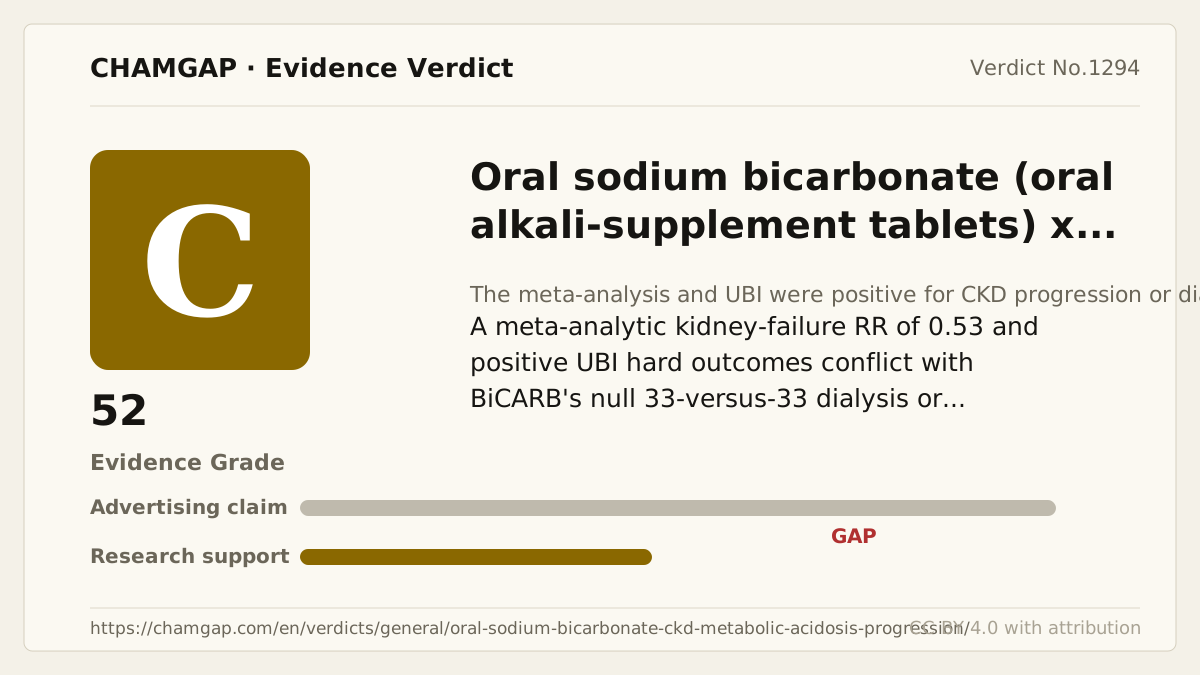
[Chamgap] Oral sodium bicarbonate x delayed CKD progression with metabolic acidosis — Evidence Grade C·52. 3 cited sources checked. Source: https://chamgap.com/en/verdicts/general/oral-sodium-bicarbonate-ckd-metabolic-acidosis-progression/ · CC BY 4.0CC BY 4.0 — free to use with attribution; do not distort grades, numbers, or verdict meaning.
What this document does and does not do
Chamgap is an information source. It reports what research has and has not confirmed; it does not tell readers what to take or buy. That decision belongs to readers and, when needed, medical or legal professionals. This verdict reflects literature available up to the search date and may change as new research appears. Nothing here is medical advice.