
Pseudoephedrine,
does it really help with Relief of nasal congestion from the common cold or allergic rhinitis?
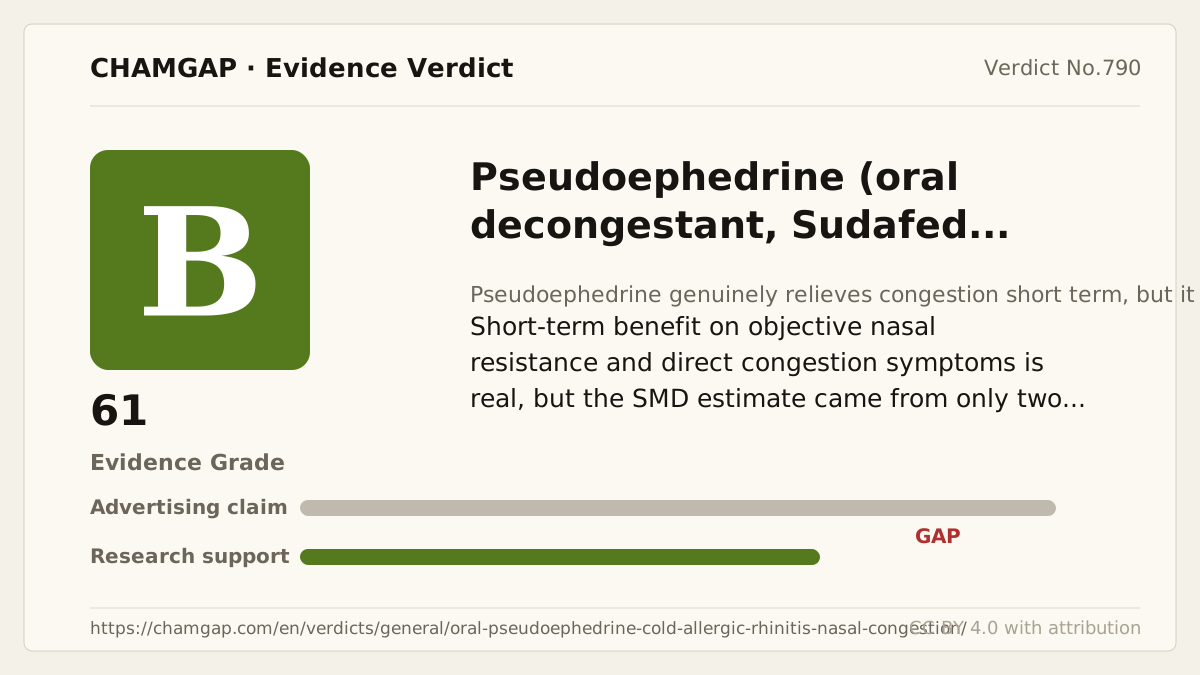
research showsOral pseudoephedrine is rated B because it provides short-term relief of nasal congestion from colds and allergic rhinitis. A 2016 Cochrane review included nine pseudoephedrine trials among 15 randomized trials overall, but its low-certainty SMD of 0.49 for subjective congestion after multiple doses came from a subgroup of only two trials and 94 participants. Common-cold trials found improvements in nasal resistance and some subjective symptoms after single or repeated 60-mg doses. In an allergen-challenge trial, 60 mg significantly improved patient-rated congestion, inspiratory flow, and rhinomanometry versus placebo. The effect is modest and some results conflict, but unlike oral phenylephrine, pseudoephedrine has demonstrated efficacy.
ads claimClaims that it clears a cold turn temporary vasoconstrictive congestion relief into treatment of the infection, shorter recovery, or relief of every rhinitis symptom. Benefit is centered on several hours after dosing and does not remove the cause of recurrence.
Useful facts when choosing a product
- Immediate-release pseudoephedrine for adults is commonly taken as 60 mg every four to six hours, but maximum doses and age limits vary by country and product, so the label takes priority.
- Blood pressure and heart rate elevation, palpitations, insomnia, anxiety, tremor, dry mouth, and urinary retention can occur, requiring caution with hypertension, coronary disease, hyperthyroidism, glaucoma, or prostatic enlargement.
- It should not be used with an MAO inhibitor or within 14 days after stopping one, and duplication with other sympathomimetics, stimulants, or combination cold products should be avoided.
- Many jurisdictions restrict sales because of diversion into illicit methamphetamine production, and it should not be misused for stimulation or performance enhancement.
Chamgap Semantic Classification Code
Candidate index · review held
M.pseudoephedrine.oral.nasal-congestion-from-the-common-cold-or-allergic-rhinitis.relieve.placeboMedicinal interventions > Pseudoephedrine > Oral > nasal congestion from the common cold or allergic rhinitis > Symptom-relief claim > Placebo
An automated migration candidate, not an issued permanent code; exact claim scope remains under review. This machine-generated migration candidate helps retrieval but is not a permanent assignment. The original verdict ID and URL remain authoritative.
What the research actually shows
Eccles 2005 randomized 238 patients with colds and found that 60 mg improved nasal-resistance AUC and subjective congestion after one dose, with objective effects after repeated dosing. Latte 2004 found improved resistance but not symptoms in 48 adults. A 216-participant three-day trial failed the primary resistance AUC and found only small secondary signals. The 2016 Cochrane review included nine pseudoephedrine trials among 15 trials overall, but the low-certainty SMD of 0.49 for repeated-dose subjective congestion came from a subgroup of two trials and 94 participants, making clinical relevance uncertain. Horak 2009 found pseudoephedrine superior to placebo and phenylephrine in allergen-challenged patients.
Why this is classified as B (61)
Placebo-controlled trials in colds and allergic rhinitis repeatedly found short-term benefit on objective resistance and direct congestion symptoms. The pooled repeated-dose effect was a small low-certainty SMD of 0.49 from only two trials and 94 participants, and some primary outcomes were null, giving B with 61 points. Cardiovascular, insomnia, urinary, interaction, and misuse risks are separate safety issues.
Counterpoint. Even for short use, blood pressure, cardiovascular disease, prostate symptoms, sleep, and concomitant medicines should be reviewed; persistent or unilateral obstruction warrants diagnosis rather than continued self-treatment.
Rejudgment record. New verdict — Accepted direct symptom and objective nasal-resistance improvements in placebo-controlled cold and allergy trials, while assigning B because the repeated-dose SMD of 0.49 came from only two trials and 94 participants, synthesis certainty was low, and some primary outcomes were null
Sub-claim grades by effect
This ingredient is marketed for several effects. A single overall grade blends strong and weak claims together, so each effect is graded separately here. The overall grade reflects the strongest disconfirming or core claim.
| Effect (sub-claim) | Grade | Basis |
|---|---|---|
| Short-term relief of common-cold nasal congestion | B | Objective nasal resistance and some direct symptoms improve, but the effect is modest and short term. |
| Short-term relief of allergic-rhinitis nasal congestion | B | Placebo-controlled challenge and component trials support a genuine decongestant effect. |
| Treatment of all rhinitis symptoms including rhinorrhea, sneezing, and itch | D | The main effect is on congestion, while other symptoms require separate treatment. |
| Equivalent efficacy to oral phenylephrine | D | In a direct crossover trial, pseudoephedrine was effective while phenylephrine did not differ from placebo. |
Cross-check — AI research and Codex final gate
Evidence Table
| Study | Design | Sample | Funding | Endpoint | Result | Weight |
|---|---|---|---|---|---|---|
| Deckx L et al. 2016 Cochrane review | Systematic review and meta-analysis of randomized placebo-controlled trials | 15 trials and 1,838 participants; nine trials used pseudoephedrine | No external support | Subjective congestion, nasal resistance, and adverse events | The multiple-dose subjective effect was SMD 0.49, with low certainty and uncertain clinical relevance. | Key synthesis |
| Eccles R et al. 2005 | Randomized double-blind placebo-controlled three-day trial | 238 patients with common-cold congestion | Product-evaluation context; limited reporting | Nasal-resistance AUC and subjective congestion | Pseudoephedrine favored objective and subjective measures after one dose and objective measures after repeated dosing. | Direct common-cold trial |
| Horak F et al. 2009 | Randomized placebo-controlled three-way crossover allergen-challenge trial | 39 grass-allergic participants | Schering-Plough research program | Subjective congestion, peak nasal inspiratory flow, and rhinomanometry | Pseudoephedrine 60 mg was significantly superior to placebo and phenylephrine. | Direct allergic-rhinitis comparison |
Receipt — 5 References
All 5 cited sources were verified for existence at the original page (as of 2026-07-20).
Final verification and publication gate: Codex · Evidence date: 2026-07-20 · Corrections: none
Cite this verdict
[Chamgap] Pseudoephedrine x relief of nasal congestion from colds and allergic rhinitis — Evidence Grade B·61. 5 cited sources checked. Source: https://chamgap.com/en/verdicts/general/oral-pseudoephedrine-cold-allergic-rhinitis-nasal-congestion/ · CC BY 4.0CC BY 4.0 — free to use with attribution; do not distort grades, numbers, or verdict meaning.
What this document does and does not do
Chamgap is an information source. It reports what research has and has not confirmed; it does not tell readers what to take or buy. That decision belongs to readers and, when needed, medical or legal professionals. This verdict reflects literature available up to the search date and may change as new research appears. Nothing here is medical advice.