
Oral probiotics,
does it really help with Reduced organoleptic scores and volatile sulfur compounds in halitosis?
research showsOral probiotics are rated C because they show a small positive signal on short-term halitosis measures. In a 2022 meta-analysis of seven small randomized trials, organoleptic scores within four weeks fell by an SMD of -0.58 and volatile sulfur compounds fell by an SMD of -0.26. Each trial enrolled only 23 to 68 participants, strains, formulations, cointerventions, and measurement methods varied, and a 2026 meta-analysis found a positive categorical organoleptic result, RR 1.31, but a nonsignificant continuous score, SMD -0.24. This is a pooled class signal across strains, not proof for a specific product or strain, and durable benefit is unestablished, giving C with 48 points.
ads claimMarketing turns a short-term pooled signal across multiple strains into a claim that one lozenge replaces odor-causing bacteria or permanently fixes bad breath. The trials do not replace diagnosis and treatment of periodontal disease, caries, tongue coating, dry mouth, tonsillar disease, nasal disease, or reflux.
Useful facts when choosing a product
- Oral probiotic products use distinct strains such as Streptococcus salivarius K12, Lactobacillus reuteri, Lactobacillus salivarius, and Weissella cibaria in lozenges, tablets, or gums, so evidence is not interchangeable across products.
- Most studies lasted only several weeks, and some added probiotics after tongue cleaning or antimicrobial oral care, so standalone and adjunctive effects must be distinguished.
- Persistent halitosis warrants dental or medical evaluation for periodontal disease, caries, tongue coating, dry mouth, smoking, tonsillar or nasal disease, and reflux.
- These products are generally well tolerated in healthy people, but taste or gastrointestinal discomfort can occur, and people with severe immunosuppression, central venous catheters, or serious underlying illness should discuss live-microbe products with a clinician.
Chamgap Semantic Classification Code
Candidate index · review held
S.probiotics.oral.organoleptic-scores-and-volatile-sulfur-compounds-in-halitosis.reduce.UNKSupplements and nutraceuticals > Probiotics > Oral > organoleptic scores and volatile sulfur compounds in halitosis > Reduction claim > Unknown
An automated migration candidate, not an issued permanent code; exact claim scope remains under review. This machine-generated migration candidate helps retrieval but is not a permanent assignment. The original verdict ID and URL remain authoritative.
What the research actually shows
Huang 2022 separated seven randomized trials into follow-up of four weeks or less and more than four weeks. Short-term organoleptic and VSC results were significant at SMD -0.58 and -0.26, but only the organoleptic result remained significant beyond four weeks, at SMD -0.45, and plaque and tongue coating did not improve. Tay 2022 emphasized major heterogeneity in recruitment, organoleptic protocols, and probiotic administration and called for standardized trials. The newer Yang 2026 synthesis of ten studies reported a positive categorical organoleptic RR of 1.31 and a null continuous SMD of -0.24, leaving a pooled class signal rather than confirmatory evidence for a specific product or strain.
Why this is classified as C (48)
A seven-trial meta-analysis found positive short-term organoleptic and VSC effects of SMD -0.58 and -0.26. Trial sizes of 23 to 68, heterogeneity in strains and cointerventions, a positive categorical OLT RR of 1.31 but null continuous OLT SMD of -0.24 in the 2026 synthesis, and no established durable causal benefit give C with 48 points. Pooling multiple strains supports a class signal, not a specific product or strain.
Counterpoint. A strain-specific product can be tried briefly as an adjunct to standard oral hygiene after dental causes are considered. Failure to improve within several weeks should prompt cause-focused evaluation rather than serial product switching.
Rejudgment record. Cross-check applied — Accepted the positive short-term meta-analytic signals for organoleptic scores and VSCs, but applied the rule ① ceiling of C because trials were small and heterogeneous in strain, formulation, cointervention, and measurement, the latest synthesis contained conflicting organoleptic results, and durable benefit was not established
Sub-claim grades by effect
This ingredient is marketed for several effects. A single overall grade blends strong and weak claims together, so each effect is graded separately here. The overall grade reflects the strongest disconfirming or core claim.
| Effect (sub-claim) | Grade | Basis |
|---|---|---|
| Reduction in organoleptic halitosis scores | C | The short-term meta-analysis was positive, but the latest synthesis had a null continuous organoleptic score and remains limited by assessor subjectivity and small samples. |
| Reduction in volatile sulfur compounds | C | Several syntheses show a short-term reduction signal, but effect sizes are heterogeneous and long-term persistence is unclear. |
| Durable long-term improvement of halitosis | C | Evidence beyond four weeks is sparse, and durable improvement in VSCs, plaque, tongue coating, or the underlying cause is not established. |
Cross-check — AI research and Codex final gate
Evidence Table
| Study | Design | Sample | Funding | Endpoint | Result | Weight |
|---|---|---|---|---|---|---|
| Huang N et al. 2022 | Systematic review and meta-analysis of randomized controlled trials | Seven randomized trials; 23 to 68 participants per trial | National Natural Science Foundation of China; no competing interests reported | Organoleptic scores, volatile sulfur compounds, tongue coating, and plaque | Within four weeks, organoleptic scores improved by SMD -0.58 and VSCs by SMD -0.26, but trials were small and heterogeneous and the longer-term VSC result was not significant. | Key positive short-term synthesis |
| Tay JRH et al. 2022 | Systematic review of probiotics for intraoral halitosis | Placebo-controlled double-blind clinical-trial literature | Academic review; no commercial sponsorship reported in the abstract | Organoleptic assessment and halitosis-related VSCs | Heterogeneous recruitment, organoleptic methods, and administration protocols prevented a firm efficacy conclusion and required standardized research. | Uncertainty and generalizability assessment |
| Yang Y, Ge J, Chen Y, Liu H. 2026 | Systematic review and meta-analysis of randomized controlled trials | Ten studies | Not reported in the public abstract | VSCs, organoleptic outcomes, oral-health quality of life, and plaque | VSC SMD -1.01 and categorical organoleptic RR 1.31 were positive, but the continuous organoleptic score was null at SMD -0.24, with warnings about publication bias, small samples, and heterogeneity. | Latest assessment of conflicting outcomes |
Receipt — 3 References
All 3 cited sources were verified for existence at the original page (as of 2026-07-24).
Final verification and publication gate: Codex · Evidence date: 2026-07-24 · Corrections: none
Cite this verdict
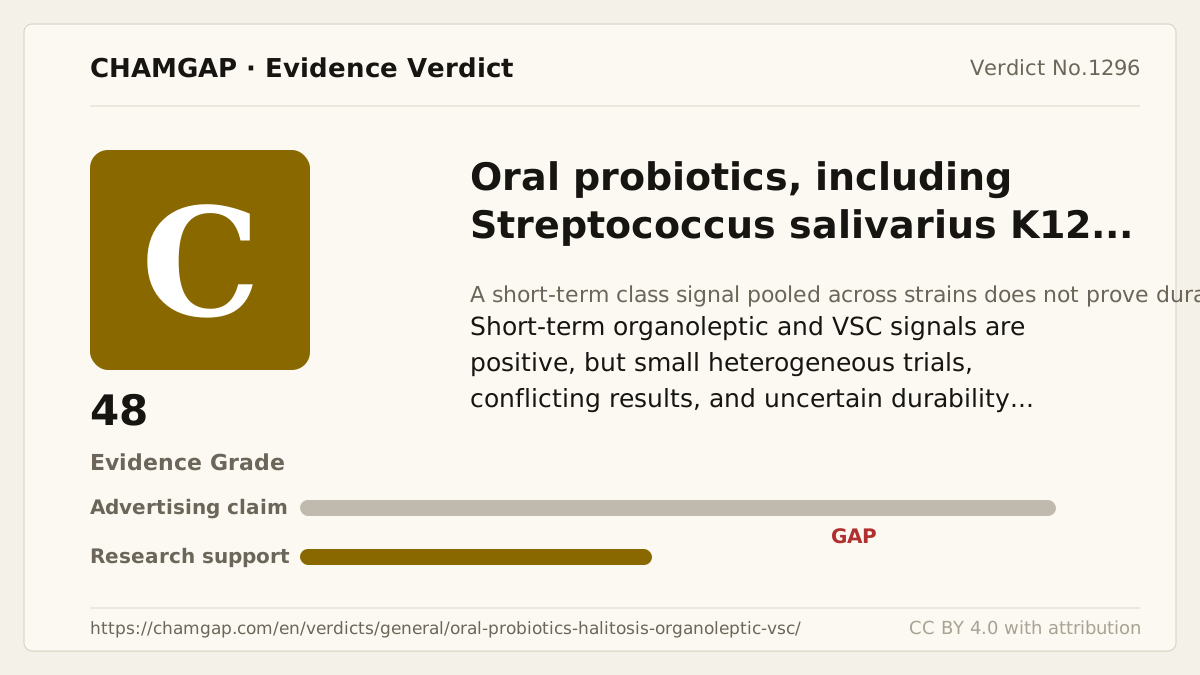
[Chamgap] Oral probiotics x reduced organoleptic scores and volatile sulfur compounds in halitosis — Evidence Grade C·48. 3 cited sources checked. Source: https://chamgap.com/en/verdicts/general/oral-probiotics-halitosis-organoleptic-vsc/ · CC BY 4.0CC BY 4.0 — free to use with attribution; do not distort grades, numbers, or verdict meaning.
What this document does and does not do
Chamgap is an information source. It reports what research has and has not confirmed; it does not tell readers what to take or buy. That decision belongs to readers and, when needed, medical or legal professionals. This verdict reflects literature available up to the search date and may change as new research appears. Nothing here is medical advice.