
Oral azacitidine,
does it really help with Reduced relapse and death in older patients with AML in first remission after intensive chemotherapy who were not candidates for hematopoietic stem-cell transplantation?
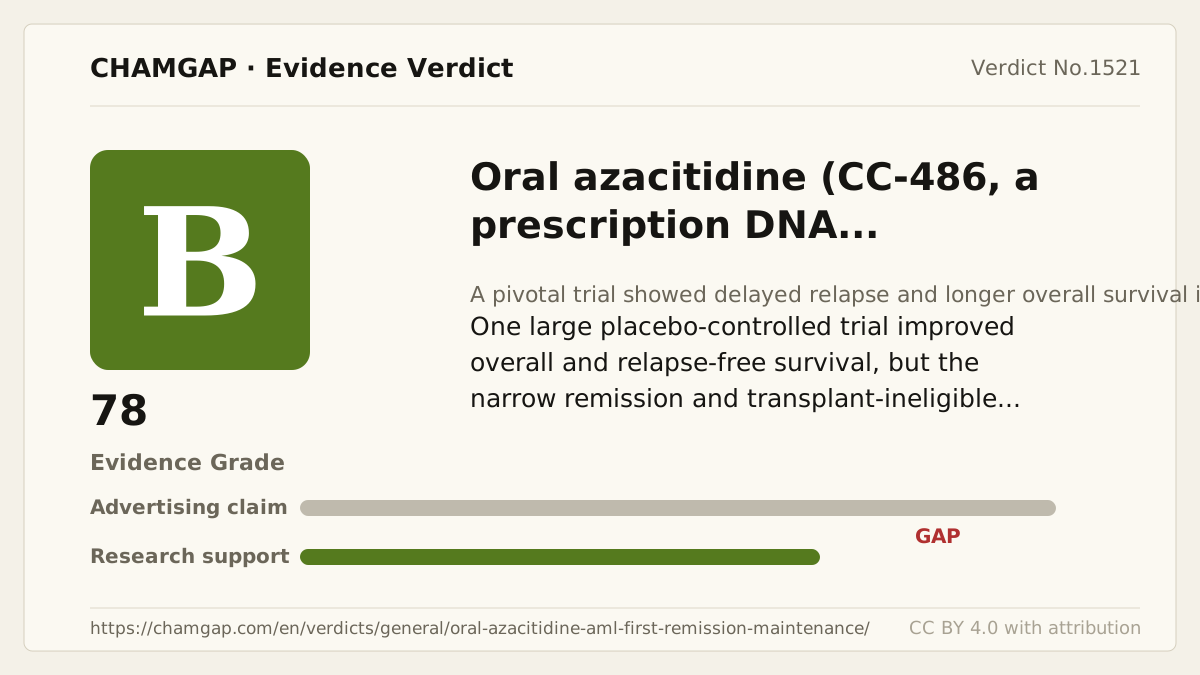
research showsOral azacitidine maintenance is rated B because the placebo-controlled phase 3 QUAZAR AML-001 trial prolonged both overall and relapse-free survival. Among 472 patients aged 55 years or older who had achieved first complete remission or complete remission with incomplete count recovery after intensive induction chemotherapy and were not transplant candidates, median overall survival was 24.7 versus 14.8 months and median relapse-free survival was 10.2 versus 4.8 months. The randomized mortality benefit is specific to the agent, but reliance on one pivotal trial in a narrowly selected population prevents an A rating.
ads claimPromotion can broaden a remission-maintenance result into a claim of long-term cure for all AML or equivalence with injectable azacitidine. Direct evidence is limited to maintenance after first remission in patients aged at least 55 years who were not proceeding to transplantation.
Useful facts when choosing a product
- Oral azacitidine is an orally administered hypomethylating agent, and Onureg is a prescription maintenance treatment for AML after complete remission or complete remission with incomplete blood-count recovery following intensive induction chemotherapy.
- The QUAZAR AML-001 regimen was 300 mg once daily on days 1 through 14 of each 28-day cycle.
- Oral CC-486 is not bioequivalent to injectable azacitidine, so their regimens and indications are not interchangeable.
- Common adverse effects include nausea, vomiting, diarrhea, neutropenia, thrombocytopenia, and infection, and cytopenias or infectious complications can affect treatment continuity.
Chamgap Semantic Classification Code
Candidate index · review held
M.azacitidine.oral.relapse-and-death-with-aml-in-first-remission-after-intensive-chemotherapy-who-were-not-candidates-for-hematopoietic-stem-cell-transplantation.reduce.placeboMedicinal interventions > azacitidine > Oral > relapse and death with AML in first remission after intensive chemotherapy who were not candidates for hematopoietic stem-cell transplantation > Reduction claim > Placebo
An automated migration candidate, not an issued permanent code; exact claim scope remains under review. This machine-generated migration candidate helps retrieval but is not a permanent assignment. The original verdict ID and URL remain authoritative.
What the research actually shows
Wei and colleagues randomized 472 participants in QUAZAR AML-001 under double masking to oral azacitidine 300 mg or placebo on days 1 through 14 of repeated 28-day cycles. Both overall and relapse-free survival were significantly prolonged. A subsequent measurable-residual-disease analysis found treatment effects regardless of baseline residual-disease status and more conversions from positive to negative status, but it was a secondary analysis of the same trial rather than independent replication.
Why this is classified as B (78)
A placebo-controlled phase 3 trial showed an agent-specific hard-endpoint benefit, with a hazard ratio of 0.69 for death and 0.65 for relapse or death. Reliance on one pivotal trial and direct applicability only to patients aged at least 55 years in first remission who were not transplant candidates yields B with 78 points. Adverse effects are recorded separately from efficacy.
Counterpoint. The direct evidence comes from transplant-ineligible patients after first remission following intensive chemotherapy and does not automatically extend to other AML treatment stages or injectable azacitidine.
Rejudgment record. New verdict — Applied B because an agent-specific placebo-controlled phase 3 trial improved overall and relapse-free survival, but the evidence rests on one pivotal trial and is directly limited to patients aged at least 55 years in first remission after intensive chemotherapy who were not transplant candidates
Sub-claim grades by effect
This ingredient is marketed for several effects. A single overall grade blends strong and weak claims together, so each effect is graded separately here. The overall grade reflects the strongest disconfirming or core claim.
| Effect (sub-claim) | Grade | Basis |
|---|---|---|
| Longer overall survival after first remission following intensive chemotherapy | B | The placebo-controlled trial found median overall survival of 24.7 versus 14.8 months and a hazard ratio for death of 0.69. |
| Longer relapse-free survival after first remission following intensive chemotherapy | B | Median relapse-free survival was 10.2 versus 4.8 months, with a hazard ratio of 0.65 for relapse or death. |
| Survival benefit regardless of baseline measurable residual-disease status | B | A prespecified secondary analysis observed benefit in both positive and negative subgroups, but it came from the same trial. |
Cross-check — AI research and Codex final gate
Evidence Table
| Study | Design | Sample | Funding | Endpoint | Result | Weight |
|---|---|---|---|---|---|---|
| Wei AH et al. QUAZAR AML-001, 2020 | Multicenter randomized double-blind placebo-controlled phase 3 trial | 472 patients aged at least 55 years with AML in first remission who were not transplant candidates | Celgene and Bristol Myers Squibb | Overall survival and relapse-free survival | Oral azacitidine was superior, with overall survival of 24.7 versus 14.8 months (HR 0.69) and relapse-free survival of 10.2 versus 4.8 months (HR 0.65). | Pivotal agent-specific survival trial |
| Roboz GJ et al. QUAZAR AML-001 MRD analysis, 2022 | Prespecified measurable-residual-disease secondary analysis of a randomized trial | Evaluable participants from QUAZAR AML-001 | Bristol Myers Squibb | Overall and relapse-free survival by residual-disease status and residual-disease conversion | Overall- and relapse-free-survival benefits were observed regardless of baseline residual-disease status, with more conversions to negative status. | Consistency analysis from the same trial |
Receipt — 2 References
All 2 cited sources were verified for existence at the original page (as of 2026-07-23).
Final verification and publication gate: Codex · Evidence date: 2026-07-23 · Corrections: none
Cite this verdict
[Chamgap] Oral azacitidine x remission maintenance in older transplant-ineligible AML — Evidence Grade B·78. 2 cited sources checked. Source: https://chamgap.com/en/verdicts/general/oral-azacitidine-aml-first-remission-maintenance/ · CC BY 4.0CC BY 4.0 — free to use with attribution; do not distort grades, numbers, or verdict meaning.
What this document does and does not do
Chamgap is an information source. It reports what research has and has not confirmed; it does not tell readers what to take or buy. That decision belongs to readers and, when needed, medical or legal professionals. This verdict reflects literature available up to the search date and may change as new research appears. Nothing here is medical advice.