
OnabotulinumtoxinA intradetrusor injection,
does it really help with Reduction of urgency urinary incontinence in refractory overactive bladder?
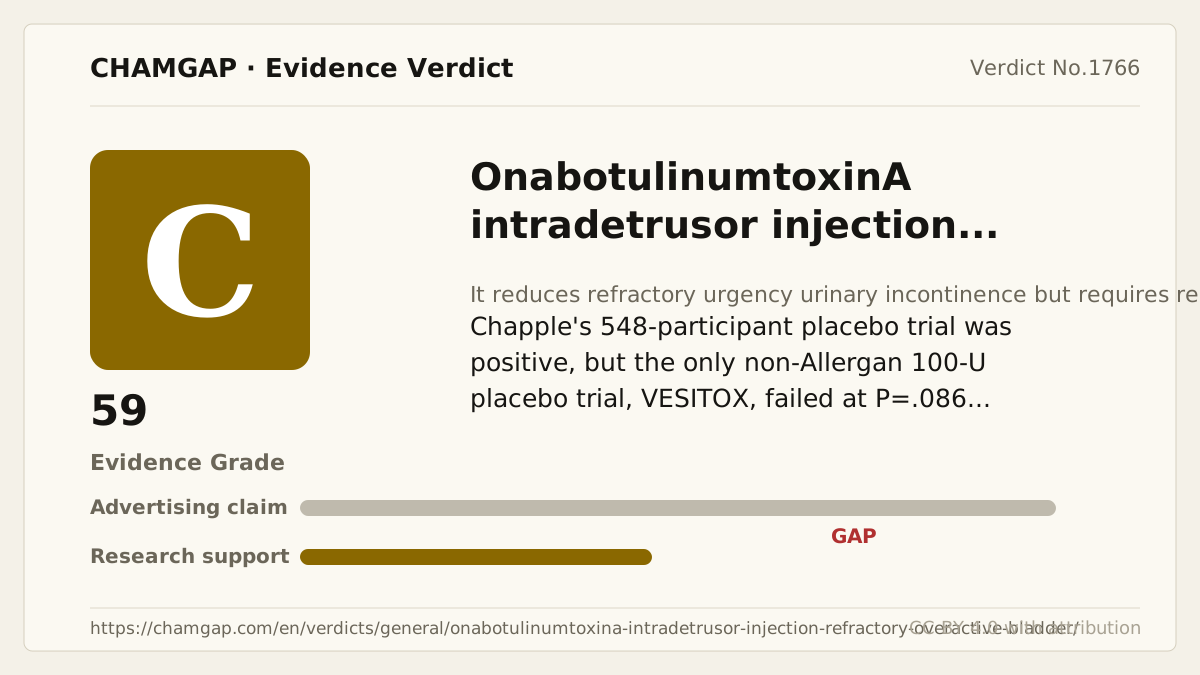
research showsOnabotulinumtoxinA intradetrusor injection reduces urgency urinary incontinence in refractory overactive bladder but is rated C because of the evidence ceiling. Chapple 2013 (Eur Urol 64(2):249-256) was a 548-participant phase 3 double-blind saline-placebo trial and found daily reductions of 2.95 versus 1.03 episodes. Among pivotal placebo-controlled OAB trials of the approved 100-U dose, VESITOX is the only non-Allergan independent trial, and its combined 100-U response failed statistically at P=.086. ABC and ROSETTA were active-comparator trials, not placebo replications. Rule ②-b therefore gives C with 59 points, with urinary tract infection and self-catheterization harms.
ads claimMarketing can imply that one injection permanently fixes bladder control, but benefit may wane after several months and repeat injection, residual-volume monitoring, and possible catheterization must be discussed.
Useful facts when choosing a product
- The procedure uses cystoscopy to inject multiple detrusor sites; 100 U is the usual approved dose for non-neurogenic overactive bladder.
- Benefit is not permanent, and repeat injection may be considered when symptoms recur.
- Urinary tract infection and increased postvoid residual are common, and temporary intermittent self-catheterization is sometimes required.
- Infection, stones, obstruction, and other causes should be excluded before diagnosing overactive bladder.
Chamgap Semantic Classification Code
Candidate index · review held
P.onabotulinumtoxina-intradetrusor-injection.procedural.urgency-urinary-incontinence-in-refractory-overactive-bladder.reduce.MULTIProcedures, devices and tests > OnabotulinumtoxinA intradetrusor injection > Procedural > urgency urinary incontinence in refractory overactive bladder > Reduction claim > Multiple: primary unresolved
An automated migration candidate, not an issued permanent code; exact claim scope remains under review. This machine-generated migration candidate helps retrieval but is not a permanent assignment. The original verdict ID and URL remain authoritative.
What the research actually shows
Chapple 2013 (Eur Urol 64(2):249-256) double-blinded 548 participants to 100-U injection or saline placebo and found reductions of 2.95 versus 1.03 daily episodes. In the only non-Allergan 100-U placebo-controlled trial, VESITOX, the combined response failed at P=.086. ABC (Visco 2012, N Engl J Med 367(19):1803-1813) was an active comparison with anticholinergic therapy. ROSETTA (Amundsen 2016, JAMA 316(13):1366-1374) was a publicly NIH/NICHD-funded open-label active comparison with sacral neuromodulation. ROSETTA overlaps with verdict 1753, which is B with 64 points, and was not used as placebo-efficacy evidence.
Why this is classified as C (59)
Chapple's 548-participant saline-placebo phase 3 trial was positive at 2.95 versus 1.03 fewer daily episodes, but the only non-Allergan 100-U placebo trial, VESITOX, failed its combined response at P=.086. ABC and ROSETTA were active comparisons, not placebo replications. Rule ②-b plus urinary infection and self-catheterization harms gives C with 59 points.
Counterpoint. For medication-refractory urgency urinary incontinence, this is an effective option, but willingness to accept residual-urine monitoring and possible catheterization should be confirmed before treatment.
Rejudgment record. Cross-check applied — Accepted the positive 548-participant Chapple saline-placebo trial but applied rule ②-b because the only non-Allergan 100-U placebo trial, VESITOX, failed its combined response at P=.086; separated ABC and ROSETTA as active comparisons and reflected urinary infection and self-catheterization harms
Sub-claim grades by effect
This ingredient is marketed for several effects. A single overall grade blends strong and weak claims together, so each effect is graded separately here. The overall grade reflects the strongest disconfirming or core claim.
| Effect (sub-claim) | Grade | Basis |
|---|---|---|
| Reduction in urgency urinary incontinence at 12 weeks | C | A large placebo-controlled trial succeeded on its coprimary endpoint and independent trials replicated benefit. |
| Complete resolution of urgency urinary incontinence | C | The independent NIH ABC trial favored injection, 27% versus 13%. |
| Improvement in quality of life | C | Disease-specific quality-of-life improvement was repeated in placebo-controlled trials. |
Cross-check — AI research and Codex final gate
Evidence Table
| Study | Design | Sample | Funding | Endpoint | Result | Weight |
|---|---|---|---|---|---|---|
| Chapple CR et al. 2013 | Multicenter randomized double-blind placebo-controlled phase 3 trial | 548 randomized, 277 versus 271; 548 in the intention-to-treat primary analysis | Sponsored by Allergan, Inc. as part of its clinical development program | Coprimary week-12 change in daily urinary-incontinence episodes and Treatment Benefit Scale response | Changes were minus 2.95 versus minus 1.03 episodes and responses were 62.8% versus 26.8%; both coprimary endpoints succeeded at P<0.001. | Pivotal placebo-controlled direct efficacy evidence |
| Denys P et al. 2012 VESITOX | Multicenter randomized double-blind saline-placebo-controlled dose-ranging trial | 99 in the efficacy analysis; 23 in the 100-U group | Independent non-Allergan trial by French public-hospital investigators | Combined response of greater than 50% improvement in urgency and urgency urinary incontinence at three months | The combined 100-U response failed statistically at P=.086. | Only non-Allergan 100-U placebo-controlled trial |
| Visco AG et al. 2012 ABC | Multicenter randomized double-blind double-dummy active-controlled trial | 249 randomized, 247 treated, and 241 in the primary analysis | Public NICHD and NIH Office of Research on Women's Health grants; no industry funding or medication | Change in daily urgency urinary-incontinence episodes across six monthly assessments | Mean reductions were similar at 3.3 versus 3.4 episodes, while complete resolution favored injection, 27% versus 13%. | Independent publicly funded active-comparator replication |
| Amundsen CL et al. 2016 ROSETTA | Multicenter open-label randomized active-comparator effectiveness trial | 386 randomized, 369 treated, and 364 in the primary analysis | Public funding through the NICHD Pelvic Floor Disorders Network | Change in daily urgency urinary-incontinence episodes over six months | Reduction favored injection, 3.9 versus 3.3 episodes, in an active comparison rather than a placebo comparison. | Independent active-comparator evidence also used in verdict 1753 |
Receipt — 4 References
All 4 cited sources were verified for existence at the original page (as of 2026-07-24).
Final verification and publication gate: Codex · Evidence date: 2026-07-24 · Corrections: none
Cite this verdict
[Chamgap] OnabotulinumtoxinA intradetrusor injection x refractory overactive bladder — Evidence Grade C·59. 4 cited sources checked. Source: https://chamgap.com/en/verdicts/general/onabotulinumtoxina-intradetrusor-injection-refractory-overactive-bladder/ · CC BY 4.0CC BY 4.0 — free to use with attribution; do not distort grades, numbers, or verdict meaning.
What this document does and does not do
Chamgap is an information source. It reports what research has and has not confirmed; it does not tell readers what to take or buy. That decision belongs to readers and, when needed, medical or legal professionals. This verdict reflects literature available up to the search date and may change as new research appears. Nothing here is medical advice.